
The former National Liquor Factory of San Jose, a large building dating from the nineteenth century, now houses the Museum of Art and Contemporary Design (MADC). Between fragments of abandoned tubes, tanks which still hold some liquid, and other non-functional, almost sculptural pieces of apparatus, an enormous hall, known as the Pila de la maleza, has undergone a radical transformation. Alongside the Museum rooms, it houses under its zinc roof artistic installations that are in keeping with the size of the place. It is here that the Venezuelan artist Milton Becerra has left his mark, in one of the most monumental works ever donated to the Museum.
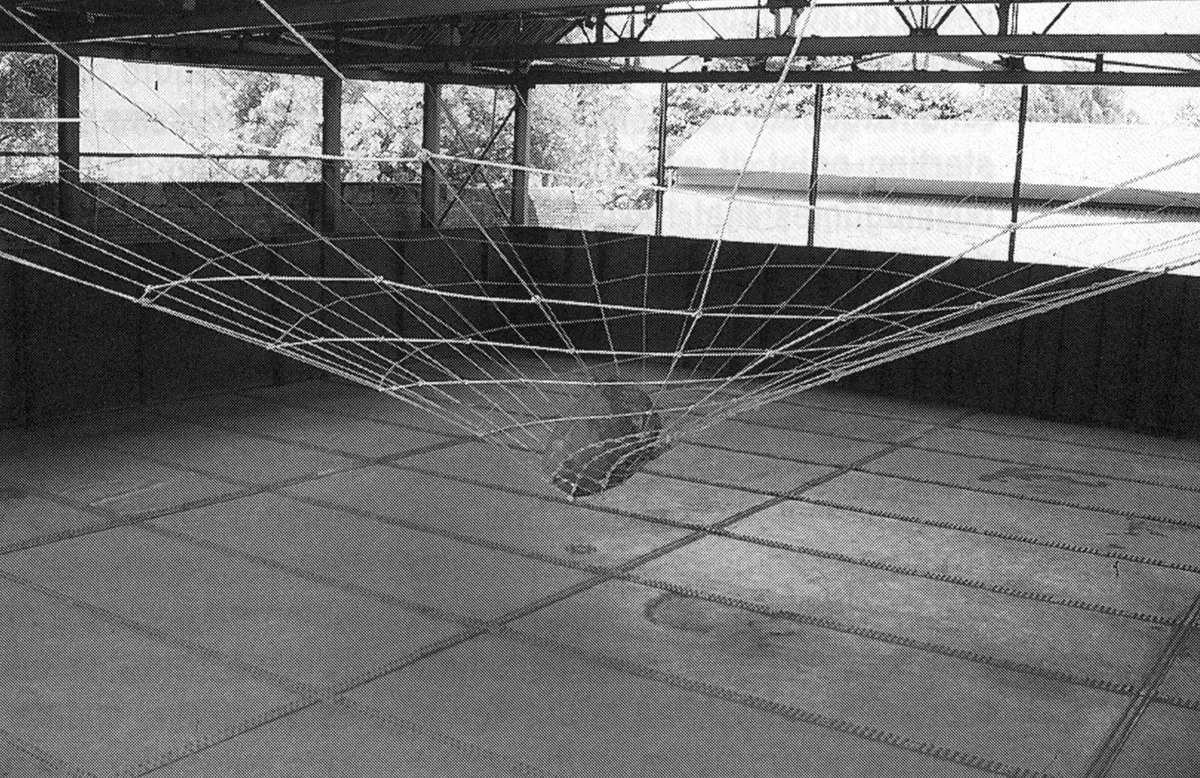
During his stay in Costa Rica, and with the help of Museum staff who had the opportunity to learn how to make knots and braid long pieces of maguey-rope and cord under his guidance, Becerra constructed in situ a broad net, in the form of a spider’s web, in the center of which he placed an enormous stone extracted from the Costa Rican mountain— a complicated task which would not have been possible without the use of a telescopic crane provided by the National Cement Industry.
After fruitless attempts to use an original pre-Columbian sphere and Becerra’s determination not to use copies, the artist divided the first days of his stay between mounting his installation entitled Chin cho rros (a kind of Indian hammock)—presented at the Fifth Havana Biennial and selected for the show at the Ludwig Forum in Aachen, Germany, as part of the group exhibition based on the Biennial—and visits around the Central Valley in search of the stone he needed.
I thus had the opportunity to see him work at close quarters, like a dedicated artisan weaving and creating his own warp, following a tradition which is still present in the collective memory and which persists despite the introduction of industrial processes and nylon cords. For Milton Becerra, vegetable fiber has ceased to be an eminently utilitarian material—even though this function remains implicit—and has become a symbolic metaphor of time itself, a point of connection and lines which record the place in space of the stone, giving it an appearance of something defying the laws of gravity in a kind of suspended flight. And although it might seem contradictory, the form in which Becerra uses the maguey rope enhances its primitive practical value, since it is used as it was in the past and as it still is by the indigenous populations in the construction of everyday objects, such as hammocks, and in covering their bodies, floors, and walls.
The stone, which is the sculptor’s material par excellence, is not intervened, but selected and maintained in its original form, in reference to ancient times when man was closer to the stone figure, a moment of unity lost in time. Stones were tools with which food could be obtained, but they were also a support for and representation of history itself; stone was both tomb and home, sheltering man and protecting him for eternity. Like vegetable fiber, it has lost its ritual significance and has now become only a utilitarian material.
From Becerra’s early work in the city and on its outskirts at the end of the 1970s down to the present, his concern for the environment and the gradual disappearance of vegetation and rivers with the overwhelming march of industrial society has been one of his principal themes. Indeed, many of his direct interventions in the world of nature, photographs, and installations have sought to highlight this dramatic separation between nature and man, two opposing concepts within the modern tradition.
His criticism, sometimes explicit and sometimes set within an artistic discourse, has led to him being seen as an ecologist, although his work for more than a decade had been reflecting this concern. By exploiting the semantic value of the materials he uses, Becerra has forged an individual language that goes beyond academic conventions and becomes a different kind of methodology linked to a ritualistic kind of logic, the starting point of which is a set of cosmogonies that have nothing to do with Western cultural processes. They are closer to those of tribal societies and realities that continue to exist in the Latin American continent, and especially in Venezuela.1
Understanding of reality is achieved through symbolic elements, so that the work ends up becoming a metaphor reflecting structures of thought characteristic of archaic cultures, including not only those of Indo-American origin but others in which certain mythical convictions resulted in a characteristic vision and understanding of the universe. However, in the case of Becerra, there is also a process based on experience, as reflected in his careful studies, maquettes, and plans of works within the space within which they are to exist.
This elaboration process is also evident throughout his artistic career, so that all his work retains a symbolic coherence. His installations reflect a logical process in the construction of his own universe, which is represented in each of his exhibitions through fragments of a world that, at the same time, alludes to others. All these aspects were well illustrated in the two works which Becerra presented simultaneously at the MADC, Chin cho rros and the Pila de la Melaza installation.
Chin cho rros (the word refers to a kind of Indian hammock, appearing here like nests or suggestive shrouds suspended between the ceiling and the floor in semidarkness), evokes the fusion of contrasting worlds, a place constructed by both—lianas and vegetable forms on the one hand and textiles woven by man on the other. Both face the same risk of extinction in the fragile balance of the planet—an idea emphasized by a light flashing at short intervals and camouflaged between a woven hammock on the floor, which seemed to suggest some kind of palpitation on the point of exhaustion.
The Chin cho rros hide something inside, something which is being preserved and protected: archeological stone remains, ceramic fragments, and animal skins. These vestiges evoke sacred objects or perhaps the "Xawara" (collective death due to an epidemic), a concept which the artist used in his installation Yanomani, XXI Century2 in which he presents an ethnic group living on the right bank of the Orinoco river, in the middle of the virgin Venezuelan forest. This indigenous group makes a kind of shroud out of fibers and vegetable material in which they wrap the victims of the "Xawara," who are then suspended in little huts on stakes, to prevent animals from eating them, and which they then abandon. On their return, they carry out the traditional funeral rites.
The objects, in this case, are hidden from view within the suggestive hammock-shroud, in an act of protection or isolation, and subsequent retrieval. The fragments, metaphors taken from the memory of time and the passage of man, are vestiges recovered from forgotten historical cycles which are presented as isolated and incongruous pieces kept by the artist, until he can show them as remains which still beat with life. Perhaps for this reason, Becerra keeps them suspended between the sky and the earth, reaffirming the sacred symbolic nature of his earlier works, as well as the reiteration of modular structure in space.
This sensation of timelessness, of apparent quietude inherent to the internal and telluric force of nature which is present in all his work, can also be clearly felt in the monumental work entitled Pila de la Melaza, the direct forerunner of which was Meridians and Parallels (a work with a similar structure done in 1991 for the National Art Gallery of Caracas).
The woven warp marks out and records the "place" from which begins a cosmogony, a center or axis of the universe (according to Mircea Eliade). Meridians and parallels make up a constellation in the center of which there gravitates in perfect equilibrium the stone mass, the symbol of the earth, the planet, and the elements which make it up. Man, too, gives new meaning to his own space through stone—the menhirs, the obelisks, or columns which indicate a place in which cosmos, space, and the earth come together, giving an order and centrality to the universe. Thus, the stones are suspended between the sky and the earth, silently, like objects found in nature and filled with magical connotations, marking the passage of man through a thicket of brambles.
Both Chin cho rros and the Pila de la Melaza installation reflect an elaborate synthesis between the creative process of the artist and his development. In conceptual terms, Becerra refers to the many meanings that are to be found in his early work, the direct interventions on the found stones and the representation of constellations, and in his most recent production, such as the Drop series, where he uses stones suspended by maguey ropes to simulate these forms. The same can be said of his ritual objects, which refer to the Amerindian tribes and the vestiges left by other cultures that have disappeared.
The dimension of his work goes beyond any kind of potential concept, since it integrates form and ritual in a construction of transcendental spirituality based on his experiences as an artist in the full anthropological sense, the principal feature of his work over the last two decades. It is objectual art rather than sculpture, the construction of meanings involving the accumulative integration of complex and highly symbolic values, the fruit of a synthesis between research and experience.
NOTES
1. In 1985, Milton Becerra visited several tribes in the upper Orinoco, a journey which resulted in a number of works in which he used original ritual objects.
2. Project and installation on the Yanomani ethnic group, presented in the exhibition entitled Arte Amazonas at the Museum of Modern Art of Rio de Janeiro, as part of the World Conference on the Environment, 1992. See Antonio Rodríguez, "Milton Becerra," ArtNexus, No. 8, 1993.
DERMIS PÉREZ LEÓN