The rich and complex surfaces of the paintings created by Argentine artist Pablo Soria are deceptively smooth and refined, despite their outward appearance as rough, crackled, withered, and multi-layered. He creates a variety of technical surface effects to reflect the elaborate interplay of ideas and materials that are the substance of his works. The paintings are constructed upon grid-like structures corresponding to antique maps and city plans inspired by Spanish papers and illustrations documenting the conquest of his homeland, the Andean city of Tucumán, which was once an Inka stronghold. In the most remarkable works in this exhibition, Pablo Soria reaffirms the persistent human presence with a series of suspended bodies, skins, and body organs placed upon the configurations of the documents.
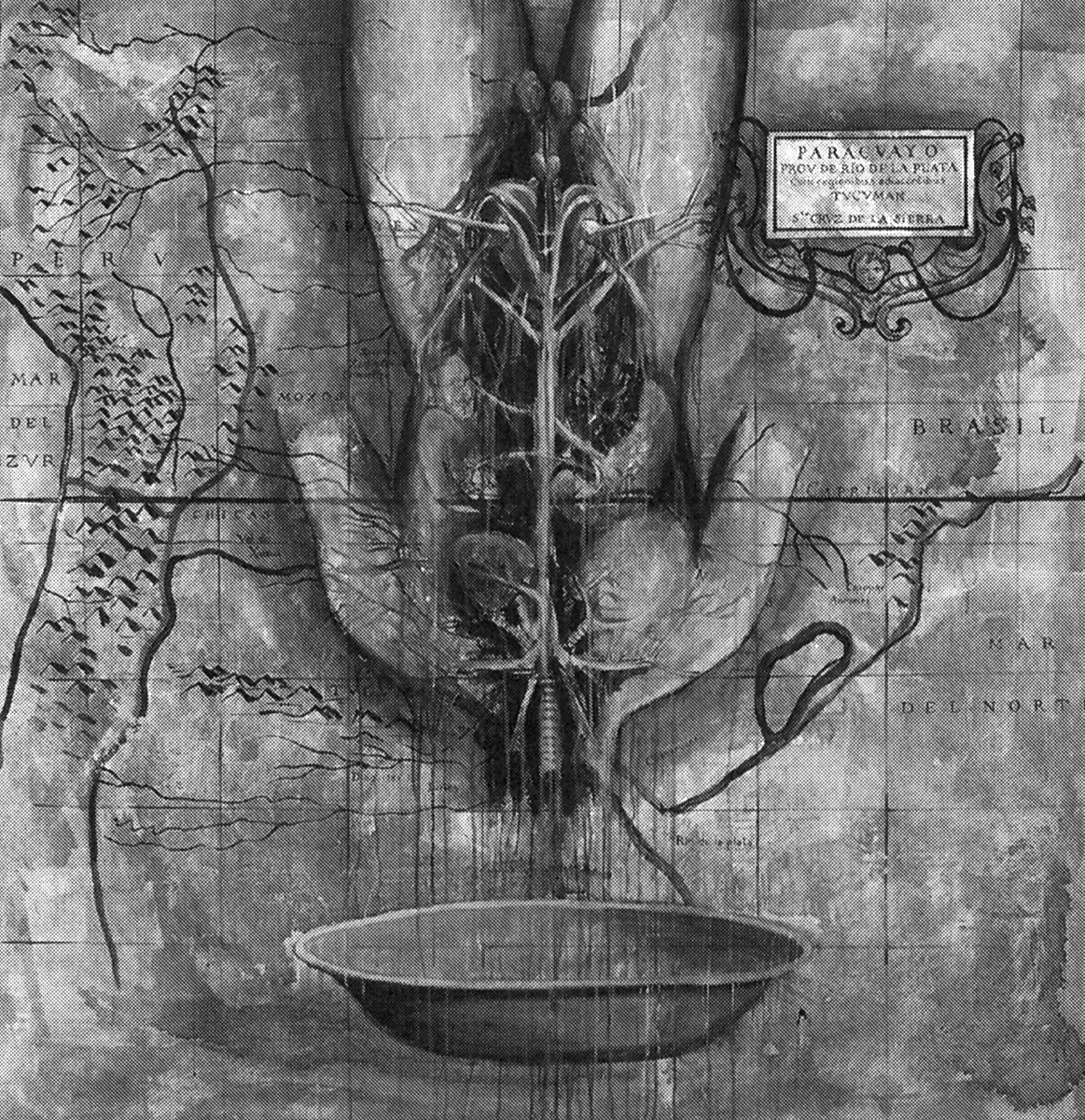
Reminiscent of anatomical illustrations, the bodies reveal their inner structure, much as the maps reveal their historical counterpart. A gruesome image of a headless body dripping bodily fluids into a pan below carries with it numerous associations, from the most literal to those related in Andean legends that describe the monks of the early years after the Conquest stealing bodies and draining their fats to make the candles of their churches or to cast the bells for their towers.
Hearts have been yanked from their bodies to float in isolation or within a network of thorny vines. The brutality of human sacrifice described in Spanish chronicles beats on in these useless organs in search of a body. In Es aquí donde peleo, Soria surrounds the vital organ with thorns and inscribes the title beneath to affirm the contemporary significance of the message and bring the heart into today’s reality. The heart and thorns beat on a surface that appears as wrinkled skin, dry as parchment, for an inside-outside effect.
At the entrance to the gallery is an installation with a mannequin suspended above a long scroll of paper with the words La fórmula del imborrable olvido ("The formula impossible to forget"). Images of his colonial city are projected in an endless sequence on the top of the scroll.
Past and present, historic and physical come together to set the scene for this powerful group of paintings.
CAROL DAMIAN