
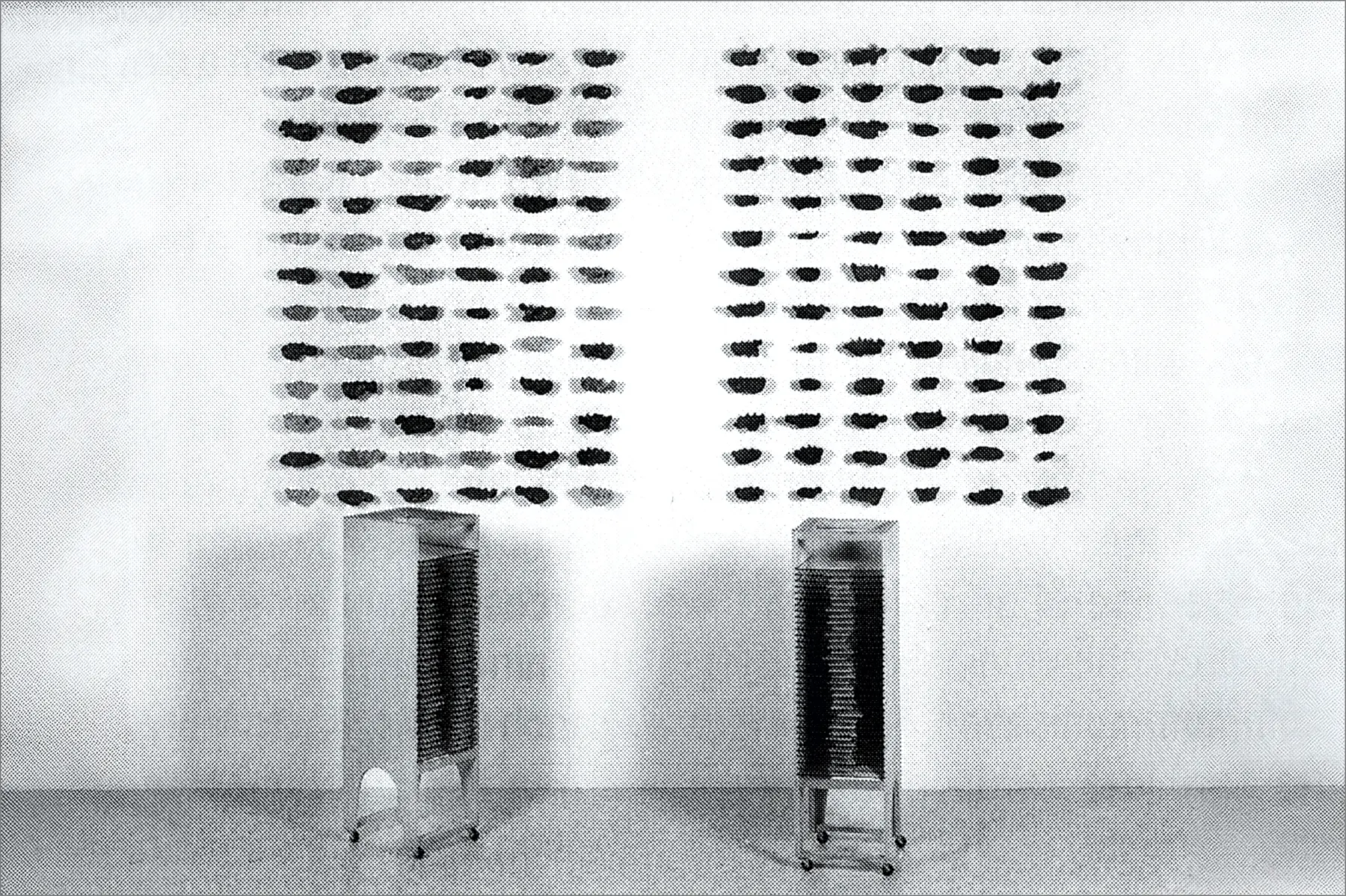
The last time I visited the Pirelli Salon, late in the evening, always when they "are witching off the lights" (to paraphrase Morand), I saw a vast expanse of ruins and debris. Two days after its closure —in Venezuela everything is inaugurated late and closes early— there only remained a few works on show, including the best (in my modest opinion): the Archivology of Alí González (the subject of much comment but largely ignored), a work by Magdalena Fernández (ditto) and the well-deserved prizewinning work by Myleen Gutiérrez, bringing streams of blue to the evening white of the Museum.
Over and above all the reservations and perplexities of an event such as this, it must be said that the selection of artists (necessarily questionable by definition) revealed some approximation to certain fragments of the real country which could be the subject of envy in their disciplines —economics, politics, sociology, and pedagogy, to name just a few of the best. There was undoubtedly a strong pulse beating in this Salon, which, even when it proved to be to the detriment of the works themselves, did provide a healthy contrast to the generally anemic mood of those who govern us.
Like all salons from the time of Manet, this one reflected a crisis in aesthetic judgment. And as in any other Salon, there was the difficulty of judging the works on show. The Pirelli Salon did attempt, both legitimately and rather abruptly, to propose a possible value judgment based perhaps on theoretical premises that were both implicit and foreign to the actual reality of the works. The fundamental and essentially regulating sentence of this attempt was written by María Luz Cárdenas: "This is not an exhibition of art objects, but of models of communication"—a vast and complex affirmation which merits an entire essay for its interpretation, as well as intense and wide-ranging discussion.
It might be imagined that from the selection process down to the prizes, the Pirelli Salon was an attempt to perceive communication models (and not exactly artistic supports), which leads, in our times of the dematerialization of information, to an attempt (perhaps unsuccessful) to propose an unusual form of dematerialization of the artistic proposal to the benefit of its "ideal" communicative virtuality. As if the "means were not the message," to paraphrase rather abruptly (and negatively) Marshall McLuhan.
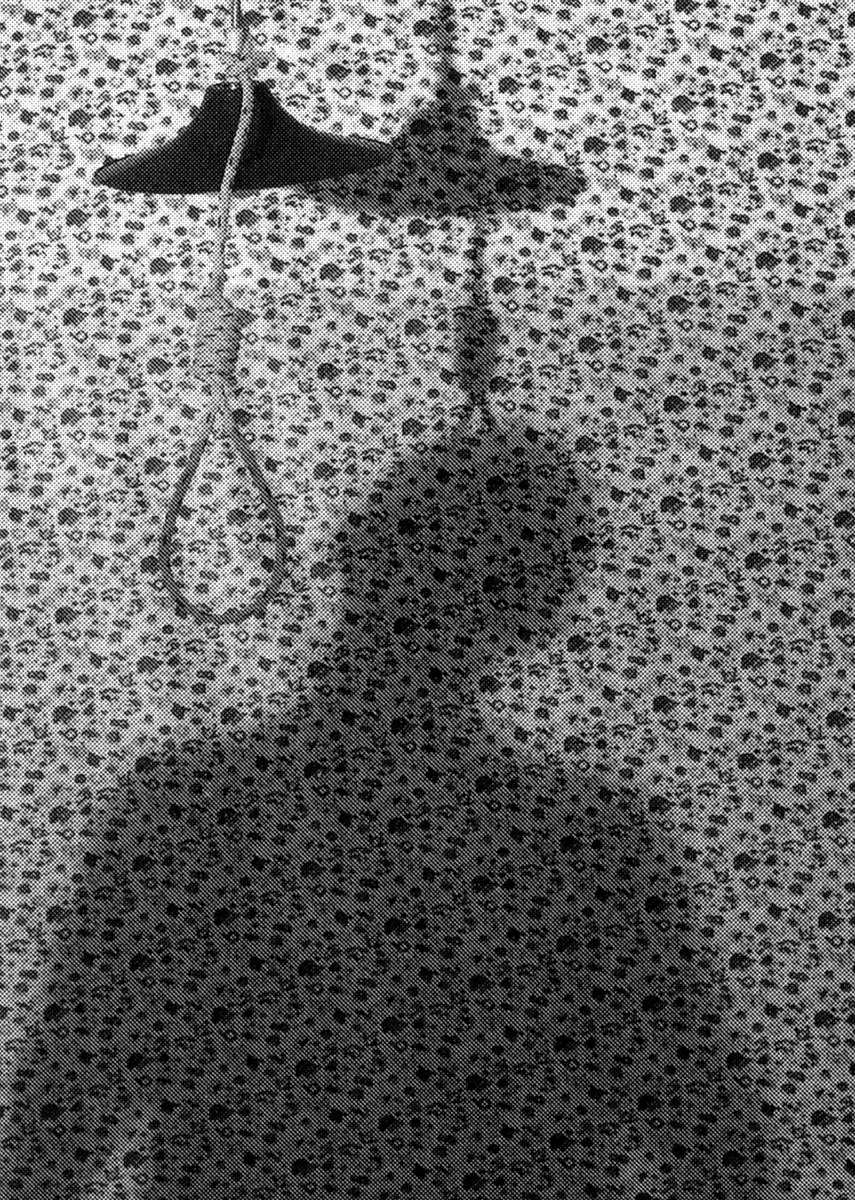
There was supposedly an ideology behind all this —a very ancient and platonic ideology— according to which the materiality of communicative mediation has a valence of zero, and is therefore neutral with respect to the intention to communicate, the first consequence of which would be to suppose the free and unlimited translatabilty of the messages: thus, The Transfiguration of Raphael could be indifferently judged as an original work, a verbal description or a photographic reproduction. In the same way, to go a little further and closer, María Bernárdez’s installation (awarded a prize by the jury), when viewed as a model of communication (and not as an art object), could also have been awarded a prize through an appropriate descriptive or reproductive substitution of the work.
I remember the words pronounced by the late French philosopher Michel Foucault in his masterly inaugural lesson at the College de France: "Ever since the games and commerce of the sophists have been excluded, ever since with greater of lesser sureness we have gagged their paradoxes, it would seem that Western thought has tried to ensure that there is the least possible gap between thought and words; that discourse should be seen as only something between thinking and speaking; thought clothed in its signs and made visible through words, or the reverse, structures of language called into play and producing effects of meaning." All of which (and against which Foucault raised his voice) leads to an attempt to avoid the reality of discourse: an extreme conclusion of someone who feels anguish at the difficulty of judging in the world in which he lives and who prefers to make it go away, in a kind of discursive sleight of hand, through the use of certain names paradoxically raised against the irreductible grain and texture of discursive media.
It is difficult to resist the temptation to think that, given the general crisis affecting our capacity to judge art objects in aesthetic terms, and thus to recognize ourselves in the value judgments we make on artworks, the Salon Pirelli was being theoretically astute by proposing not to judge the element of art work in the pieces, but only their function as models of communication. But it is also difficult not to believe that, in the end, what the judges actually judged when they announced their verdicts was rather the presence of art objects in the supposed communication models.
A communication model is a schema, just as an artwork is a thing, and what artists make, including those who explicitly resist the concept of object, is more like things than schemas. Given the difficulty we have in judging these things, which artists make, the solution is not exactly to try to judge everything that is not a thing, or to try to judge them as if they were not things. A better solution would be to look at them again as supports of discourse, to see them as complements of meditation and similarity not bereft of tradition, in other words, to re-learn how to see them as things, and above all, as things which are made.
It must therefore be said that the Salon Pirelli reflected a concern about "hiding art", in the wake of the unease and anxiety caused by poverty and the real smallness of our country among the artistic community which has tried, as in other fin de siecle periods, to show — through its heavy and inoffensive mises en scenes, that it is still up to date, pulsating with contemporary life and endowed with a clearly international profile.
Two major characteristics were evident in the Salon: a healthy desire to link up artistic forms with social postulates and political referents (in the wide sense of the term), and the definitive consecration of North American academic sources as occurred at the end of the nineteenth century with the French academic current. This feature in itself merits study and reflection: never before, as in the last twenty years, has artistic contemporaneity in Venezuela been so marked by the presence of models and practices imported directly from the North American art schools. Curiously, this "American-style" academic mold (which, of course, has its exceptions) is being imposed on an artistic environment whose modern tradition —for whatever reasons— fervently resisted the North American version of modernity. The result, in the worst of cases, was that many of the artistic practices and forms evident in the Salon —in terms of objects rather than communication models, such as serial repetition, delayed transmission video or environment simulation, seemed to be disconnected from their original sources and at the same time perfectly contemporary in their final results and uses in the metropolitan artistic context.
Thus, the Pirelli Salon, despite the excellent curatorial work, seemed to re-establish contact with a stylistic feature of our artistic tradition which I would call a stubborn, deaf, and continuous "double anachronism". This can be seen in practically all our main artists: Michelena was, at the same time and in the same process of the consecration of the French academic style, a kind of Delacroix and a kind of Manet, and a kind of Bouguereau when he was dying; Marcos Castillo, with half a century of youth compared with Cézanne, was our best Cézannist and, occasionally a kind of Matisse; Narváez was our Bourdelle and our Brancusi; Reverón was fully the Caribbean equivalent of Monet and unexpectedly our "naturalist" Malevich. Modernity —and with it contemporaneity— has appeared in the most unexpected ways and places in our country, and always with the sediment of time already passed and hastily assimilated.
There were some works in the Pirelli Salon which were deeply marked by "metropolitan" models (and heavily influenced by Bruce Nauman), stammering and stuttering in a Duchampian sea, with works "a la Carl André," practically unrecognizable because they were set in modalities "a la Tàpies;" works worthy of setting alongside those of such artists as Wolfgang Laib, where in turn the bourgeois aestheticism of Yves Klein lingers on; actionist-oriented works curiously elaborated with and adolescent festive ingenuity; as well as others in which anachronism could be assimilated into the continuity of local traditions, and other lamentable works of youth and yet others which were simply lamentable.
It can be argued, and rightly so, that it is better to see the works as they are rather than in terms of their similarity to or difference from foreign models. Except that, until the contrary is shown to be the case, the Pirelli Salon did not in any way differ from the previous salons of modern Venezuelan art, which have attempted to achieve novelty through similarity with artistic forms and practices favored by the main currents of international criticism. It would be better, once and for all, to assume our haphazard Eurocentrism: have you ever seen an artist or art critic in Venezuela thinking in terms of an analogy with models from Gabon, the Comoros, Morocco, or Pakistan?
A last note of suspicion must be added, namely that there seems to be a curious solidarity between the praise bestowed on communication models and the establishment of a new academic model, or to be more exact, that any disregard of the quality of the art object conjures up the specter of the Academy. It os not by chance that those who claim to see a confused theological treatise in the place of the frescoes of the Final Judgment view the work of Michelangelo as if it were a communication model; just as Michelangelo’s disdain for Brueghel’s landscapes —which he said lacked logic, order, and reason— was seen as a schematic judgment which put the linguistic element of painting higher up than the visual function. The characteristic of any academic approach, and its cliché, has always been its decision to refuse to see the works as objects and to see them as schemas, ideas, stories, communication elements, and images.
Charles Le Brun, a small painter, made Poussin’s return to his country unbearable —out of envy— and dared to make an apologetic reading of some of the greatest works of the master from Normandy before the Academy of France, including The Conversation of St. Paul and The Manna. Felibien and De Piles listened to him speaking of those pictures as if they were texts, stage-settings, the transfer into figures of the truth of history; they heard him speak about the relevance of the depicted figures in terms of concordances and probabilities, which, although they are important, always precede the actual work of art. After his arcadic Roman exile, Poussin, a man of prudence, practicality and laconic reasoning, and "professing the virtue of things that cannot speak," might have responded to the academic pretensions of someone who saw his works as models of communication by saying simply, soberly, and plainly as he once wrote, that "the little figure of St. Paul only wants two more days of caresses."
LUIS PÉREZ ORAMAS