
Ricardo Wiesse (Lima, 1954) is an artist who began to emerge at the end of the 1970s, whose rigorous work has gradually evolved from the initially dense textures towards a sense of linear rhythm acquired during his period at the Hayter workshop in Paris. Little by little, both sources have come together in a solid proposal in which the long desert of the Peruvian coast has become a metaphor in his work.
Many of us have seen the Nazca lines in his allegorical canvases; for others, Ricardo Wiesse proposes a reworking of the coastal landscape, with each picture characterized by a marked asceticism in its stark use of color, although in recent years, there has been an explosion in this respect, which helped him win first prize in an important competition: Bright Red.
Ricardo Wiesse’s work suggests apparently spontaneous lines, although they are in fact highly premeditated. Working separately with colored sand and earth, which he spreads over the glued surface, Wiesse creates a combination of real and virtual textures that give his highly respected work a considerable sense of dynamism.
Ricardo Wiesse’s career has developed in parallel to the violence of our environment, although that work is far from exacerbating reality and is much closer to reflection than any kind of rhetoric. Art, as he himself has said, must try to encompass a magical content.
During this decade, the violence has slowed down, although in a recent terrorist incident, a patrol group entered the University of La Cantuta, arresting students and teachers who were never to be seen again.
The cantuta is a flower that was already familiar in Peru during pre-Columbian times. The Inca Garcilaso de la Vega, in his Comentarios reales de Los Incas, describes it as follows: "sprigs of two kinds of flowers were worked in the hair; one was called the form, and the colors of which are very handsome, some yellow, some purple, all extremely fine. The other flower is called chihuahua; it is yellow and is similar in size to the Spanish pinks. These two kinds of flowers could not be worn by ordinary people or even the Indian chiefs, however high-ranking they were, but only by those of royal blood."
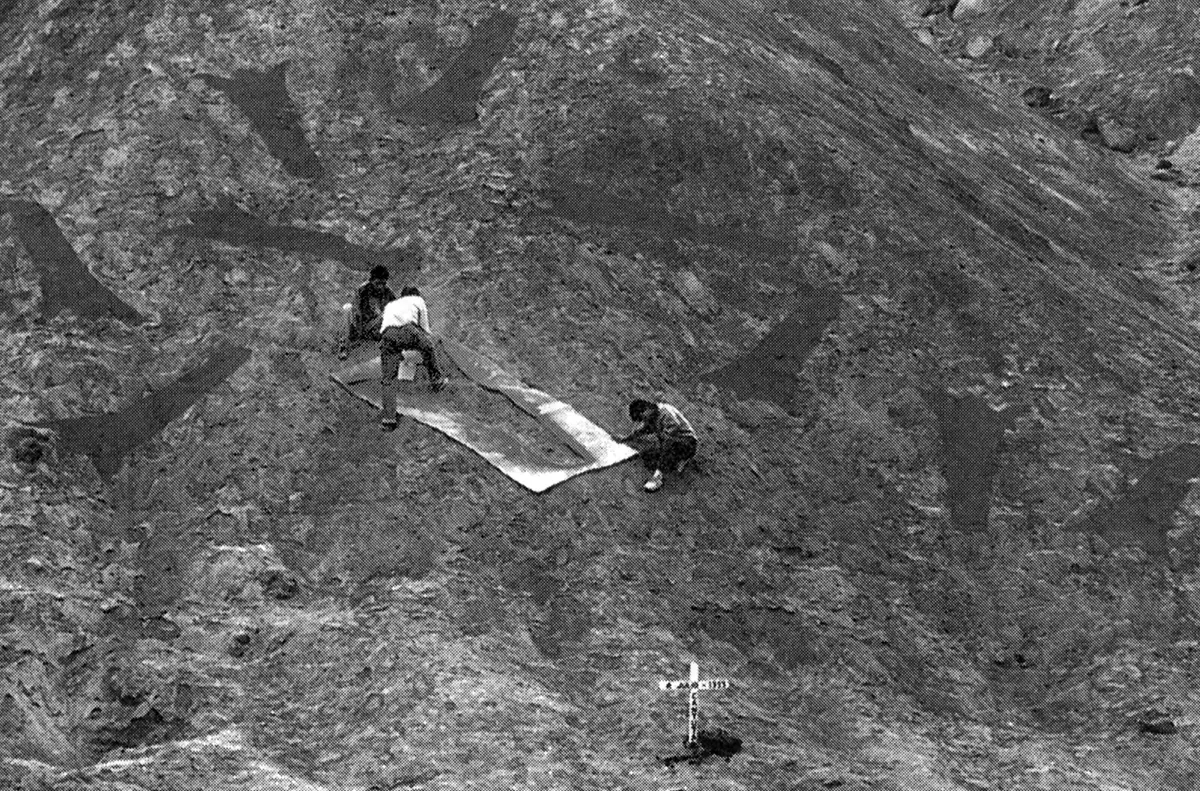
For the inhabitants of contemporary Peru, the cantuta is rather a tragic symbol, because the remains of those who were captured and killed were found two years later, in the hills of Cieneguilla, a region near Lima surrounded by desert. Two crosses now mark the place.
Wiesse paid homage to the victims by painting in earth and pigments ten enormous cantutas on the project as follows: "We poured ten kilos of red pigment and two hours later had before us a carpet of flowers, each of which was three meters high, placed along the side immediately above the second cross. Seen from the opposite hill, which we rapidly climbed, they appeared set in an imposing panorama: infinite stretches of land under the violet afternoon sky. Our cantutas looked like clear cuts in the surface of the land, beating our temples with an ancient and powerful cry."
A team of photographers and video operators fully documented this project to "paint the Andes," a project through which the artist participated in a national campaign to repeal a law that establishes an amnesty for those who assassinated the inhabitants of La Cantuta.
This was an unusual project in our country. Usually, our artists who take up a given cause make the ideological content subordinate to their artistic objectives. This is not the case here. There is an absolute coherence in the artist’s decision to exhibit, along with the video, some of his most successful works. These red cantutas have opened a breach in the artist’s two-dimensional work, taking him towards a more sculptural kind of expression, a new form of aggression which both invades and breaks up space.
Ricardo Wiesse’s proposal is, like that of any transcendental artist, the product of two elements: art and life, which here come together to create a work that has been unanimously heralded as one of the best in contemporary Peru.
LUIS LAMA