In 1966, Rodrigo Pimentel (Zinaparo, Michoacan, 1945) entered the National School of Fine Arts at the Autonomous National University of Mexico (UNAM), formerly the Academy of San Carlos. Four years later, he presented his first one-man show at the Institute of Modern Languages in San Angel. On the occasion of that show, one of Mexico’s greatest poets, Salvador Novo (Mexico City, 1904-1974) wrote a brief yet prophetic note dated October 5, 1970: "I believe Rodrigo Ramírez will achieve a well-earned and well-deserved place in the new Mexican painting. His works are full of poetry, youth, and humor—as well as a markedly musical sense of color, for which I wish him every success in his first one-man exhibition."1 Pimentel has proved that the poet was not mistaken and has shown perseverance and tenacity in his emergence as a painter. His creative work and his dedication to art have finally earned their "reward"—the word is his—in this exhibition, which he presented in the Museum of the Fine Arts Palace in Mexico City last year.
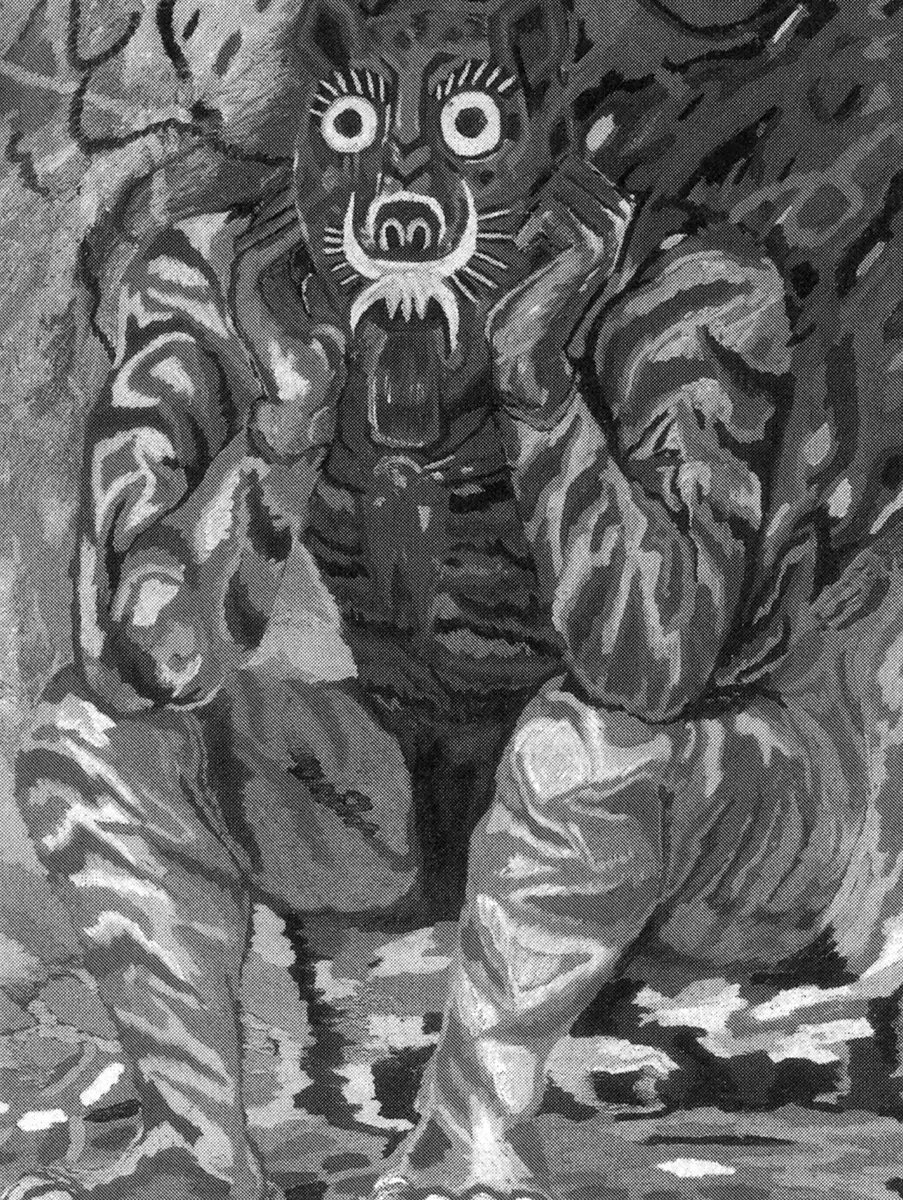
Twenty-five years after his first one-man show, Pimentel has now achieved full artistic maturity. Now aged 50, he has followed a long path, which has not been without its obstacles. His work was not very well known in Mexico City, since his shows had mainly been in Guadalajara, Monterrey, and the United States. After his splendid abstract-informal period of the 1970s, unjustly unknown to our critics, he returned to figuration in the 1980s to construct little by little a neo-Mexicanist language which now distinguishes his work, as could be seen from this memorable show.
Inaugurated on August 16 in rooms 6,7, and 8 of the Fine Arts Palace, the show, which was entitled Absent Witnesses, was made up of 66 oilworks dated between 1989 and 1994. Divided thematically into five sections (masks, sorcerers, animals, pre-Hispanic gods, and Mexican motifs), the exhibition offered a perfect visual panorama of the various elements of his current language. Pimentel is an artist who belongs to the figurative current, which Teresa del Conde has called neo-Mexicanism, which encompasses artistic expressions that seek to rehabilitate iconographic motifs, symbols, and other elements related to supposedly "Mexican" characteristics.2 Pimentel is undoubtedly a nationalist painter who has tried to emphasize what he considers as essentially "Mexican," but who has unfortunately avoided any ideological absurdity or folklorism in his aspirations of a universal kind.
Perhaps this is the most interesting aspect of his painting: namely, that although it is very Mexican, it also contains a wide range of universal features. Pimentel is a painter who has undoubtedly seen a lot of paintings. His extensive visual culture has enabled him to create work that reflects the influence of several of the great masters of the twentieth century, including the members of the COBRA group, the Fauves, Chagall, Dubuffet, Picasso, and Tamayo, among others. These lessons were fully assimilated by Pimentel, who went on to examine those aspects of the Mexican character that interested him. Using a chromatic lyricism which is much indebted to the instinctive and wild spirit so typical of Fauvism, he has explored facets of our identity, recreating signs and symbols of the so-called Mexican spirit in works which exalt nationalism, often tinged with humor and irony.
After the Museum of the Fine Arts Palace, Absent Witnesses began its journey to other exhibition venues. It is now being presented at the Cabanas Cultural Institute in Guadalajara, Jalisco, from where it will travel to Monclova, Coahuila. Plans are being made for a possible showing in the United States.
NOTES
1. The full name of the painter is Rodrigo Ramírez Pimentel. Novo used only his first surname (that of the artist’s father), but the artist has, for some years, used his maternal surname in signing his work.
2. Teresa del Conde, "Nuevos mexicanismos," Unomásuno, April 25, 1987.
ANTONIO ESPINOSA