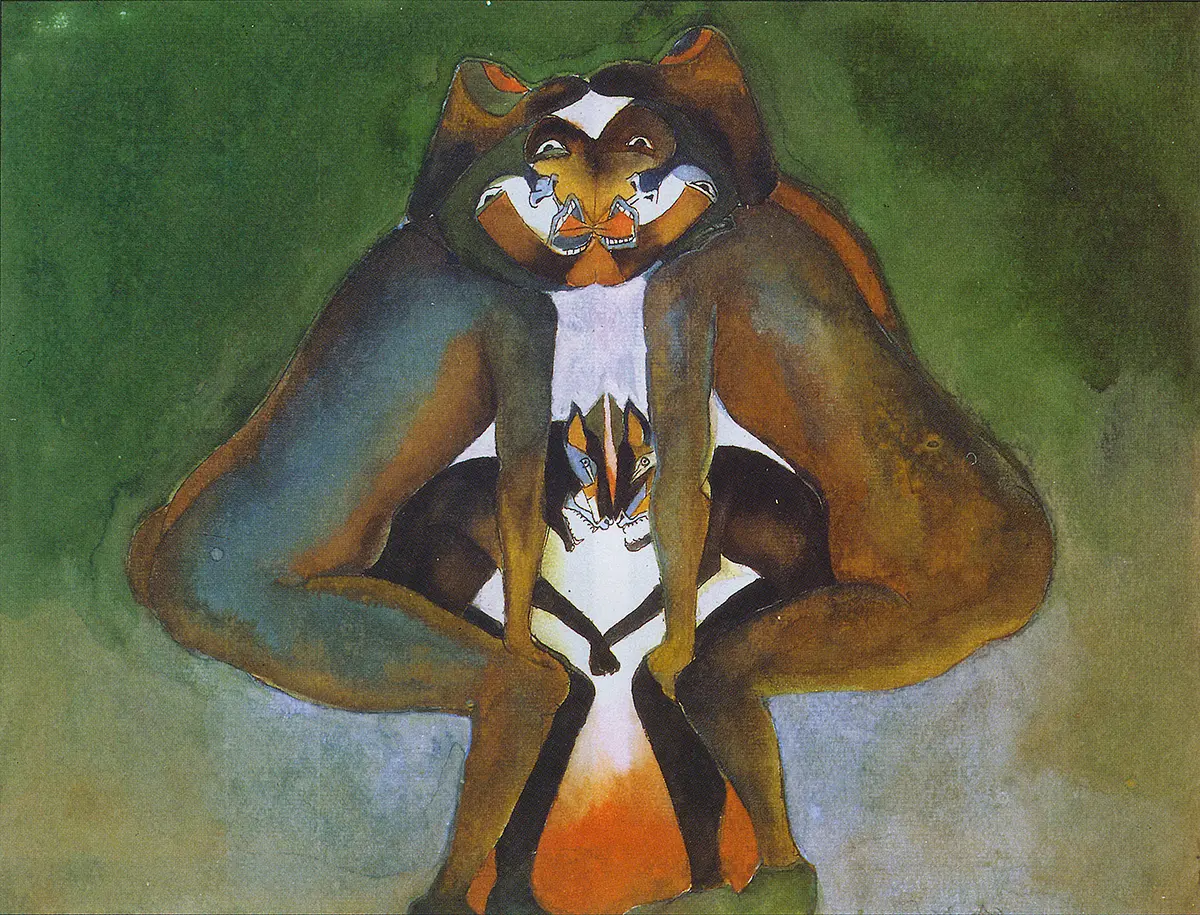
Arte en Colombia recently included in its advertising a reproduction of a 1986 gouache by Francisco Toledo titled The Greenish Ones (Arte en Colombia, No. 41). It consists of a sheet of paper covered with a delicately graduated grid of color, ranging from green at the top to vermilion in the center, forming a stain which fades towards the top to leave a white space. The gouache contains all the colors of our national flag and the “greenish ones” are of course the Mexicans. The form in which Toledo combines various elements in this work is, amongst other things, an example of his very special sense of humor. Set against the background which I have just described, there is in the foreground a couple of half-androgynous figures whose heads seen from a three-quarter angle fuse with the center to create a multi-faceted effect. This is very typical of various stages in Toledo’s work. At first, we see only one head, which may be that of some devilish feline, but a closer look at the body of the figures, from the feet up, reveals two heads, joined at the center as if they were Siamese twins. Two additional figures, also seen in profile, appear in the middle ground, each of which is stretching out an arm and holding hands; in fact, we see only one hand, in a metamorphosis and paraphrase of the effect created by the main figures. The overall result is both interesting and ornamental. By this, I do not mean that the gouache is just decorative (although it is decorative), but that the bodies, with their arms, legs, and heads form a symmetrical pattern which in some way recalls those found in certain works of primitive art in various regions of the world, or that which we can also find in the arrangement of certain elements in architectural decoration from different periods.
Toledo is far from being primitive: he is in fact a very sophisticated artist whose wide cultural vision is constantly inspired not only by the work of man but also by the life of nature, plants, and animals, which he observes with the precision of a botanist or zoologist. However, this vision is not scientific, but aesthetic. Of course, a scientific approach may be based on well-defined aesthetic principles —an algebraic equation may be extremely beautiful. Still, the kind of vision to which I am referring is conditioned by the perception of the formal structure of organic things, which precisely because they are organic provide the basic structures of any ornamental organization, as Ernst H. Gombrich illustrates so clearly in his book The sense of order.
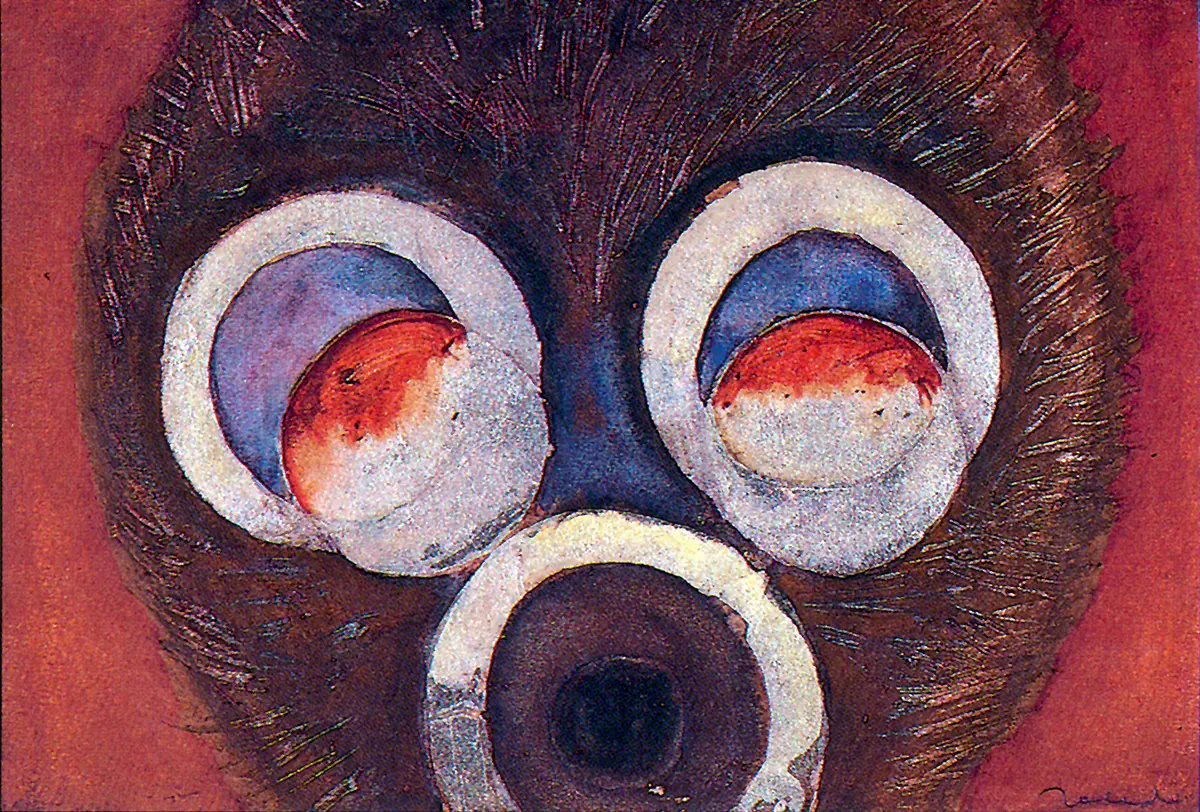
There are some kinds of organizations which are easy to achieve. This principle can be seen just as easily in an ordinary brick wall as in the dense coming together of identical molecules which results in glass. In the organic world, these standardized elements can be found in the formation of cells or in larger units, such as a sea urchin, a pomegranate, or a spike of maize.
Gombrich has pointed out that many of these structures also illustrate the advantages of the principle of hierarchy: units that are grouped together to form larger units which in turn may be easily set within a larger whole.1
I believe that Toledo considers himself a disciple of the natural world. A world which has been fashioned by a creator, which at the beginning (before the creation of man) did not have any spectators, but which was there nevertheless. All that was missing was human perception, the only one capable of giving it meaning.
When it is said that Toledo is a “creator and re-creator of myths” (a favorite description by almost all those of us who write about his work), we are basically drawing attention to the artist’s capacity to rework legends and fables which he endows with unusual qualities. However insufficient attention is usually given to his organizational skills, which allow him to order elements within a specific artistic space, generally quite small; it is this organizational talent that enables Toledo to recreate without lapsing into anecdotes.
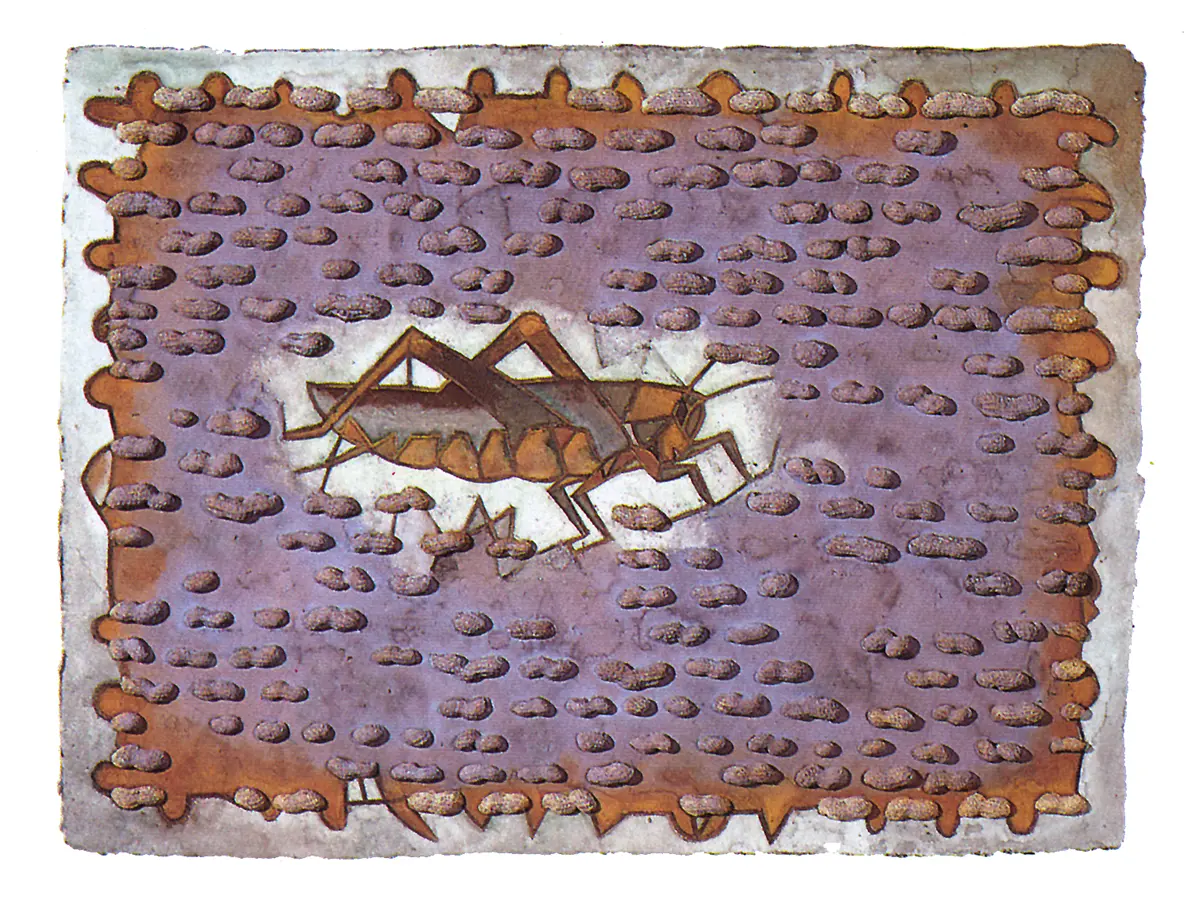
Let us examine, for example, his mixed media work titled Elencacahuatado (1990), in terms of its symbols and forms.
The word encacahuatado is clearly based on cacahuete (peanut). In its first meaning, encacahuatado is the name of a very delicious Mexican dish.
Toledo spent a long time investigating the history of the symbolic nature of excrement, in association with the historian and anthropologist Alfredo López Austin, for whom he prepared several illustrations on the subject. The initial result of this joint endeavor was a little book titled An old tale of shit.2
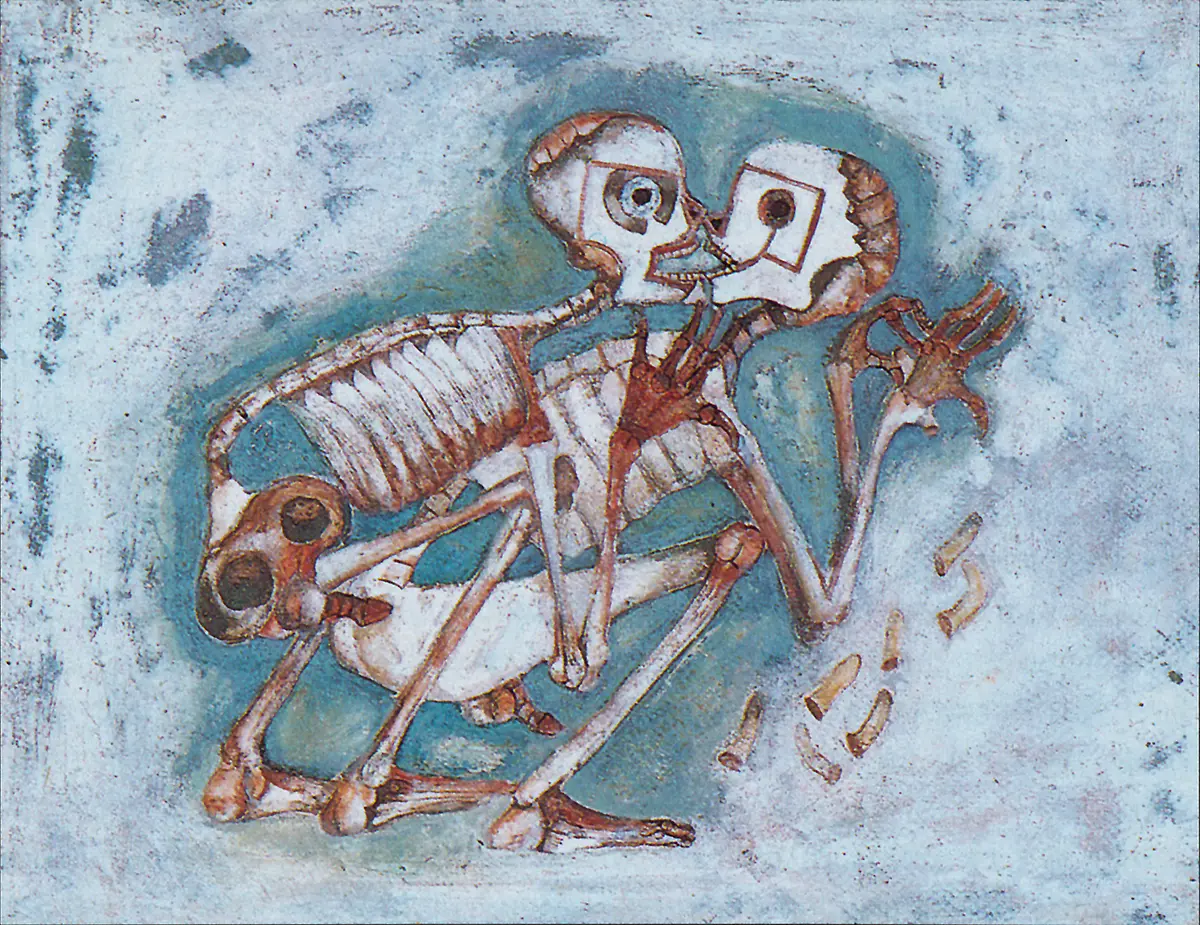
According to the chronicler Juan de Cordova, the word "cacao" (cocoa) is related to the word cacahuete.3 The fruit of this tree of the pistachio family is now a favorite throughout the world, as it was in the pre-Hispanic period, although perhaps not so much as "cacao". The peanut husk is “waste” material and is one of the “post-modern” materials that are now the subject of much interest by scholars like Jean Baudrillard, amongst others. Toledo pays homage to this unusable husk in his art: not only is the husk indigestible, but its form has a number of plastic qualities and is analogous in some respect to forms of excrement. In formal terms, the mixed media work which we are examining is a collage of peanut husks, arranged at intervals in a horizontal, telegraphic rhythm. If that were all, then the work would be nothing more than a pretty and very simple illustration of one way in which this “waste” material could be used. But such things do not happen with Toledo. The paper supported with its swollen reliefs is the frame for a creature that has lorded over Toledo’s iconography almost since the beginning of his career: cricket. This insect has for centuries had a special significance in the country and has given its name to a number of very important places, such as Chapultepec in the Valley of Mexico. Of course, the cicada is also eaten and is an essential ingredient in all gourmet dishes, not only in Oaxaca but throughout Mexico.
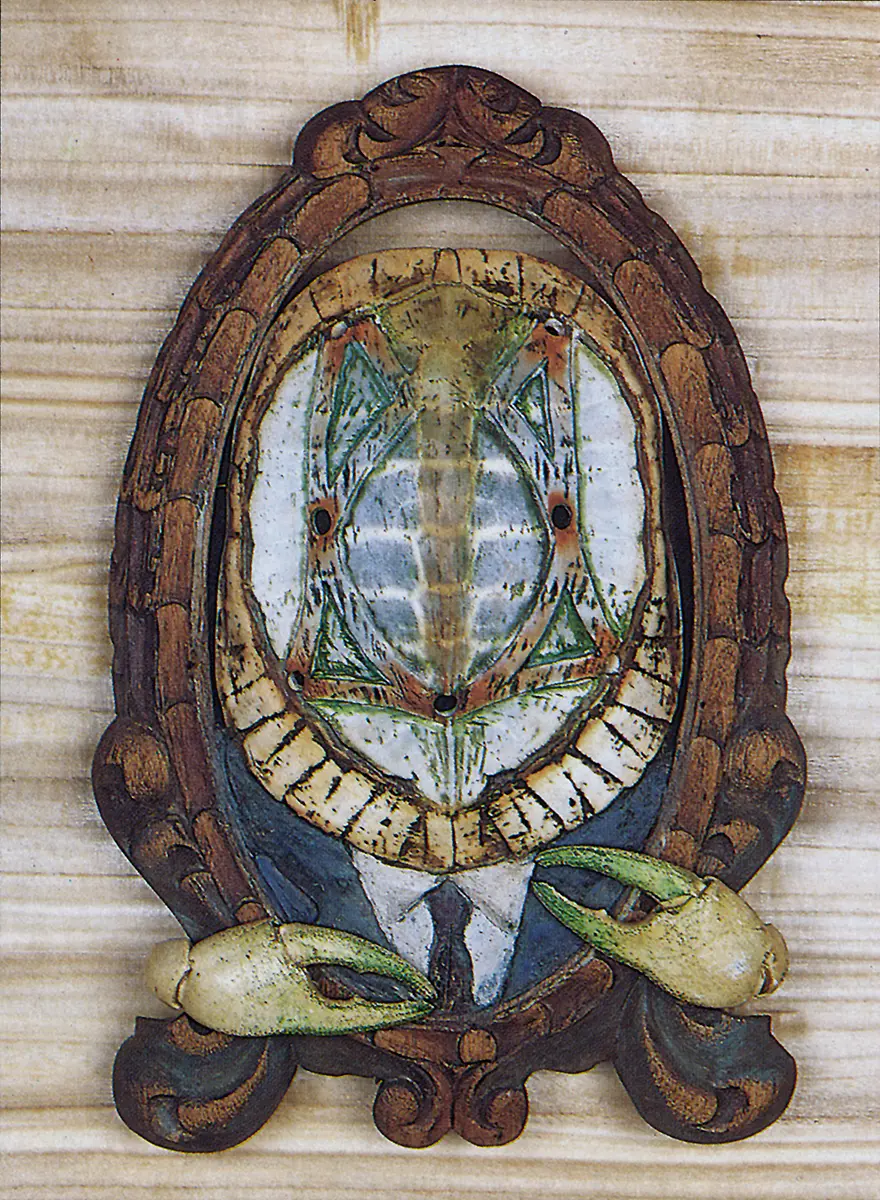
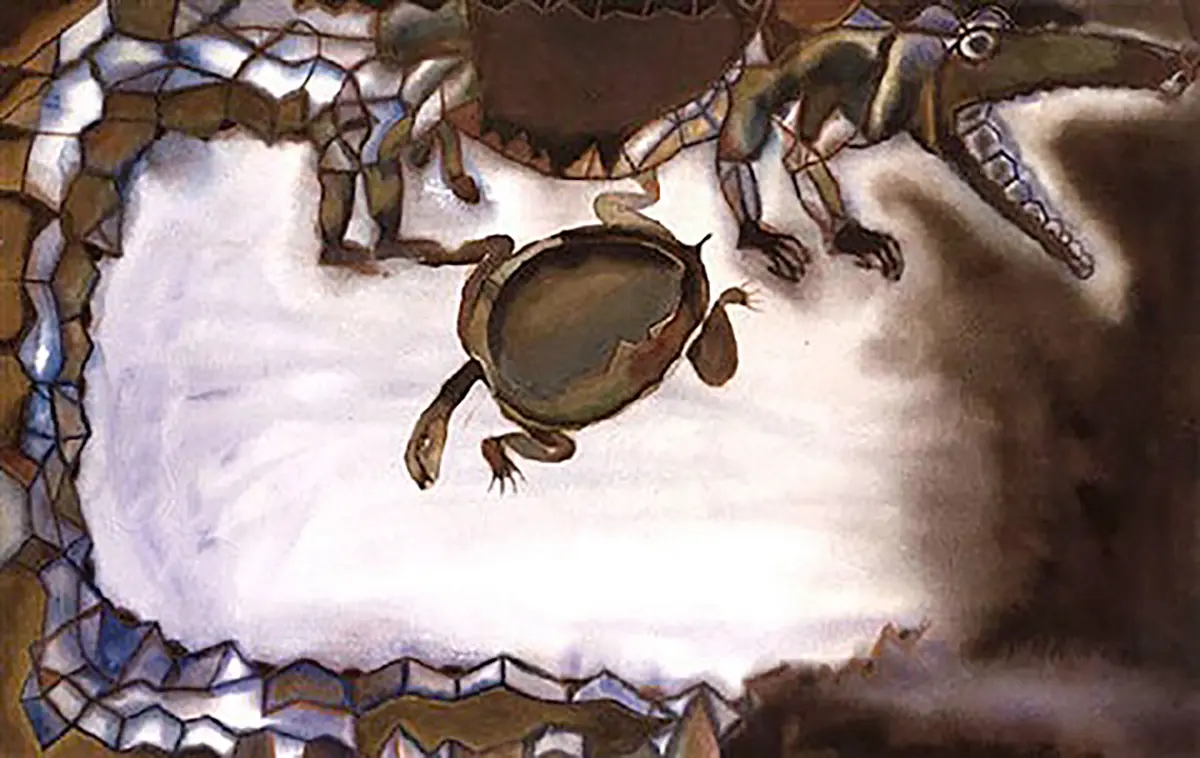
The cricket in the picture we are discussing appears slightly to the center of the work, almost in the gold section, in a free area that allows it to “breathe". The tendency to simplify the compositional elements and to reduce surface saturation in the interests of clarity is one of the characteristics of Toledo’s work over the past five years and one which can even be traced back to his first works when, for example, he painted with sand and natural pigments, in a form of “texture” painting. The Tortoise (1963), whose shell is both a labyrinth and a face, is an example of a work from this earlier period and, incidentally, one that alludes to Toledo’s very obvious desire to offer readings that, far from being unequivocal, are merely indications that for the spectator to use to “complete” the works themselves.
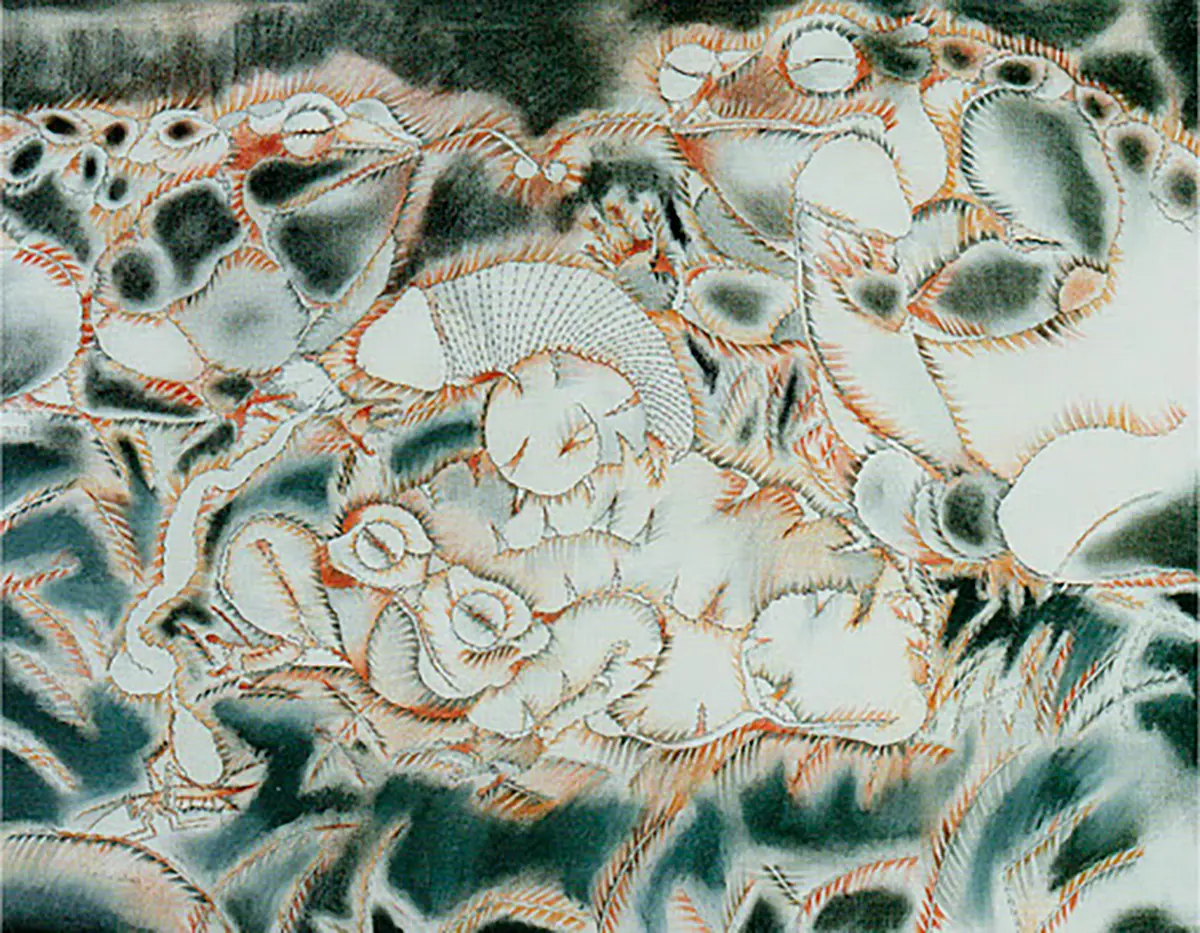
In Landscape of Bern (1990) Toledo pays homage to Paul Klee, as can be seen not only in the title but in the two clearly delineated areas in the picture which flank the central part of the composition. It is the lower one that most recalls Klee; the upper one is a close symbiosis between Klee, Toledo, and the early period of Maya ceramics. The central part is filled with a vortex in which organic elements once again play a protagonist role: burst seeds which seem to be tiny cells whose nucleus, protoplasm, and membrane have been transformed into spiraling plastic elements.
Last winter Toledo used this same technique to decorate the glass in one of the windows in his house in Tlalpan at Christmas. The glass seemed to be filled with the little flowers, flakes, and droplets that are spontaneously produced by frozen water.
Another frequent feature of Toledo’s work has been the way he integrates his figures by means of several staggered segments that remain independent of one another. Sometimes these figures suggest the presence of a specific material, for example, sections of wood cut by a carpenter or a stave. Others appear to be inspired by the structure —as seen through a microscope and enlarged— of certain vegetable or animal organisms, which we remember from our childhood.4 The effect of these chequered patterns and marks, similar to the tracks left by certain animals when they move, is also important, as is the use of segments which, especially in the drawings, create an impression of iridescence or irradiation.
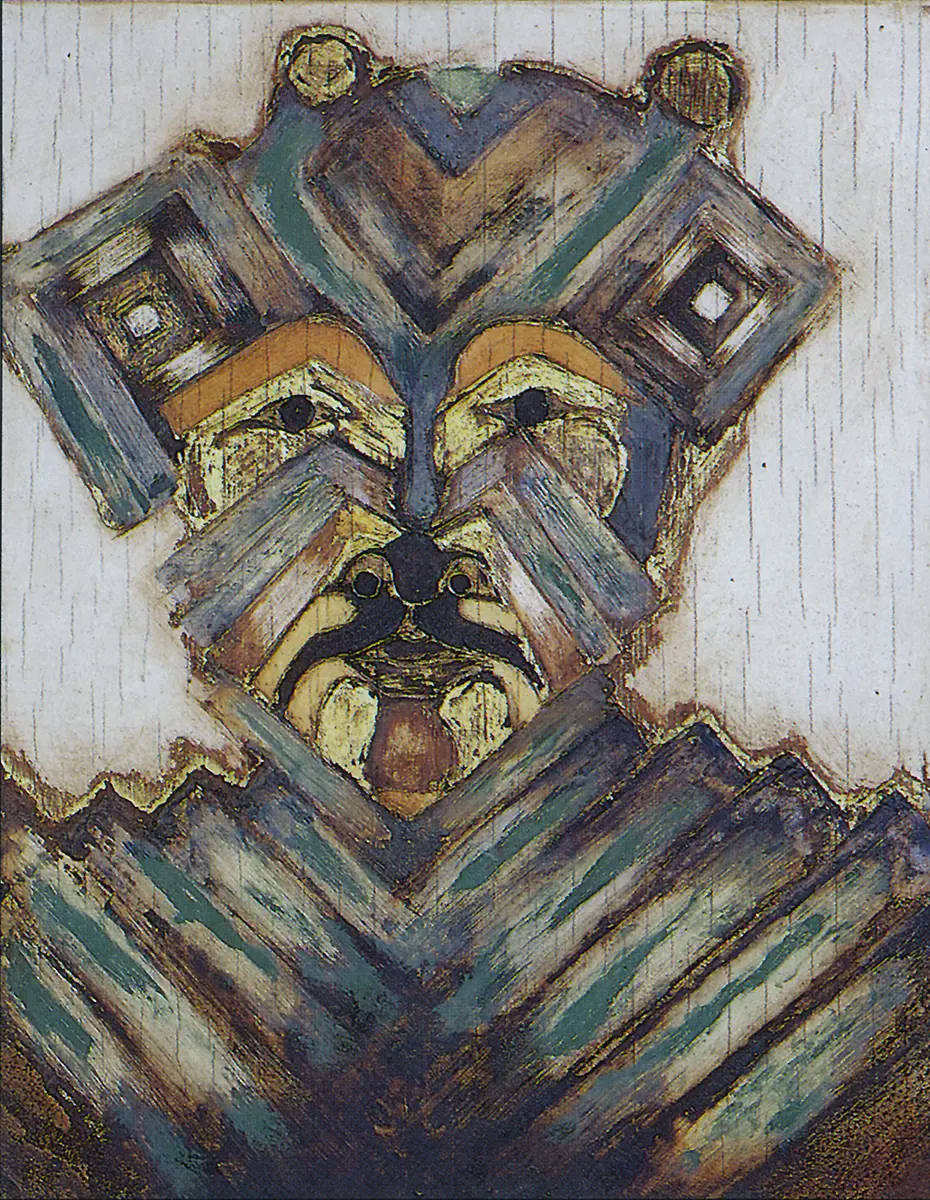
Toledo has produced a large number of “self-portraits” over a period of some thirty years. They are never simply copies of his appearance, although they retain something of his physical likeness, which is made geometrical and transformed by a radical process of abstraction. Only rarely and on very specific occasions has he allowed himself to be photographed. Thus what he gives us is a mask, which incorporates many of the features of an icon. However, in these icons (with their Byzantine touches) the human features are intensely fused with animal attributes. In the Self-Portrait on Wood (1990) Toledo once again includes the tlacoache and bat, combining green and sienna hues with gold paint confined to certain strategic parts of the composition. The work seems to be an indirect homage to another Mexican artist who recently devoted a large part of his production to three-dimensional works, in ceramic or wood, Vicente Rojo.
One of the most recent essays on Toledo’s work is a text by the North American critic Edward J. Sullivan, who emphasizes the artist’s interest in the decorative arts of the East.5 I myself have mentioned in previous articles Toledo’s taste for certain ornamental details from specific periods, such as Art Deco. I would imagine that such preferences are to a large extent the result of what Toledo assimilated during his creative processes. During his last and longest stay in Paris, for example, which extended over four years, he lived at 12 rue Cassini in the same studio where another Zacatecas artist had lived, Pedro Coronel. Every day he was thus able to admire the reliefs of Bourdelle which decorated this building and on his walks along the Boulevard Montparnasse he could see a number of buildings decorated in the style which I have mentioned. In another period, he was also attracted by Chinese bronzes, as well as the designs to be found in Hindu reliefs. Indeed, he once planned to visit India, although the trip did not materialize. Such stimulus occurs in the work of all artists, but it is only when the artist identifies with such influences that we can say that they have become part —either temporarily or permanently— of his formal and iconographical vision. For example, everyone knows that one of the constant features of Toledo’s iconography is eroticism. More than eroticism, a better term would be the “protean sexualization” of everything that surrounds him. Carlos Monsivais emphasizes the relationship between this “ferocious” sexualization and the extreme refinement of Toledo’s work.6 It is easy to see this concept as a desire on Toledo’s part to identify with non-Western cultures. However, his posture as an artist is at all events one which has been emblematic of twentieth-century art in the Western world, as can be seen in the work of Picasso, Henry Moore, Klee, or Tamayo. Toledo could never be confused with the creators of the Zapotecan funeral urns or some Chinese painter from the seventeenth century. He belongs to the Western tradition.
In an article like this, it is not possible to examine in any depth Toledo’s attitudes to art or the act of creation. Furthermore, we would need to be able to quote him. However, one or two points can be mentioned, because this is a subject of vital importance to any artist. I believe that Toledo fits into the category of the skeptics, those people who concur only with difficulty. Sometimes he appears to be excessively introspective and defensive. He is neither complacent nor condescending either with his own work or that of others. He has assembled a collection of graphic work from all periods (and which continues to grow), for the Institute of Graphic Arts of Oaxaca, a small museum that is open to the public. The care he has lavished on assembling this permanent collection implies considerable discipline. The graphic arts, as we know, require immense technical skill. Printmaking is one of the artistic fields where it is indeed possible to speak of degrees of perfection, at least as regards craft and the use of the medium. Perhaps for this reason Toledo has had such an intense interest in graphic production and editorial design.
Toledo does not like to possess things. He lives in unadorned and simple surroundings. As Cioran once wrote,7 "As soon as we possess an object, and become its 'owner,' we become in fact its slave; we also become the slave of what we produce and handle. Toledo would well approve of such remarks."
NOTES
1. Ernst H. Gombrich, The Sense of Order. A Study in the Psychology of Decorative Art, Phaidon Press Ltd., Oxford, 1979.
2. Alfredo López Austin (illustrations by Francisco Toledo). Una vieja historia de la mierda, Mexico City, Ediciones Toledo, 1988.
3. Fray Juan de Córdova, Vocabulario en lengua zapoteca, printed by Pedro Charte and Antonio Ricardo in Mexico in 1578. I consulted the facsimile version, Ediciones Toledo, Mexico City, 1987.
4. Teresa del Conde, Francisco Toledo, Mexico City, September 1981.
5. Edward J. Sullivan, Francisco Toledo. Private Mythologies, Public Dreams, New York, Nohra Haime Gallery, October 1990.
6. Carlos Monsiváis, Borges y Toledo: las zoologias complementarias, in Francisco Toledo. Zoologiafantastica. Homenaje a Jorge Luis Borges, Mexico City, Secretariat of Public Education, Frontier Cultural Program, coordination by Arvil Gallery, 1986.
7. E.M. Cioran. La caída en el Tiempo (The Fall in Time). Foreword and translation by Esther Seligson. Barcelona, Monte Ávila Editores. 1988.
TERESA DEL CONDE