Gerchman uses the particular to reach the universal in his art. His poor are poor everywhere, the hopes and fears of his common man are universal hopes and fears, as are his joys and pleasures. He endorsed the people of Rio and built his art from it.
LESLIE JUDD AHLANDER
I first met the Brazilian painter, Rubens Gerchman in the southern highlands of Colombia, where we were both exploring the extraordinary sculptures of the San Agustin culture. I was very impressed by Rubens’ intelligence and knowledge of art, and vowed to look him up when next I went to Rio.
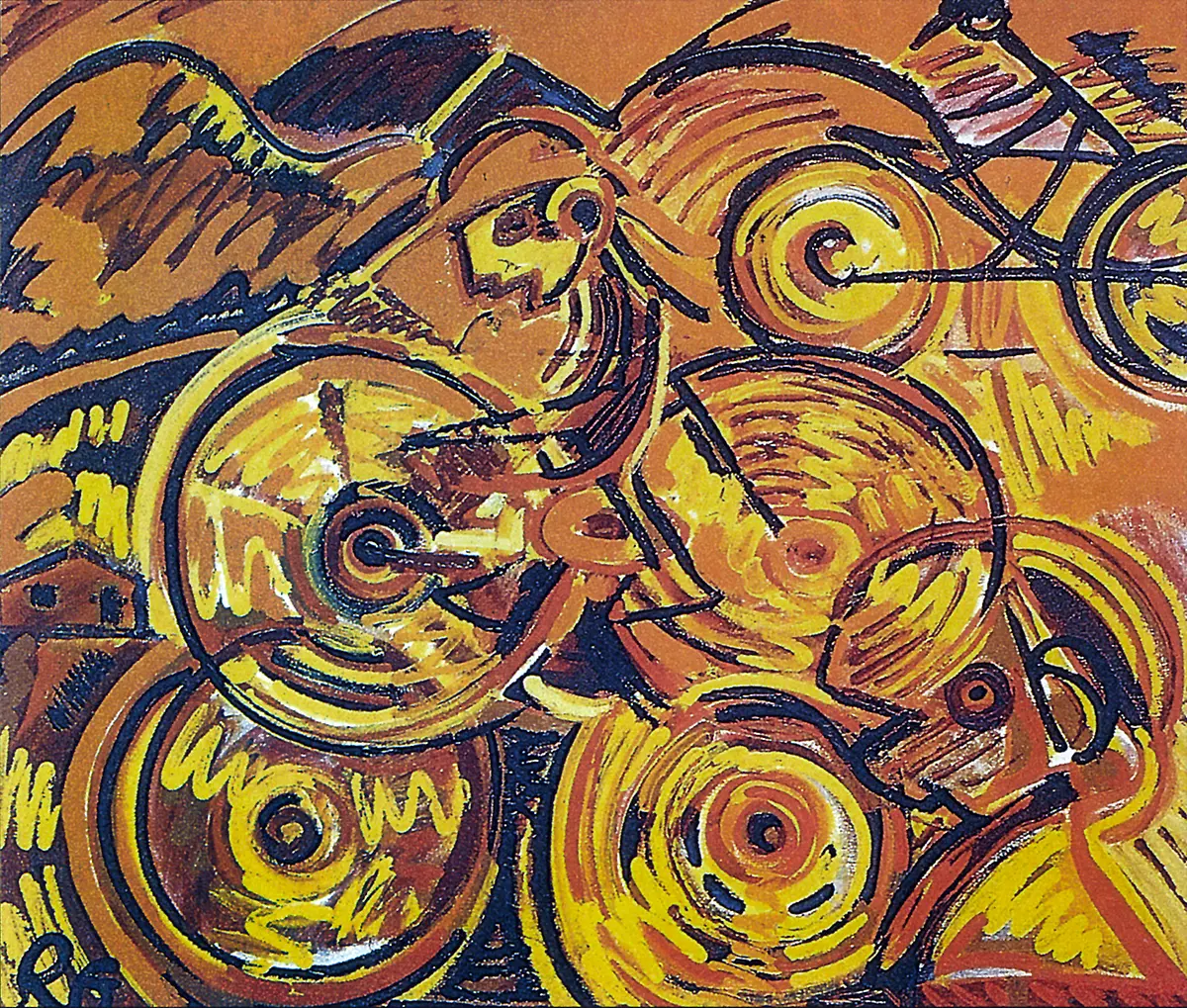
Rubens Gerchman is a painter of the city of Rio: its streets, people, lights, fiestas, crime, and poverty. He is very much in the tradition of Toulouse Lautrec, of Degas and Manet, who painted Paris in its heyday. He often makes me think of the remark by Charles Baudelaire, one of Gerchman’s idols, in his work, The Mirror of Art:
The painter, the true painter to come, will be he who wrests from the contemporary scene its epic side, and shows us, through color and line, how great and heroic we are in our ties and polished boots... by modernity I mean the transitory, the fleeting, the incidental: one half of art, whose other half is the eternal and immutable.
In just such a way Gerchman draws upon the particular to arrive at the universal in his art. His poor people are poor people everywhere, the hopes and fears of his common man are universal hopes and fears, as are their joys and pleasures. He has made the people of Rio his own and built his art upon them.
The artist, who is a poet as well as a painter, wrote in 1966:
Give realistically urban images
Multiple, faceted, simultaneous,
A photographic mural to be read
Infinitely adding new images.
Involved in events,
The artist testifies
And makes himself known.
Contemplation, said Gerchman, is a word which is inadequate for the Portuguese language, and most of all to describe our intentions, which are not to end up sitting passively in front of a painting or an object. It is necessary to change the public’s “sleeping beauty" attitude. You have to make people act and think.
This poet-painter was born in 1942 in Rio. Both his parents were Russian Jews who fled to Brazil to find a new life. His father was himself a commercial artist and illustrator, who exposed his son at an early age to good literature and encouraged his artistic leanings.
In 1955 Gerchman became a student at Andrews College, where he met other young poets who together developed a romantic approach to poetry and art. Soon, however, Gerchman’s interest in the visual arts became stronger, and in 1960 he entered the National School of Fine Arts, where he won first place. Soon he began to go out into the city with one of his teachers, Plinio Cipriano, to draw people in the streets. This was Cipriano’s School: the discovery of the urban landscape and of the printed word in newspapers and magazines. It was he who taught me how to look at the people in the streets, how to see people riding in a tram as a small theater in which they each played a role. He encouraged me to take train rides so as to study the many types of people who rode in and out of Rio, the poor people of the countryside who fled to the city to find work, only to end up in the slums that skirted the city.
Later Gerchman began working for the magazine Manchete, where, he says, I had to design texts. It was worth doing for it gave me the opportunity to see lots of good photographs. I learned to do layouts and design and enjoyed doing them, sometimes working until two or three in the morning. I also got to read the “personal" letters that came to the magazine, the letters from the lovelorn that were later to become the subject of a series of paintings, entitled Sentimental correspondence. I was very conscious of news and headlines. I loved working on the newspaper because I learned so much. I became concerned about the living conditions of the poor and the need to teach people to read and write. I even worked on a book to teach literacy to the poor.
Becoming fascinated by printmaking and lithography, he bought a printing press and installed it in his bedroom. Gerchman also learned to make frames, a skill which was to be very useful later on for making his wood constructions. He started doing a series of works entitled Collective Dwellings, based on views from his apartment window: people eating, sleeping, dressing and undressing, making love in the back seats of cars, quarreling and making up. Everything was useful for his paintings of city life.
At that time, I wanted a fast method of painting. I tried everything from dolls’ baby bottles to ketchup tubes filled with industrial ink in opaque blacks. Spontaneity was very important to me, and I worked to keep my paintings free at the edges. His first crowd scenes were in black and white, very freely and crudely drawn.
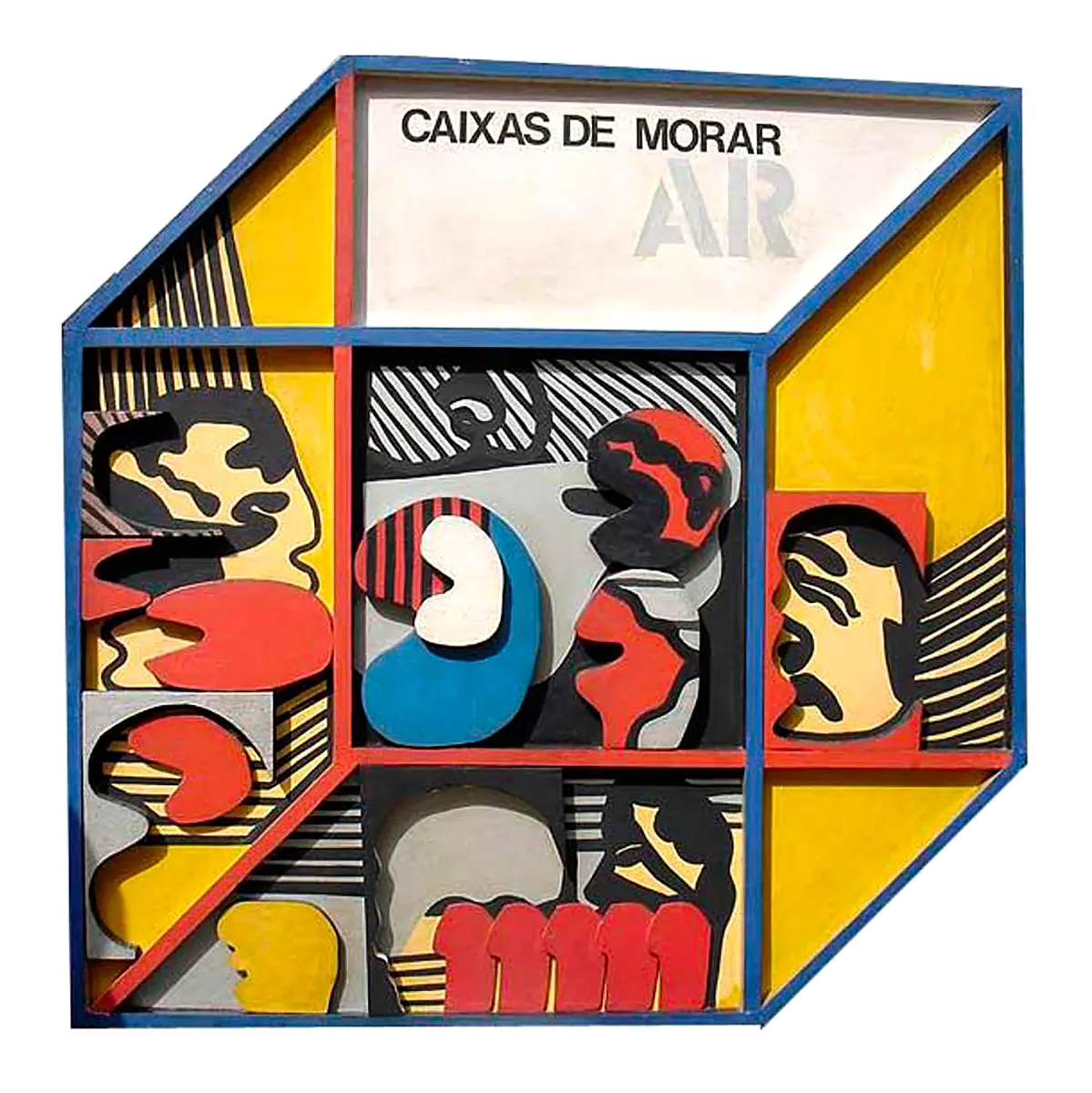
In 1963, he visited the Sao Paulo Biennial for the first time. There, informal art was all the rage. But we wanted a way out that would not be oil ink. We used to look at the informal paintings, full of materials, and concluded that we did not want that.
The following year Gerchman took part in the National Art Exhibition, entering one of his Multitude assemblages. At that time, this art exhibit was very important and everybody wanted the first prize: a trip. Although he did not win the prize that year, he continued painting, drawing on his journalistic experience and using photographs as a vehicle for his images.
The following year he met the art critic and director of the Museum of Modern Art of Sao Paulo, Mario Pedroso, who was to be crucial to his development. Pedroso visited his apartment in Rio and then wrote a critique about his work.
Pedro advised him to use his graphic background and to continue in his spontaneous, expressionist manner of painting the world around him: the cars, bicycles, and the crowded streets of Rio. But the public considered his work rough and brutal and said he should paint more tastefully. In those days, such expressionist work was considered in bad taste and was not accepted. But I needed to learn to live with my brutal approach. Refined art was not for me. Drawing with a fine pen was not my temperament. I had been painting in a very expressionist manner but I was slowly getting rid of it.
Mario Pedroso wrote of his work at this time: The art of Rubens Gerchman, already stripped of expressionist vestiges, more and more explicit, without symbolic elements, speaks the language of the urban collective, where we all drown, sleeping or awake, aware or dazed. And Gerchman himself wrote: I believe my main responsibility is to say: I personally want an art of content in which man may always be the measure. I make urban art and choose my material from everyday life.
Pedroso arranged for Gerchman to be included in the 1965 Salon de la Jeune Peinture in Paris, and later he showed at the VII Sao-Paulo Biennial. From this point on Gerchman began to exhibit regularly and to sell his paintings. He began to work in wood, creating large three- dimensional pieces with lettering on them. The written word was always very important to the artist and he deliberately used it as an integral part of each work. He noted: I do not think the use of the word in the plastic arts creates a literary view of what should be visual or tactile. I think it is important to reduce the word to the essential, the meaning worn out by itself. I want to re-learn it. More strength comes from the redundance of placing the word, “water,” written inside a cube of water: an overload of information.
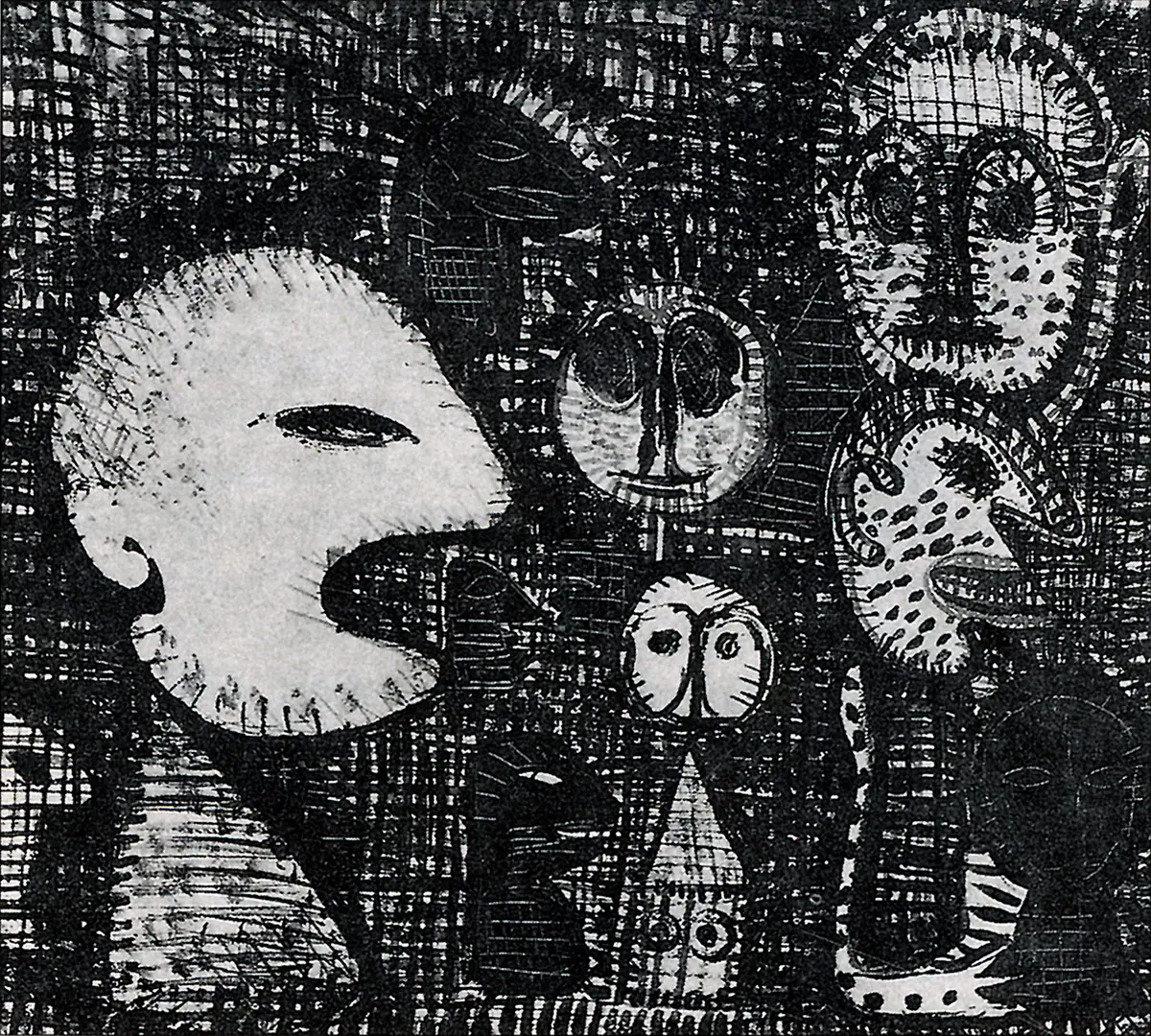
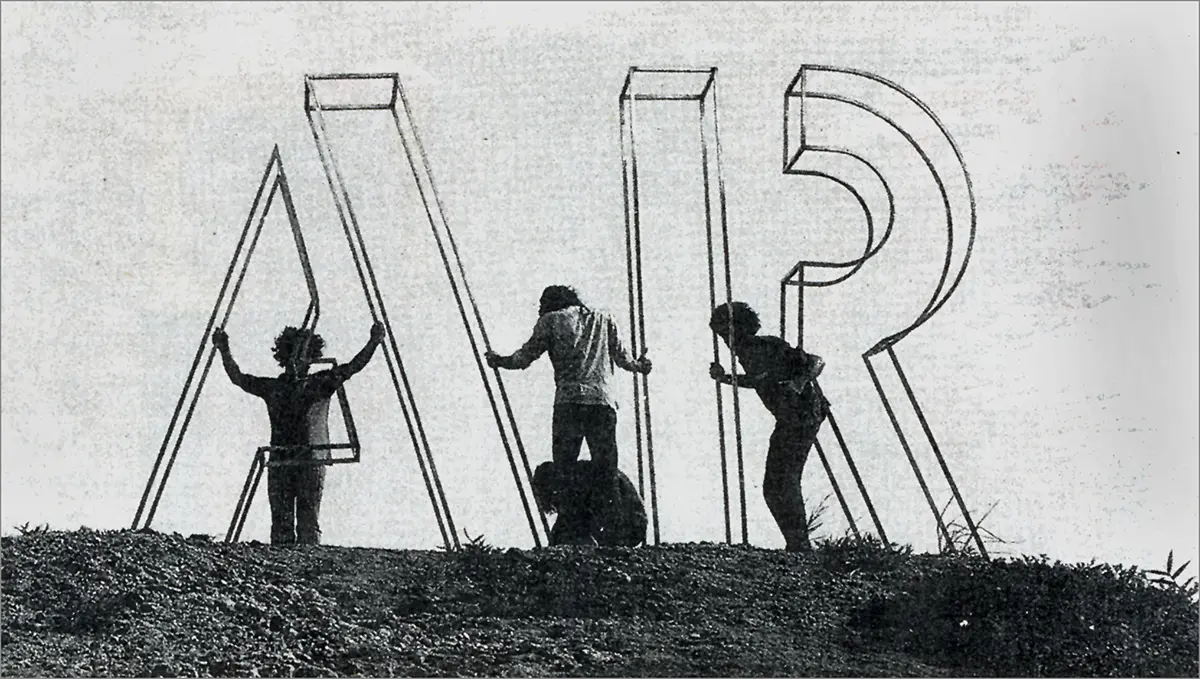
Gerchman was slowly becoming more conceptual and more literary, combining his love for the written word with his passion for visual art. Works like Boxes for Living: AIR, Social elevator and Bus were either three-dimensional or gave the illusion of being so. Gerchman’s work became more political and commented freely on conditions in Brazil, where the gap between the wealthy and the starving poor was becoming more obvious every day. Boxes for Living: AIR showed the manner in which people were crowded into small apartments, often taking turns sharing the same bed, holding down several jobs in order to make ends meet. The painting was in low relief: a box seen in an acute perspective, filled with Gerchman’s simplified renderings of human heads, painted in brilliant primary colors. Also from this period came the series of beauty pageants, with the contestants, lined up in their tight bathing suits, pathetic in their desire to rise above the triviality of their existence. There was also a football series with its play on words: SOS were the initials of a local football team, but Gerchman was also aware of its meaning as a cry for help, and he played with the pun in these works.
As the critic, Wilson Cotinho, pointed out: Gerchman was the most demanding artist of his generation. That is, he has done his best to distinguish what was important within a savage polyphony. The masses were everywhere: they moved, they passed through northeast to south; they filled Central do Brazil railroad trains; they had fun, watching football games at Maracanna Stadium; some of them disappeared in the big city; they died, they were killed or murdered. They were sad or happy, and they disappeared. They were anonymously moving in front of him. Moving masses were the Futurism of the poor. Gerchman was their poet.
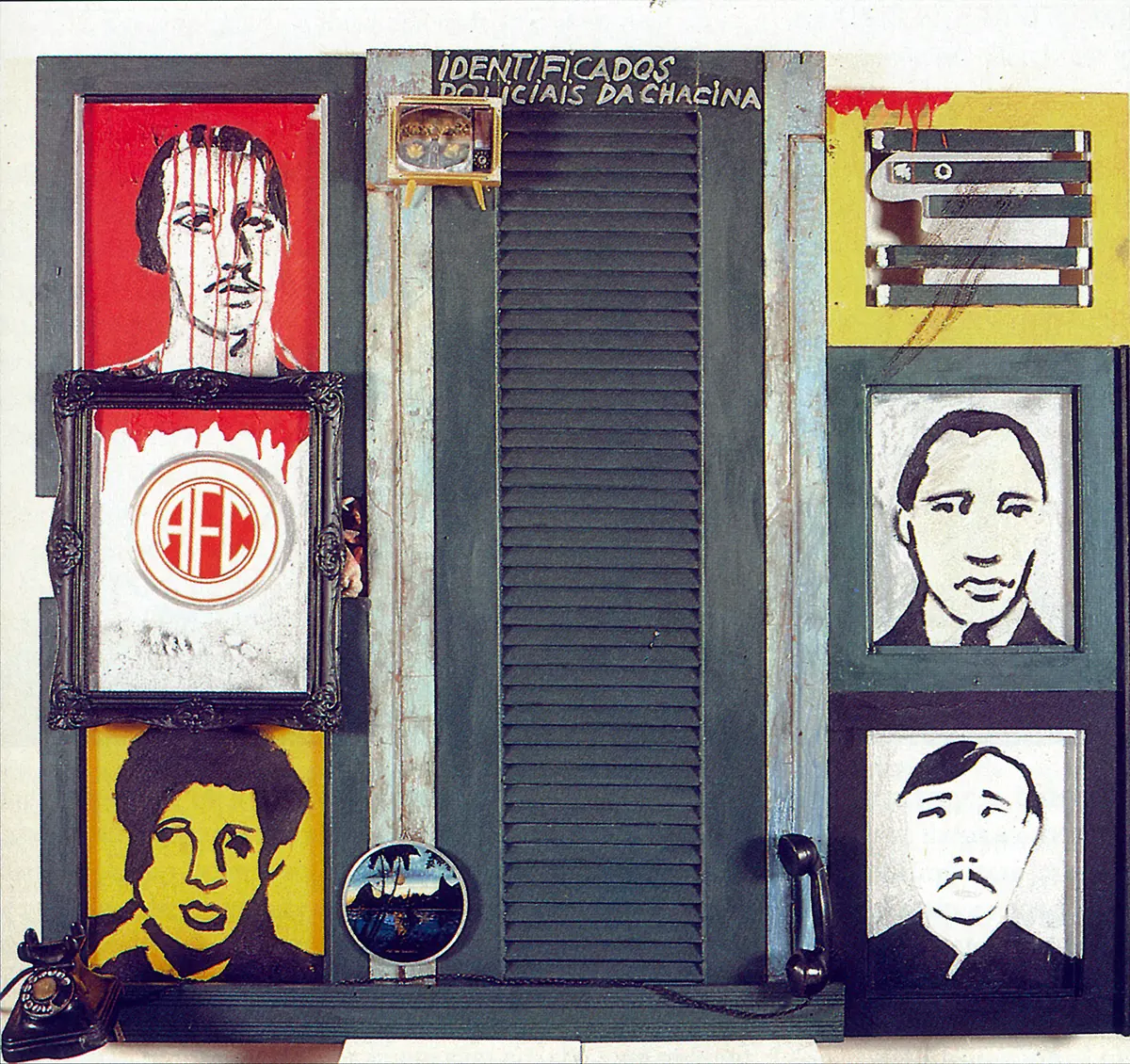
In 1964 the military dictatorship came to power in Brazil, and its cruel excesses soon drove all thoughts of bathing beauties and cars and football games out of Gerchman’s head. A series called The Disappeared Ones was the result. The disappeared ones had already found their supporters in Argentina, Chile, and Colombia; now it was for Gerchman to speak out for the imprisoned victims of oppression in Brazil. The paintings were done in a deliberately crude manner, presented like “mug shots” taken of victims by the police, which often became the only record of their passing. These were to include a series of The young school teachers who' were either assassinated or who disappeared. Assassinated worker depicts a young man who was killed, with a safety pin driven through the flesh of his forehead on which an identification label had been fastened.
The critic, Mario Barata, wrote: Today's vanguard is most of all a breakthrough art, and even a protest art within a system in crisis, or at least a changing one.
In 1967 Gerchman finally won the coveted trip abroad for his painting entitled A dictator of all things, exhibited in the National Salon. Although his former orientation had been entirely in the direction of Europe and toward the New Figuration groups in Paris and Argentina (where he admired the work of Jorge de la Vega), two things had happened that now sent him to New York rather than Paris: Mario Pedroso had recently invited him to go to Venezuela, where he had met the American art critic, Harold Rosenberg.
Rosenberg had liked Gerchman’s work but said he should go to New York, which he felt was the center of the artistic universe at that time. And Gerchman had also met Sam Hunter, at that time director of the Jewish Museum in New York, who had come to Argentina to judge a show at the Cordoba Museum. He also had encouraged Gerchman to go to New York.
So the artist took off for New York, where he was both confused and perplexed by the strange environment and “found it difficult to understand the Anglo-Saxon mind.” For the first year, he did no work at all, but visited museums and galleries and gradually oriented himself. Gerchman took part in a group show called Fashion, Poetry, Event, in which Andy Warhol, Marisol, and Claes Oldenberg also participated and where he showed his Boxes for Living rebuilt in aluminum with yellow and green felt.
Gerchman however did not consider himself a Pop artist. He said: It was impossible for Brazilian art in those days to have a Pop foundation for these reasons: our mass society was still in an embryonic stage and did not reflect a complex system; four years after the military coup our industrialization was poor and unable to shelter heavy production; our history of art developed unevenly; at that time our art market did not have decisive strength; the Pop art we did have was mimesis, not a process.
Later he shared a loft in New York with the Argentine artists Cesar Paternosto, Luis Wells, and Fernando Maza, and began working at a steel foundry in New Jersey where he did constructivist sculptures and translated some of his wooden works into metal. During this time he was going to poetry readings and incorporating more and more written words into his conceptual sculptures. He entered his Boxes for Living in an exhibition, fashions in Shelter, at the center for Inter-American Relations, but he placed two naked girls inside it who at a certain moment stood up and carried the structure with them, with only their bare legs showing. The center was not amused and complained bitterly. Gerchman, ever the activist, then became part of a group of Latin American artists who went against the Center and produced a manifesto decrying “Rockefeller’s cultural politics.” Both the art critics Grace Gluck and Lucy Lippard sided with the artists and they went on to form the Latin American Museum where each artist presented his concept of what a museum should be. Besides Gerchman, the Museum’s founders included Lionel Gongora, Cesar Paternosto, Arnold Belkin, Omar Rayo, Abularach, Luis Wells, Luis Camnitzer, A. Puente, and Liliana Porter.
Gerchman began producing large works using words. He took part in the Cali Biennial, in Colombia, in 1970, winning first prize for his large sculpture, Air. He was invited by the art dealer, Jack Misrachi, to join the group of artists who would inaugurate his new gallery in New York, which later became the Lerner-Heller Gallery, specializing in the work of Latin American artists. There Gerchman showed his large works, Tool, Air, SOS, City Desert, Snake, and Menwomen. Museums and private collectors began acquiring his work. He took part in an exhibition, Below the Equator, organized by Lerner-Heller in Sao Paulo, but at the same time he and Hans Haacke, the German artist, arranged a boycott of the American artists invited to the Sao Paulo Biennial, which they called “The Dictatorship Biennial.” As a result the delegations from many other countries also canceled their participation and the Biennial was a failure.
Along with Luis Wells and Luis Camnitzer, Gerchman next created the “Integral Corporation,” to produce small multiples. In addition to the multiples, more than 200 of which were sold, the company created interiors for offices and a six-hour video with music by Nan Vasconcellos; it was one of the first Latin American productions of alternative culture videos.
Later that year, the artist returned to Brazil for an exhibition of his work at the Camargo Gallery in Sao Paulo. He lived for a year and a half in Sao Paulo, but left it to return to Rio. Sao Paulo was too provincial at that time, though now it is very open. Gerchman continued to work on films and video, as well as publishing prints of paintings. He recalled a statement by Van Gogh that had early impressed him: Prints are like bread: they can multiply. He wanted to get art out to the people at a price they could afford and arranged to have prints made of his painting, The beach is a bad one, a view of the bathing beach frequented by the poor people of Rio.
In Rio, again the artist helped publish a magazine called Malazarte, with a group of friends. The group was divided into a political trend and another, more purist one. I belonged to the political group, he notes dryly. Throughout this period Gerchman remained passionately committed to helping the Brazilians, through literacy campaigns and through his work, which continued to protest conditions under the dictatorship.
Finally, in 1975 he took charge of the School of Fine Arts in the Parque Lage, immediately changing its name to School of Visual Arts to get away from the purism of “fine art.” He opened up the school’s curriculum and introduced new teaching methods, including music, dance, cinematography, photography, and theater design as well as painting and sculpture, encouraging the students to create freely. The school became one of the most active centers in the city in promoting culture with events, conferences, and shows. But there inevitably began a campaign by reactionary forces, as opposed to modernization and hoping to have the chance to regain power at the school. Although the school was very successful it was soon closed down by the military, which claimed that the students were engaging in free love, smoking pot, etc. Gerchman was fired and denounced by the dictatorship, but when he left he took the school archives with him as a record of what had been accomplished.
The artist returned to painting as his first love. He said: My project for the coming years is to concentrate on painting. I certainly do not feel less radical for having returned to painting than if I had chosen any of the ways considered so radical today. From the beginning, some people accused me of doing a rustic, imperfect, badly finished work. First, it used to bother me, for I could not imagine any other way for me: it was the way it had to be. Maybe it was a compensation for the neatness, reckoning, and exactitude of the phase represented by my trip to the United States. But now I am back to what I feel is my true activity. Fearless. No need to correspond passively to things that seem to be avant-garde.
In 1978 Gerchman won a Guggenheim Fellowship which allowed him to travel to Guatemala and Mexico, studying the pre-Columbian cultures and renewing old friendships. From there he went back to New York before returning once again to Brazil. He loved Mexico: It is my favorite country after Brazil, he says, but I feel more freedom in Brazil because we do not have the weight of pre-Columbian art and culture hanging over the artist. Mine was the first generation in Brazil to be open and free, and to be able to paint the city without being weighed down.
He continued his work in films, video, and in painting, always with the use of words as an integral part of the conception. He does not see his work in any sense as part of a popular movement, but rather as a conceptual and socially involved statement: he still wants to act as the voice and conscience of his fellow Brazilians. In 1980 the Forum of Contemporary Art in Mexico, organized by a committee that included Rufino Tamayo, invited him to come to Mexico and hold a one-man show of his work. Gerchman spent six months in Mexico, visiting galleries and meeting old friends from his early New York days. Back in Rio he started working in glazed tiles and exhibited in Sao Paulo, Rio, and New York. Later he was invited to Germany where he took part in a large group show of Latin American artists, and, always politically involved, exhibited in a show in New York called Artists’ Call: Against U.S. Intervention in Central America.
In 1987 he was honored by the Boghici Gallery in Rio with a celebratory exhibit of 25 years’ production. Jean Boghici has represented Gerchman’s work from the very beginning and is the director of one of the best galleries in Rio. But this retrospective will not slow Gerchman down: he continues to work in all media with undiminished energy, and always continues to support, artistically and politically, the poor and downtrodden cariocasot his beloved Rio. He is, in the truest sense, what Malraux has called un homme engage.
LESLIE JUDD AHLANDER