This exhibition, organized by Marcia Tucker, the current director of the New Museum, gathered together works by 50 artists who have so far not been given a high profile in the museum and gallery circuit of New York. Tucker’s main interest—as she points out in her catalogue essay—is to transgress the frontiers separating "museum art" from such popular forms of creation as handicrafts, embroidery, and the decorative arts. Many of the creators who participated in the show are not professional "artists," but rather artisans, designers, and even convicts, who for one reason or another (mainly "for love," the curator insists), have decided to engage in the production, not always successful, of the elaborate objects included in the exhibition. The selected pieces had one thing in common: they were all the product of meticulous work, a Labor of Love, on which the artist had been engaged for many hours (or even days, months, years). Tucker notes that some of the pieces were so incredible that they seemed to have come from Ripley’s Believe It or Not, and all showed what the human hand and mind can achieve.
On entering the museum, the visitor was surprised by the unusual nature of the installation: the space was not only crammed with pictures, sculptures, and handicraft works, but also “arranged” with tables, sofas, and chairs allowing the visitor to sit down and rest while looking at the surrounding aesthetic chaos. Hidden behind the pieces of furniture, there was sound equipment which played—non-stop—a series of popular melodies specially selected by the curator. Tucker’s proposal—to include domestic elements in an attempt to dismantle the barrier between the museum, as a public and institutional space, and the private space of the home—was meritorious. But it was a pity that the selection of styles and forms of furniture was so lax, something which in the end detracted from our appreciation of the works.
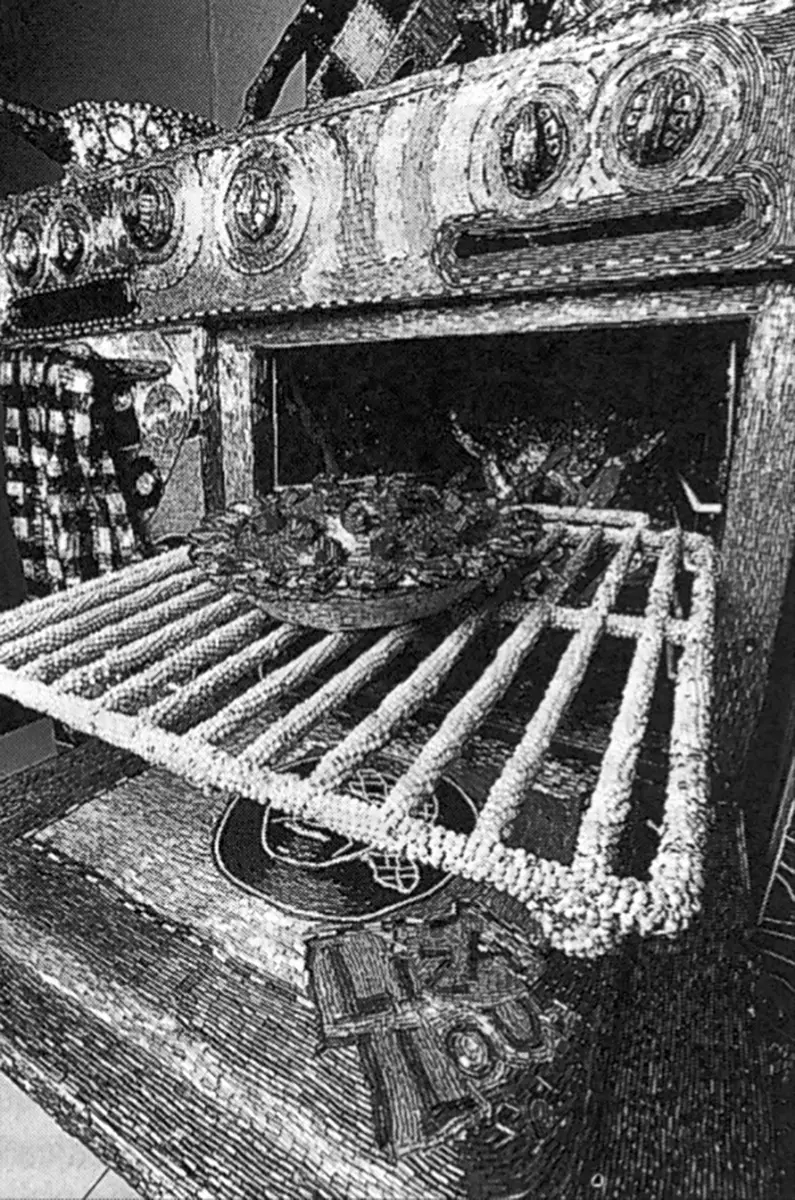
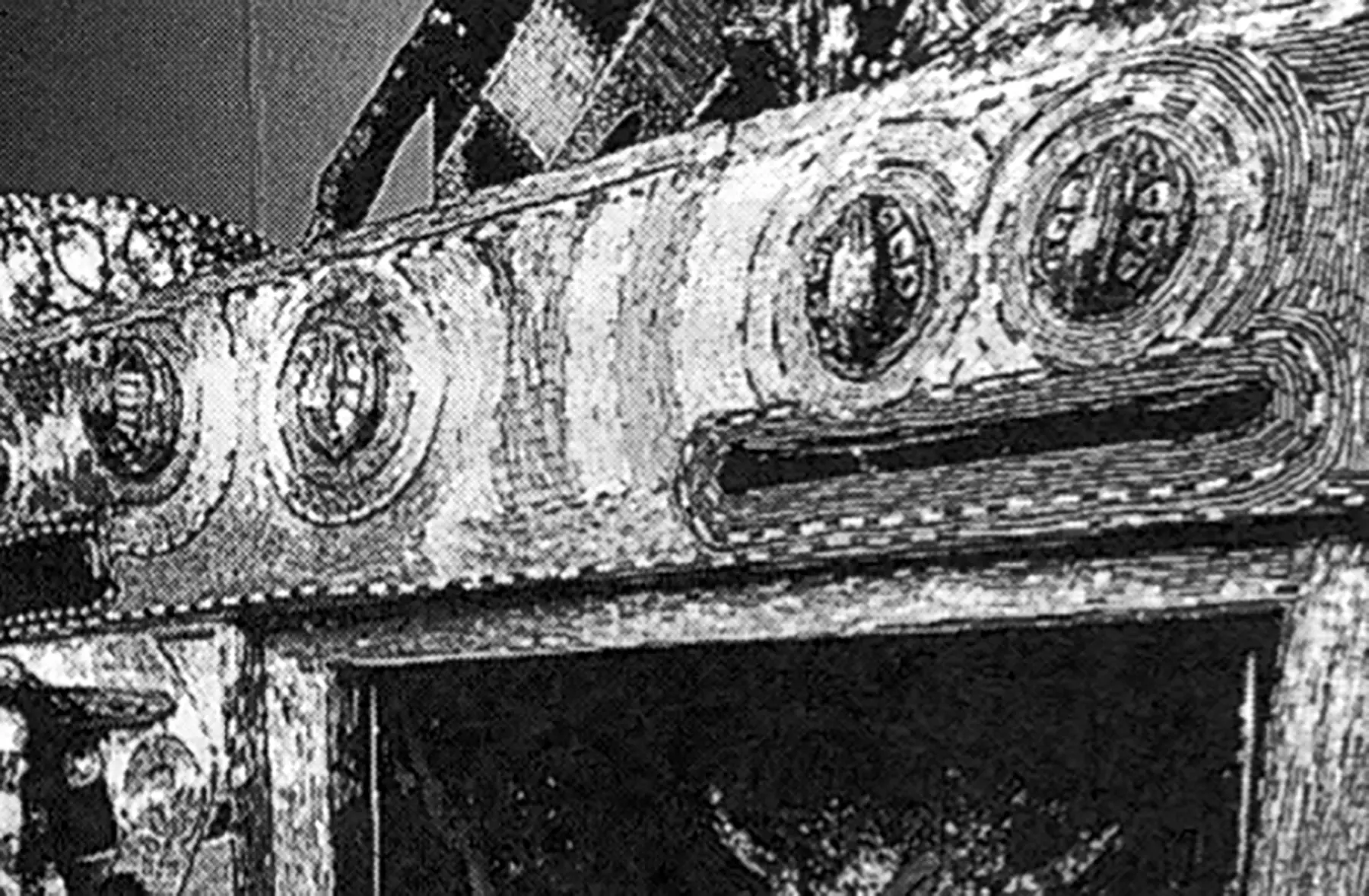
The installation was fortuitous and even capricious. On one wall, the visitor could see the silk ties (untitled) with hand illustrations of psychodelic landscapes by Oliver hering; in another corner, a naïf landscape by Carmen Lomas Garza, showing a woman cutting "little nopals for you;" nearby, there were the strange collages of bread and embroidered fabric by Dianna Frid; and in another room, the fragile little neo-folkloric sculptures by Kululi Velarde. There was also an enormous piece by Liza Lou, which seemed to provide the center of gravity of the show: a monumental Kitchen (1991-1995), which the artist completely covered with tiny colored beads that from a distance shone like sequins. The work occupied almost 60 square meters, and included curtains, floors, breakfast ready on the table, and an oven with a recently baked cake. Lou devoted five years of her life to creating this temple to kitsch, and in the many publications accompanying the show, Marcia Tucker did not hide her enthusiasm for such a Labor of Love.
The exhibition contained a handful of interesting works, although unfortunately their effect was almost entirely lost in the mare magnum of mediocre objects. Of the most successful pieces, mention must be made of the elegant chests of drawers by Kazumi Tanaka (The Chocolate Boot, 1994-1995), whose drawers opened to reveal other drawers that contained yet others, like Russian dolls or Chinese boxes. In a separate corner, there was also an intriguing and mysterious piece by Chuck Genco (Influence Generator/Transmitter, 1987-1992), full of wooden components, gears, and gracefully rotating parts. And finally, there was a notable work by Richard Rule (Sampler Self-Portrait No. 2,1995), consisting of a canvas with hand-embroidered letters and figures, in the style of women’s compositions from the Victorian era, but where the lettering did not refer to a family tree or prayers but to a revealing leyend of Size Queen.
It is a pity that Marcia Tucker’s theoretical proposal—which contained some very valid and praiseworthy ideas—was not complemented by a carefully thought-out selection of works. Tucker’s essay offers an intelligent discussion of the policies governing the institutionalization of art and manages to make the reader question (or at least admit) his or her own prejudices about artistic "value." Unfortunately, the visual component of the exhibition did not achieve the objective set out in the essay, in part because the motley variety of objects and pictures simply over.
RUBÉN GALLO