Over a period of 20 years, Adrián Pujol has been unwavering both in his vocation as a painter and his vision of nature. At a time when pictorial objects have been radically questioned and even pushed to one side in the everyday practice of art, and when fashion, or any kind of novelty, has captured the attention of countless artists who have, without thinking, given themselves up to the repetition of models, Pujol has moved forward through turbulent waters to confirm once again his position as a painter engaged in the exploration of landscape art in Venezuela.
A landscape painter is what this comprehensive exhibition, curated by Axel Stein of the National Art Gallery of Venezuela, revealed, and which was accompanied by a 40-page catalogue with texts by Stein and Roberto Guevara.
But Pujol is more than just a landscape painter: he is a fine and sensual artist who explores themes which, despite their familiarity, remain complex and demanding, creating a dialogue with texture, color, supports, and the subjects themselves. The result is a work which is personal, intense, and very handsome.
In the mid-1970s, Pujol used the walls of the urban landscape to capture time on the point of collapse, an architecture about to disappear. The result was an exhibition entitled Monologues and Walls (1978), with very large format works of striking realism, in a very special technique of tempera on wood, which sometimes open like altar-pieces in an interplay of reality and appearance. The exhibition was preceded by another with workshop subjects which reflected the artist’s strict training, at a time when easel painting simply passed unnoticed in Caracas.
Pujol then began to reflect on the object of painting and, using the graphic arts, started to depict domestic elements, such as taps, water, tanks, gas cylinders, staircases, boxes, and in particular, barrels. Barrels conjure up the idea of petroleum. Pujol continued to be a painter, but he was now concentrating on the concept of painting. He would print or paint a barrel as a means of emphasizing nature and the action of man. Barrel, sign, incognito, moment, stone. A closed space which would lead to his Labyrinths, the title of an exhibition from 1985.
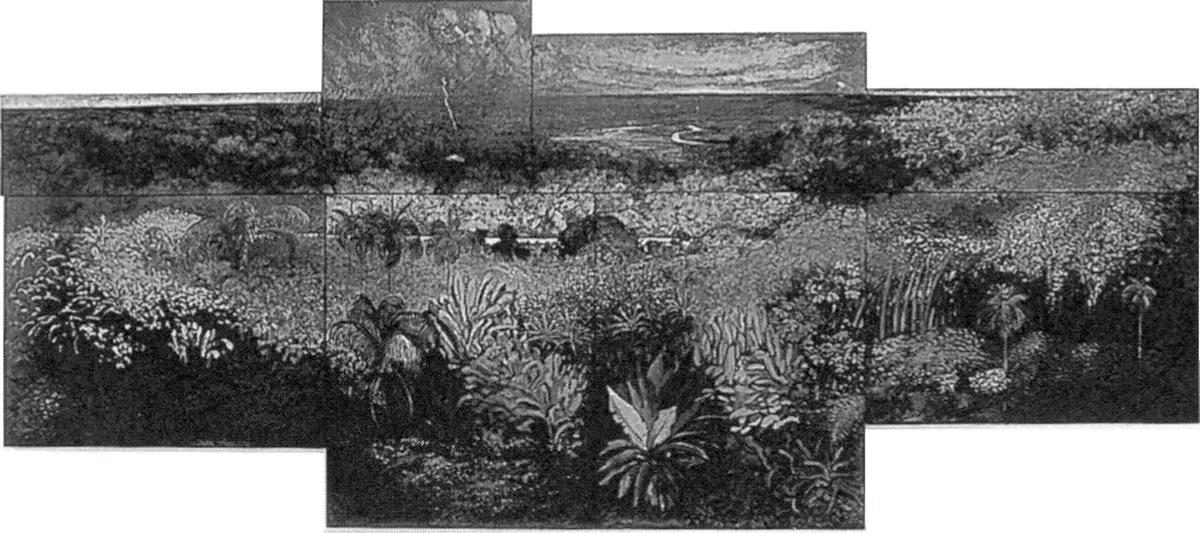
The year 1985 also saw the emergence of another major generational and aesthetic debate. The labyrinth led to a combination of cultures, illusions, and eras. Stone conquers the deterioration of the centuries and remains present as a riddle forever to be deciphered. In the distance, the landscape, immense, wild, and exuberant. The jungle moves forward, completely and impetuously.
There is general agreement about Pujol’s merits as a landscape artist, merits which have been confirmed in four one-man shows: two exhibitions entitled Recent Painting in 1987 and 1989, Landscapes in Margarita in 1990, and Land of Grace in 1992. Pujol travels throughout certain areas of Venezuela and paints in situ. He has an extraordinary enjoyment of the creative act, which progressively leads to the reinvention of landscape, the exploration of the transparencies and densities of color, and the sense of light and organic matter as essential components of his resources.
The air in nature —in the wide open spaces, in solemn dimensions, in the sky and sunsets, the compact light behind the curtain of vegetation— would appear to be one of Pujol’s themes: air as a basis of composition and imagery, air which leads to atmosphere and splendor in his works, air which dematerialized the grandiose aspects of what is being depicted.
Adrián Pujol’s landscapes are large-format works and reflect a firm but delicate handling of his media. They are landscapes which transcend the canvas itself and seem to linger in the eye and memory, in the inner, fantastical side of ourselves. Memory is therefore the other dimension of Pujol’s art, which conjures up the imaginary landscape of the country, which is the only true landscape.
Adrián Pujol is a painter whose real sources of pleasure are to paint, decipher, and thus recreate the world of nature.
JUAN CARLOS PALENZUELA