If we place Álvaro Barrios’s work within the aesthetics of camp, we would be doing justice to his aesthetic proposals. But why not pop? Barrios was never interested in popular iconography as a point of departure for exploring its concepts, but deliberately preferred those superficial elements to be found in camp and, above all, in the way such imagery presupposed the exercise of wit.
Pop, in the North American case, meant an exploration of the anthropological traditions of another culture as regards what these codes of a new life supposed in terms of the renewal of local traditions. Soto opted for camp meant not engaging in deception, a gesture which should be gratefully acknowledged. Wit therefore deliberately tended towards ludic elements; the game is just a game, but its apparent frivolity signals the permanent presence of an inner freedom.
In other words, the freedom of something which is not included within the visual systems of great culture. Boxes, drawings —initially expressionist and visceral— rehabilitate the academic concept of manual work in which, in the end, the iconography does not come from Art with a capital “a” but from the child-like and adolescent mirages which have created a symbolic world through illustrations of fairy tales and prints in books.
For this reason, the first feature to be noted today in his work is his fondness for giving legitimacy to this artistic endeavor, which is deliberately oriented to a world of dreams, of prints which have become an intimate legacy. The value of not changing, of remaining the same, confirms with the passing of time that the visual material selected is no mere transient caprice but a way of defining the artist’s persona.
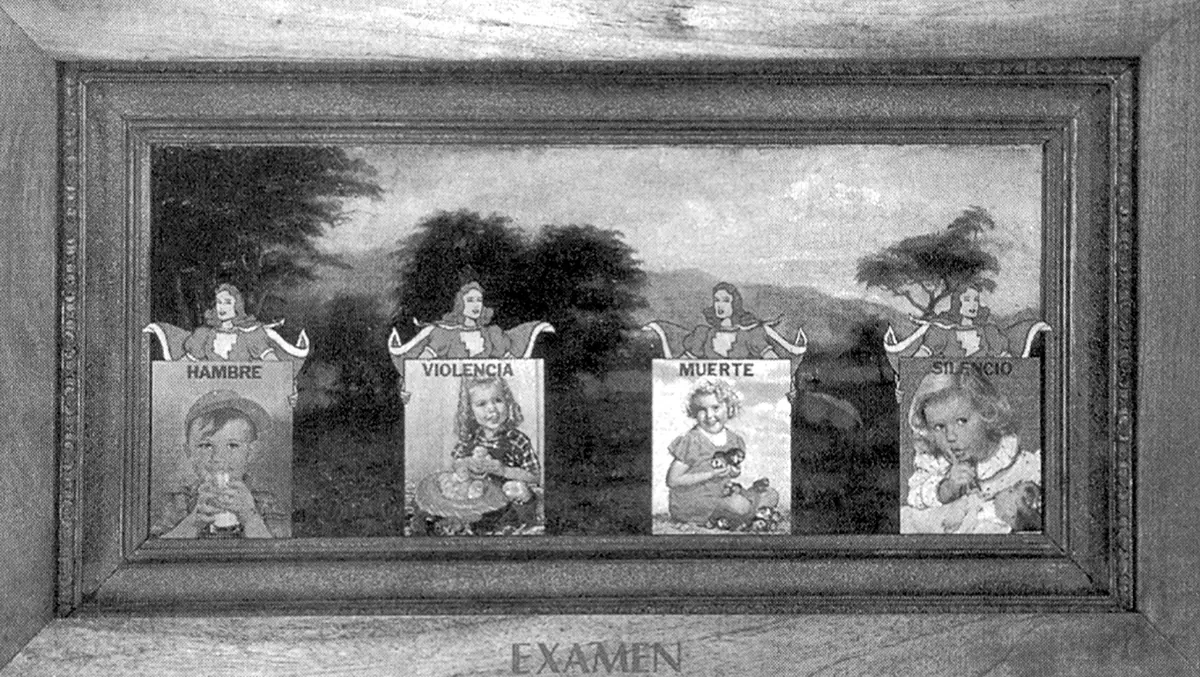
An interesting aspect of this exhibition at the Suramericana was the way Barrios, against a landscape by Francisco A. Cano, and within the framework of the ironic connotations made possible by the words (the label in the manner of not only Barbara Kruger but the Starn brothers), highlighted the contradiction of that dreamlike world in which he has always worked. The collage does not create an illusion but destroys it, like some kind of embryonic misfortune, indicating a justified change in aesthetic direction.
To select material bordering on the trite and endow it with a sense of poetics, to attempt to create visual effects and give them content, are all indications of the effectiveness of an artist who has chosen discretion, who has approached an apparently limited plastic domain and discovered new paths there, new things to say.
DARÍO RUIZ GÓMEZ