Body of Work was both a "set of works" and a "body of work." It was a selection of works based on or inspired by the human body, a set of proposals by a group of artists from North America, South America, and Israel, which reflected different versions of the body as an object of conservation, manipulation, or even veneration, from a clearly conceptual standpoint. Organized by Genaro Ambrosino and presented in his gallery, Body of Work went beyond the usual framework of a group show and proved to be an exhibition based on excellent curatorial criteria.
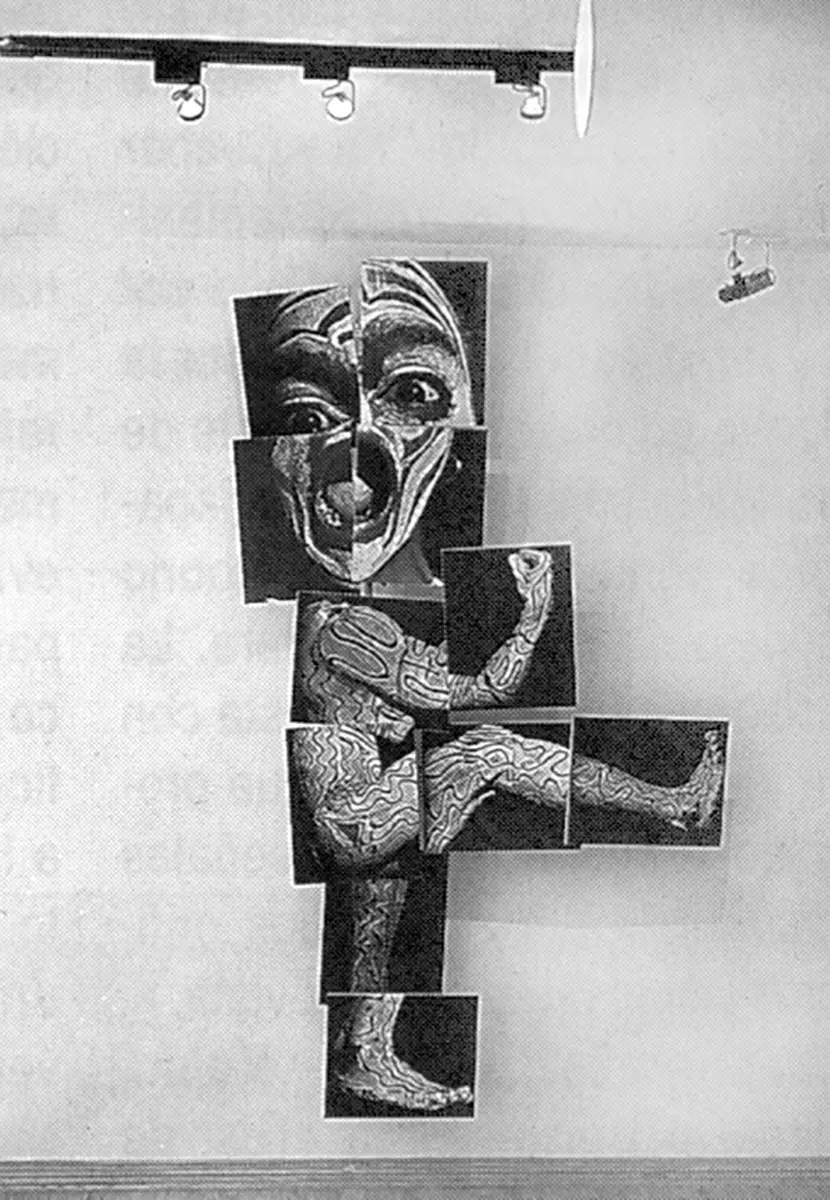
The first work in the exhibition was Bongo Man (1992), by Renée Cox (United States), a wall installation done with photographic plates, individually mounted with metallic tubes. Each plate showed a close-up of different parts of the body. The human figure, arranged like a kind of enormous jigsaw puzzle, was painted white and framed with black, waving lines. The ritual nature of the figure was emphasized by the position of the arms and legs, which suggested a frenzied dance. This frenzy was also reflected in the face, the protruding eyes, and the open mouth of the person, who seemed to be uttering some terrible cry. The trance-like figure seemed to be moving, with the montage giving the impression that it was a motorized installation which would actually begin to move at any moment.
Kevin Clarke (United States) presented a very different vision of the human body. His works include no kind of figuration. They are cibachromes of rural landscapes, in warm colors, framed by graphic elements and repeated letters. Portrait of Mel Chin (1993) and Portrait of Marian Zazeela (1993), like many of his other works, are the result of a very interesting process. First, Clarke asks his friends to give him a blood sample, which is then sent to a laboratory for a DNA analysis. The result of the scan is provided in graphic form, similar to that of an EKG, or a code based on the four chemical elements making up the DNA. These results are used by Clarke to depict the individual in his work. In Portrait of Marian Zazeela, he uses a grid with the letters "c," "a," "e," and "g" of the code, and in Portrait of Mel Chin, he reproduces an enlargement of the graphic result. The reddish color of the photographs is the result of the manipulation of the chromatic intensity during the photographic process. However, it can also be interpreted as a reference to the blood sample initially provided by the donors and which, he says, "is their portrait. "
The installation by Sara Maneiro (Venezuela), entitled Berenice’s Grimace (1995), depicted a decayed and unevenly placed set of teeth. The work was based on small black and white X-rays, which were enlarged in color and carefully arranged into four lines with three X-rays in each. The montage created a wide range of emotions, from consternation at the way an image which is normally restricted to dental care professionals could be made public, to repulsion at the actual appearance of the teeth. The clinical or "hygiene" aspect, suggested by the use of clips that pressed each plate between two sheets of glass, contrasted with the half-decayed images in the photographs.
In the center of the first room, there was an installation by Juan Carlos García Lavin (Cuba- United States), Untitled No. 147 (1995), which consisted of five metal tables, the tops of which were photographic images in glass. They apparently showed X-rays of the chest or breast, or perhaps were enlargements of details such as an open skin wound or a close-up of sweaty skin. Given the context, it was impossible to imagine that the photographs were very far from what they seemed to be. In fact, however, they were photographs taken with a macrozoom, showing details of resin which seemed to be what might be seen in a dissected or decomposing body. Far from the emotional nature of his earlier works, García Lavin was here playing with the visual character of the image, in particular the contrast he established between the table, which was strong, solid, and heavy, the X-rays, and the fragile, transparent glasses supporting the metallic bases. The only indication about the origin of the image is the resin which fills the lower part of the glasses, placed upside down to suggest greater instability. However, the effect of the X-rays was so well achieved that the dominant impression was the bodily one, even after the formal explanation of the image.
The second room presented two photographic works and two videos. Because of its lighting and the effect of the image, Untitled (1995) by Aziz y Cucher (Venezuela) proved particularly impressive. A female face, with sensuous, long blond hair and wearing a pair of pearl earrings, was framed within a sober wooden hand mirror. The seductive image contrasted with the frightening effect of the absence of any distinctive features in the face. The orifices of the organs of sight, smell, taste, speech, and hearing disappeared through the use of computerized digital technology, creating a monstrous effect. The hermeticism became intolerable, not only because of the visual impact of the face completely covered with skin, but because of the idea of not being able to use the senses and of being completely cut off from the world.
The video by Smadar Dreyfus, Accumulation (1994), had an almost analogous effect. Installed in a closed room and with a television set placed on the floor with the screen pointing upwards, the tape showed the dark, brilliant hair of the artist and her hand caressing it monotonously. The image of a woman lying on her back, sensuously caressing her hair, has a number of connotations. The repetition of the same movement over twenty minutes destroys any initial reading and creates a tension and sense of despair similar to those generated by the work of Aziz y Cucher.
Ex Voto (1990), by Tania Cypriano (Brazil), handled the body in a different way. This was an autobiographical work in which the artist pays tribute to the patron saint of Brazil for having saved her from a fire when she was ten years old. The video begins with the flames enveloping a black background. Voices and cries are heard. Photographs of a child appear, and then the artist, naked, in a bathtub. As she takes her bath, the ritual connotation of which is obvious, she recites a text which refers to her tragic experience. She slowly rinses her hair and washes the scars of her burns, which the video highlights in close-up shots. At the end, dressed in red, she is clutching some flowers which she will undoubtedly offer to the Virgin in gratitude. The work ends with a view of a sanctuary full of burning candles. Once again, the fire, but this time symbolizing faith and life.
The individual character of all these works contrasts with the image denounced by Eduardo Aparicio (Cuba-United States) in the series Public Body (1994). Four color blow-ups of street advertisements rework details of the human body, such as the face, the mouth, and the male sex organs hidden inside tight-fitting jeans. The photographs of torn posters intensify the denunciation of the manipulation of the body by advertising, which depersonalizes it and transforms it into an object, as well as reflecting the artist’s interest in discourse on violence and sex.
Just before the stairs leading to the second floor of the gallery, there was Scar I (1995), by Tad Beck (United States). This work is part of a series on "emotional" wounds that the artist has suffered, documented by photographs of real scars. In Scar I, a photograph of an arm with an enormous wound is pierced with a thick screw which fixes the plexiglass to the concrete base of the work. The mechanism of the montage and the reliefs of doors and windows in concrete refer to what Beck calls the "urban® wounds. Architecture, like the body and soul, suffers wounds, and in New York, where Beck lives, this is an obvious reality.
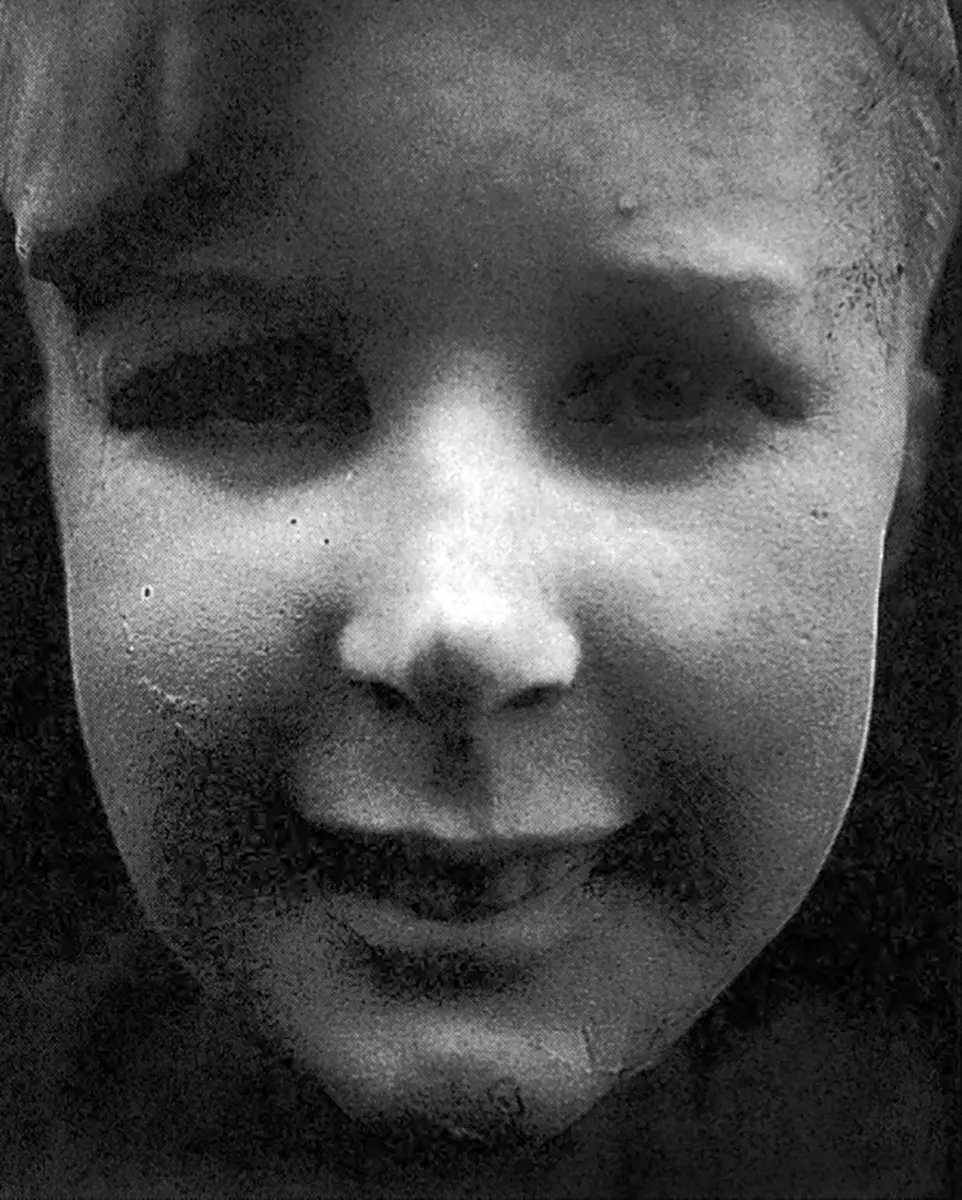
Dean McNeil bases his work on photographs of cemeteries. In the selection presented in Body of Work, he used details of figures that adorn cemetery tombs and gives them a morbid vitality. In Paris (1992), he shows a woman’s face which, beyond the coldness of the marble in which it is sculpted, transmits a feeling of deep sadness; in Paris (1994), the face of an old woman sculpted in granite gives the impression of a grandmother petrified and frozen in time; finally, in Vienna (1994), the artist creates the most macabre effect by showing the phantasmagoric images of a smiling child, whose glassy pupils confuse and confound the spectator. In McNeil’s work, the body is both an allusion to its disintegration after death and a reference to its permanence, represented in the sculptures and the documentary nature of the photography.
It is precisely the documentary side of photography that is used by Arturo Herrera (Venezuela) as a basis for his work entitled The Circular Ruins (1995). Two photographs of a man’s neck show different instants of the same shot. They are apparently the same, but the beard in one is different from the other. The difference, which is virtually imperceptible, refers to the passing and futility of time, which exists, disappears with a shave, and reappears, forming a recurrent cycle.
Black Body in Progress by Thomas Allen Harris (United States) was set in a separate space behind a black curtain inside a dark room. At the back, there was a cibachrome of a face with the words My Lesbian Self-Videograph written on it. In front, a television screen showed an androgynous body, bound up tightly in ropes, trying to break free, while a series of words gradually appeared in the center of the screen. The darkness of the skin is a direct reference to the criticism made by the artist of the physical abuse suffered by the black race. The African element was emphasized by the music of drums and heavy rock, ending in total silence at the end of the video. The message communicated by a male voice and a female voice, representing the two sexual dimensions of the same being, was even clearer in the context of the words written on the screen: "black body is," "desired," "loved, " "despised, " "beaten"... The presence of the spectator made the latter an accomplice and/or an impotent witness to the artist’s denunciation.
The tension of the final part of the video was lost because of the cries coming down from the second floor, which housed an installation by Dan Moshe (Israel), entitled Performance (1994). Three television sets hung from the ceiling projected independent images of the face. The first screen showed a nose, seen from below; the second an eye, facing upwards; the third a mouth from which loud cries emerged. The close-up of the mouth recalled the video of Hila Lulu Lin (Israel), entitled A Cow, a Turtle, and a Fish (1995), shown at the gallery in an earlier exhibition. In Body of Work, the Israeli artist this time presented Untitled (1995), a montage of nine boxes made with Polaroids, cotton, metal, and pins. The delicate and fragile nature of the cotton contrasted with the sharpness of the pins, which in turn referred to the marked, tattooed, scarred, burnt, or tied bodies appearing in the photographs.
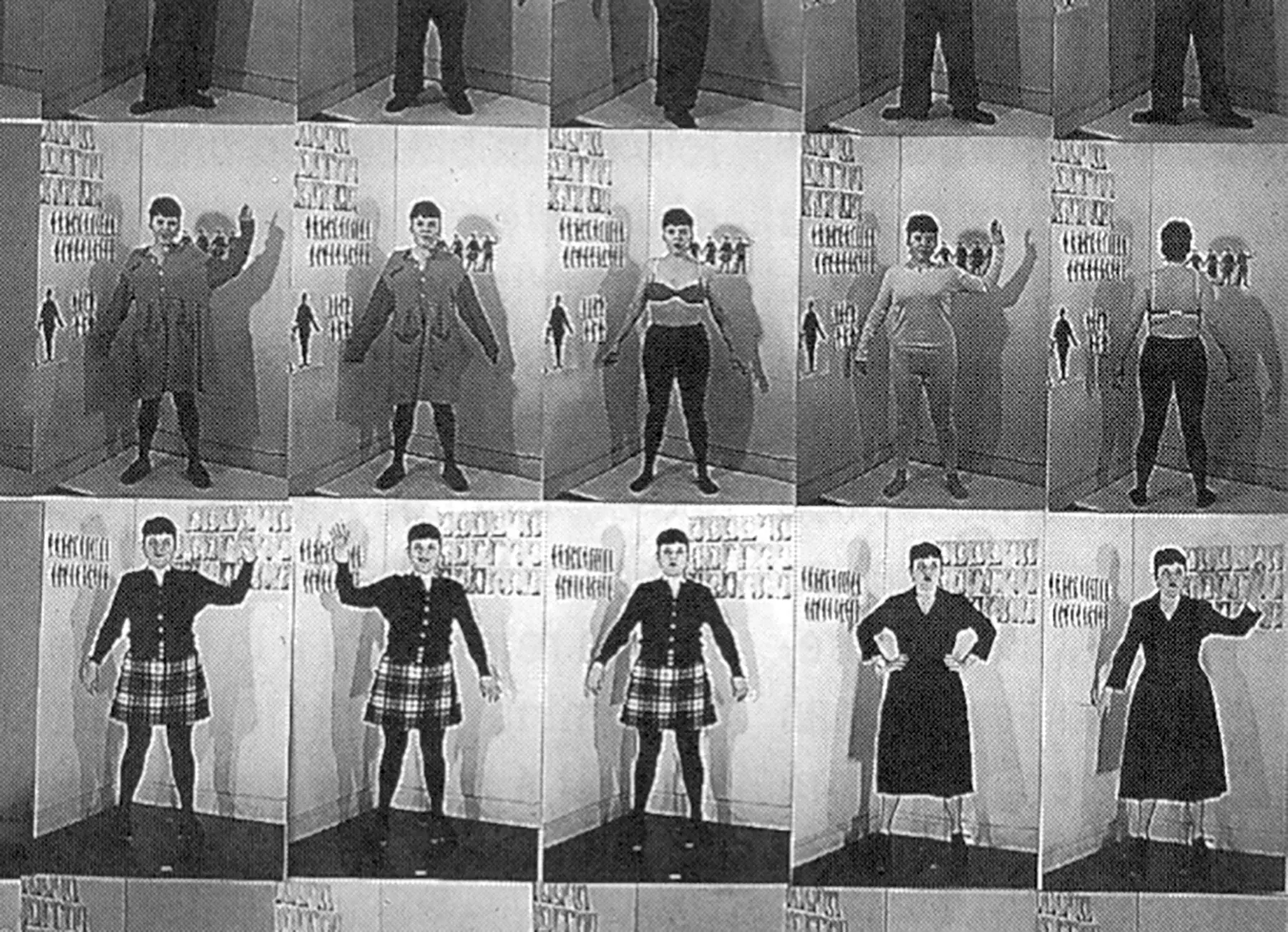
Another woman, Suzanne Ragan-Lentz (United States), saw the body in very different terms. In Positively Me (1994), she reworked the idea of paper dolls and photographed herself wearing different outfits, in different poses, in a critique of the image of the perfect model and woman as object. In My Negative (1994), the earlier photographs are cut, with the space occupied by the figure being left blank. Her body is reduced to a blank silhouette, which is repeated over and over again. Another silhouette appears in the work of Todd Gray (United States), Dream Man (1986), a black and white photograph touched up in charcoal, showing a colored singer. The man appears naked and is holding a microphone, and in the back of the photograph, there is the sentence "I am the man of your dreams."
The final work in the show was a selection of six polaroids from a series by Gonzálo Morales (Mexico), Untitled (1995), in which the artist documents the tattooed body of a prisoner who, during his period in prison, spent his time marking his entire body. It is strange, given the current fashion for tattoos, that there are not more works on this subject or on "piercing," which has become so popular among young people in the United States. In any case, Morales’s series was a good example, and its anecdotal nature did not detract from its aesthetic quality and was at the level of the other works in this show.
FRANCINE BIRBRAGHER