The vitality of folk painting rarely intrudes into Carmen Lomas Garza’s well-ordered visual world. She imposes the lessons of formal academic training on the traditions of Mexican popular art, but the resulting paintings are not uniformly successful. Her more recent sculptures, however, movingly combine the sensibilities of traditional craft with modernist trends.
In folk art, composition plays a narrative role. Although Lomas Garza paints in a style common to naive painting, the arrangement of her figures is strictly a function of composition. The design of her paintings overwhelms any subjective representation or narrative impulse that might have focused the viewer’s attention. Her densely populated paintings might recall the snapshots of an amateur photographer, but the deliberate placement of her figures divorces them from their surroundings. This results in a bland neutrality in which the death of a shark or the butchering of a rabbit produces the same compositional response as a birthday party or a neighborhood dance.
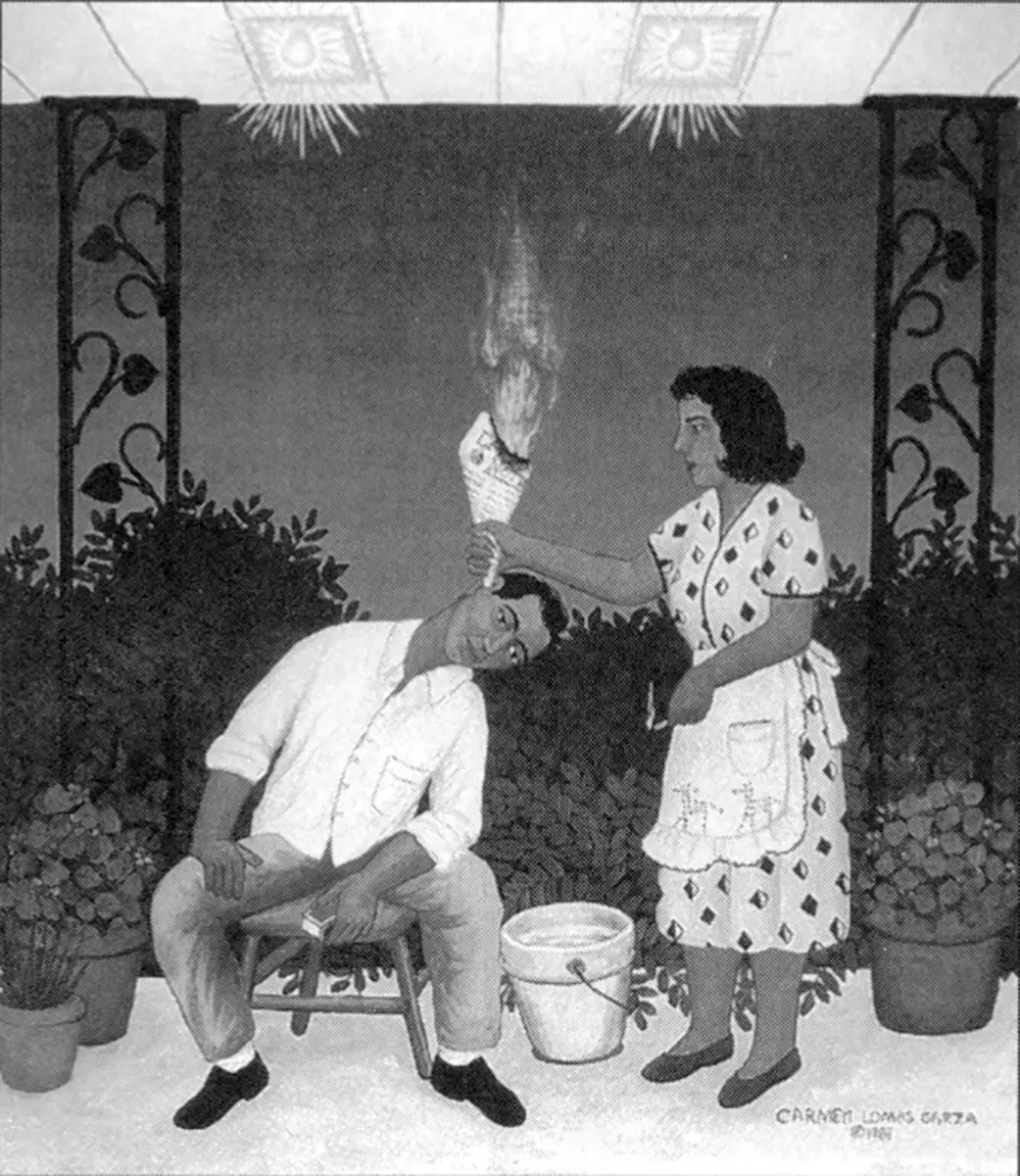
Lomas Garza’s use of figures as compositional anchors also places a barrier to other interpretative approaches. The crowd of spectators in El Milagro (The Miracle) might be adoring the apparition of the Virgin on the planks of a wooden water tower, or they could just as easily be staring at the trio of dead rattlesnakes draped over the tank’s scaffolding. If the two events are somehow connected, the clues that link them lie somewhere beyond the painting itself.
In all too few instances, such as Polvo y Pelo, el Pleito (Dust and Hair, The Fight), with its women brawling outside a nightclub, Lomas Garza reveals her own emotional response to a scene. In Las Pachucas (Razor Blade’ do), the artist provides a touch of irony by juxtaposing an image of Our Lady of Sorrows, her heart pierced by swords, with that of a young woman arranging her hair with razor blades.
While her two-dimensional works always seem to be working at cross purposes with their popular roots, Lomas Garza’s steel cutouts reinvent and revitalize the folk tradition of Mexican cut paper.
Rather than limit herself to the typical floral designs or skeletal figures for the Day of the Dead, she recreates the same childhood memories depicted in her paintings. With Ofrenda para Antonio Lomas (Offering to Antonio Lomas), she makes the drama and value of the everyday abundantly clear. Her rendering of a south Texas garden gives free play to her modernist training, the spray from the gardener’s hose boldly echoing the traditional forms of the garden’s cacti. Rendered in laser-cut 20-gage steel rather than ephemeral paper, Lomas Garza’s sculptures embody the lasting contributions and value of Hispanic culture. Steel, not paint, provides the ideal material for the important preservation of cultures that Lomas Garza wishes to convey.
K. MITCHEL SNOW