Hernando Tejada is a most unusual artist of extraordinary artistic charm. He recently presented an exhibition at the Diners Gallery (February 1-March 9), with a series of mangroves and landscapes of pitcher-cities, his most recent sculptures. These works, done in cedar wood and balsa, rework themes from the artist’s early production of nature sketches or still-life paintings.
From his first one-man show in Bogota in 1948, and despite his long artistic career, the number of his one-man shows can be counted on the fingers of one hand. This does not mean that his production is not large or that his creative process is not constant—observations which would run counter to the meaning of his work, which is always imbued with his love for creation.
Perhaps the most significant aspect of his work is the handling of his materials. The wood is molded, sculpted, cut, assembled, transformed, drawn upon, painted, and interwoven, with the artist playing with it and becoming an exquisite constructor and presenter of life and nature. From the 1960s, he began to produce a series of pieces of furniture which won him a special place in the history of art.
Some of the works included in the exhibition were examples from earlier years, when he placed men or women in humorous situations. Stephanie the Telephone Woman, Paula the Cage Women, The Organ-Grinder are works in which the young public in Bogota could recognize the wit and skill of this artist with an invaluable richness of words and artistic forms, based on his mastery of manual craft. He is undoubtedly an artist and magician of fantasies and legends in Colombian art.
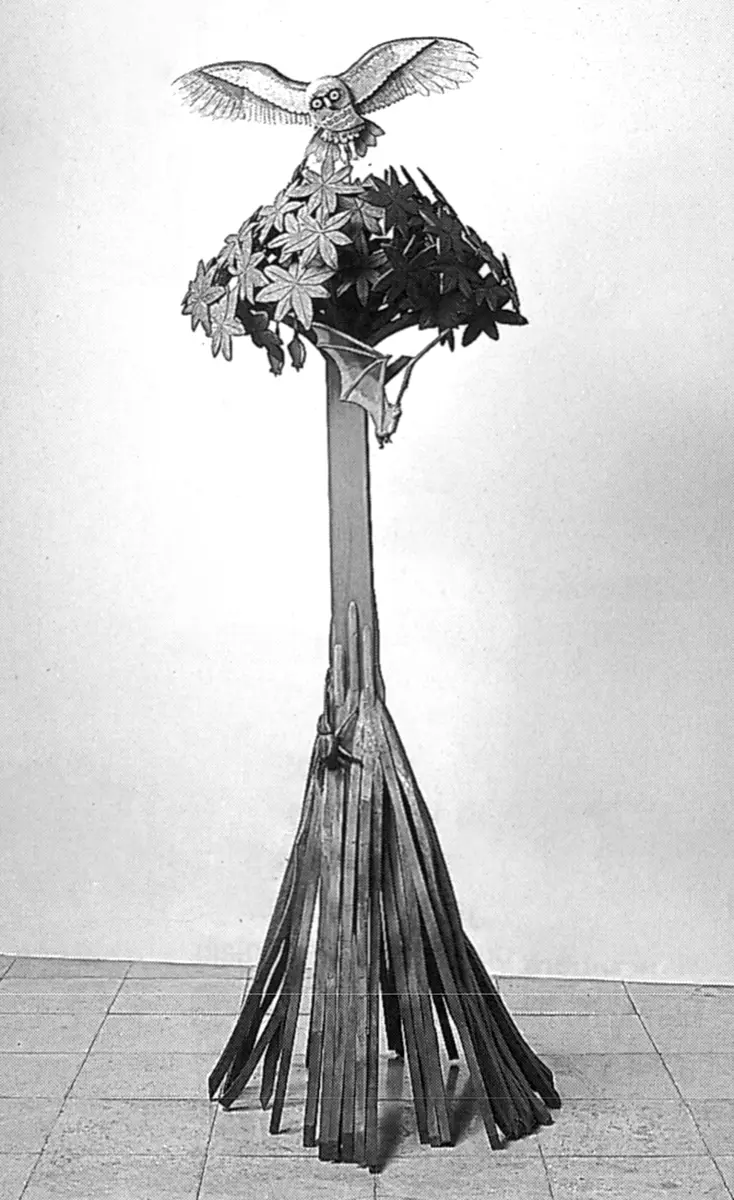
His new series of mangroves leaves aside the pieces of furniture, such as cupboards, chairs, doors, and lecterns, and moves towards the theme of nature: the fauna and flora of the Pacific are presented in two groups. One, entitled Spirit of the Mangrove I and Il, more complex and larger, synthesizes the sense of nature; the works in the other group, Mangrove of the Pelican, Mangrove of the Stork, Mangrove of the Bat, Mangrove of the Kingfisher, Mangrove of the Eel, Nest of the Blue Heron, Mangrove of the Green Iguana evoke fragments of nature in specific hymns dedicated above all to specific animals.
Thickets and tangles of undergrowth evoke the freedom of forms and contribute to the aesthetic pleasure. Thus, the mangroves invite the spectator and at the same time call attention to the destruction of the environment. By emphasizing the sense of oblivion and loss of respect which characterize contemporary man, Tejadita—as his close friends call him— knows that it is with tenderness that we can keep the image of nature alive; and by reminding us of these images and emotions, he helps us to reconstruct it. His sense of observation is a constant feature, complementing his great sense of imagination and humor. These new works sharpen the eye, interpreting and recreating nature.
The pitcher-cities are nocturnal and diurnal city landscape reliefs in which a sense of coquetry and play emerges from the metaphysical geometry based on still-life forms. Large pitchers, which match the size of the works, simulate buildings, columns within a textbook reading of rigor and soberness. The poetics of the imagery allows him to baptize the works City of the Diurnal and Nocturnal Pitchers, Nocturnal City, where an exquisite contrast between the exuberance of nature and the rigor of geometry is present.
Hernando Tejada can be seen as the most “child-like” of Colombian artists, since he takes enormous pleasure in creating the most fantastic kinds of symbiosis and legends with his hands. In this way, he has been able to recreate the most serious kinds of themes, where his sense of invention has transformed pieces of furniture into playful creatures.
MARÍA TERESA GUERRERO