Lima has two exhibition spaces dedicated to the memory of the country’s most important critics. First, there was the Luis Miro Quesada Garland Room, in the Municipality of Miraflores. Now, the Museum of the Nation has paid tribute to the memory of Juan Acha by inaugurating a room dedicated to him with an exhibition of work by José Tola (Lima, 1943), an artist who has managed to capture popular imagination through the emphasis placed on imagery closely linked to putrefaction and death.
Tola might be one of our very few peintres maudits, because his commitment to art has distanced him from any other kind of contemplation other than the exploration of a world dominated by his own demons. At the beginning of his career, at the end of the 1960s, his work was marked by an expressionism resulting from his experience at San Fernando. After trips through Europe, he won a Lima competition, which caused controversy, although this subsided with his first one-man show, the following year (1970), in which he reaffirmed the presence of deformed physionomy and the passionate use of texture. This period was also characterized by his xylographies done with spoons and his tormented, textured oilworks. These were dark works, to some extent derived from the Spanish tradition, in which the bodies emerged from a baroque gloominess which lured the spectator into its nightmare.
The 1980s saw the emergence of a sordid iconography which became emblematic of our suffering. This was the time when the artist began to work oil on paper, creating exacerbated forms accompanied, paradoxically, by a formal refinement which accentuated the pessimism of a world which for the artist became identified with his hells.
Tola’s lacerations were not gratuitous. They were consistent with a society that was entering the winding path of violence, which led to the explosion of a convulsed world that few artists have been able to depict as impressively as Tola.
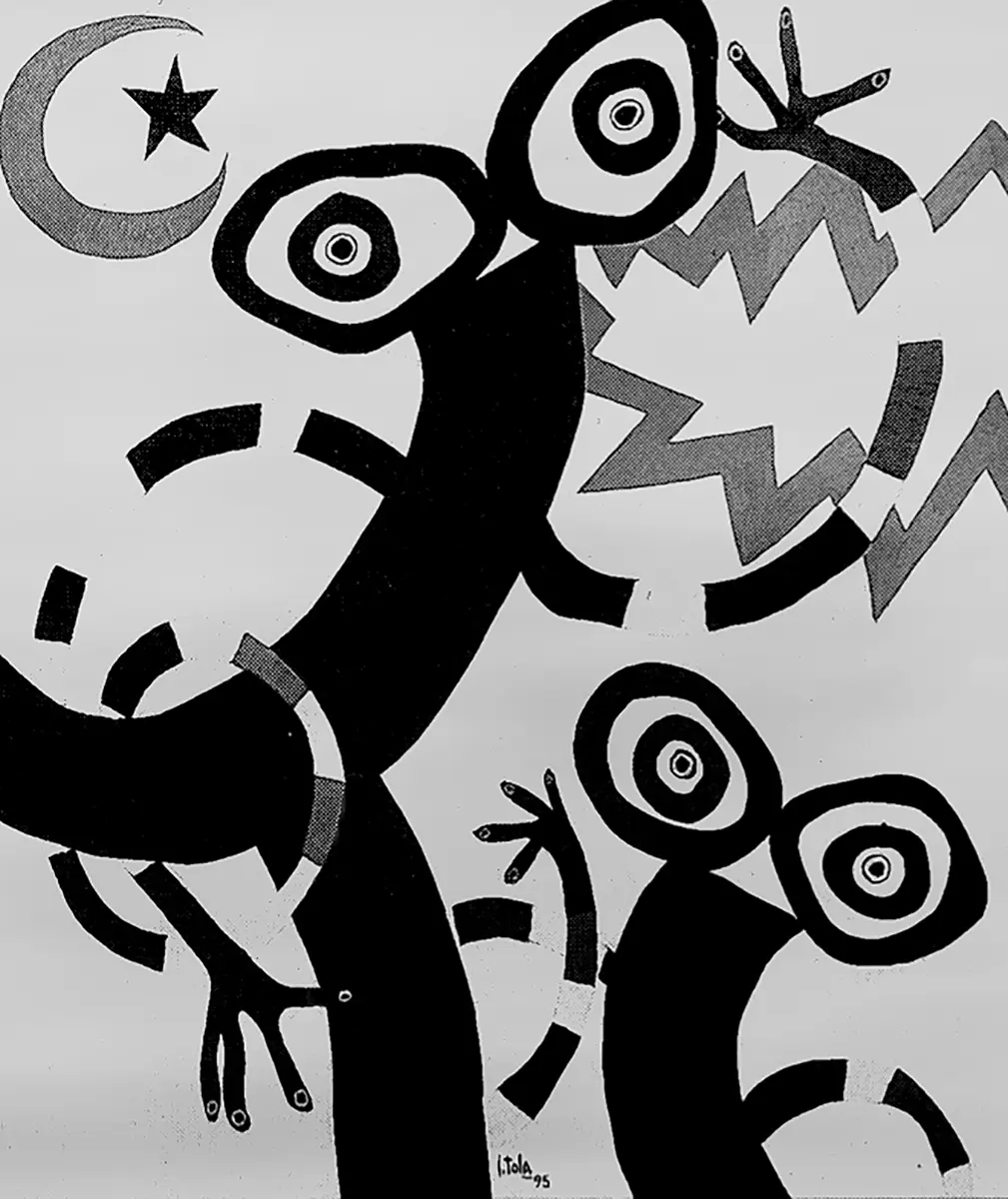
In 1984, he abandoned his descriptive refinements and devoted himself to working cut-out silhouettes, painted in flat colors, which stood out from the frame and occupied the surrounding walls. The characters were the same as before, except that now they were more simplified in their physiognomy, with each body acquiring a monumentality resulting from organic forms which went beyond the stretchers. From this point on. Tola abandoned easel painting and moved towards a synthesis of anthropomorphic beings, which, for those unfamiliar with the artist’s intellectual development, might suggest an affinity with Dubuffet.
Tola subsequently began to fragment the space of the bodies with signs which indicated that although he had relinquished all his former rhetoric, he continued to pursue and reassess the obsessions that haunted him. These were the works that won him the Grand Prize of the Wifredo Lam Biennial in Havana in 1987.
These works were followed by his use of nails, textures, metal, and rope, elements which in their turn symbolized the oppression and horror of a society which found itself in an impasse. At the beginning of this decade, Tola was working with "tortured materials, objectifying figures," since, according to Juan Acha, "abused materials are the best means of expression for abused men. It is worth examining to what extent textural metaphors exist and, if so, what meaning they are given by Tola."
The artist thus created sculptures, which were to some extent ephemeral, in which he accentuated the fragility of life and the horror of death. Three main colors predominated - black, white, and red. The burned plastic, the oxidized metal, and the jaws opening before the spectator in these assemblages reflect Tola’s radical commitment to ugliness.
For Acha, Tola restates the questions raised by Coatlicue: "What is horrible in Etarot...is that it is a legitimately aesthetic and thematic world. The artistic impact of this assemblage makes it an exemplary work for the plastic arts of our times, and not only for Latin America".
The Tola retrospective stops with a picture from 1995. The artist returned to the easel after his experiments with vinyl chloride, polyethylene, resin, fabric, and wood. They are large formats in which the painter turns once again to painting, in which color emerges anew, and where there is room for the bursts of irony and bits of humor.
The best text that Juan Acha ever wrote on a Peruvian artist dealt with Tola and was published posthumously. And it was a text which Tola fully deserved.
LUIS LAMA