Philosophical discourse based on photographic production is becoming increasingly common. The "realism" implicit in this technical medium has led to a number of proposals that question reality as an objective, concrete, and non-representational phenomenon.
It might even be said that instead of bringing us closer to reality, the development of photography has in fact resulted in the opposite. Everything is image and interpretation, and the tangible artifact has become an archetype of the thing that constantly escapes us.
Leandro Katz, an artist who is used to waging battles with images in film and photography, is not unaware of these questions, although he prefers to adopt a different perspective. He proposes the hypothesis of photography as a means of intermediating a possibility of reality: a story, a character, a point of view. A unique experience, which Katz seeks out, is guided less by what the photograph shows than by what lies hidden behind it.
In this way, he becomes a sort of archaeologist, digging not into the reflection but into the quicksilver of the mirror. Urged on by this pressing need to reconstruct an instant of reality and re-mount the original piece fragment by fragment, Katz deconstructs the story, discovering it, and rewriting it. In his search for the "other," which he finds to be like himself, he places the spectator in a kind of labyrinth of mirrors in which the reflections constantly rebound and multiply to create a symmetry of times and glances. In this process, his semantic construction becomes more complex.
It is within this conceptual framework that the two installations that Katz recently presented at the Museo del Barrio have their points of contact. Projects that apparently seemed to be different thus became familiar, and the extreme physical proximity in the exhibition space became an advantage rather than a source of controversy.
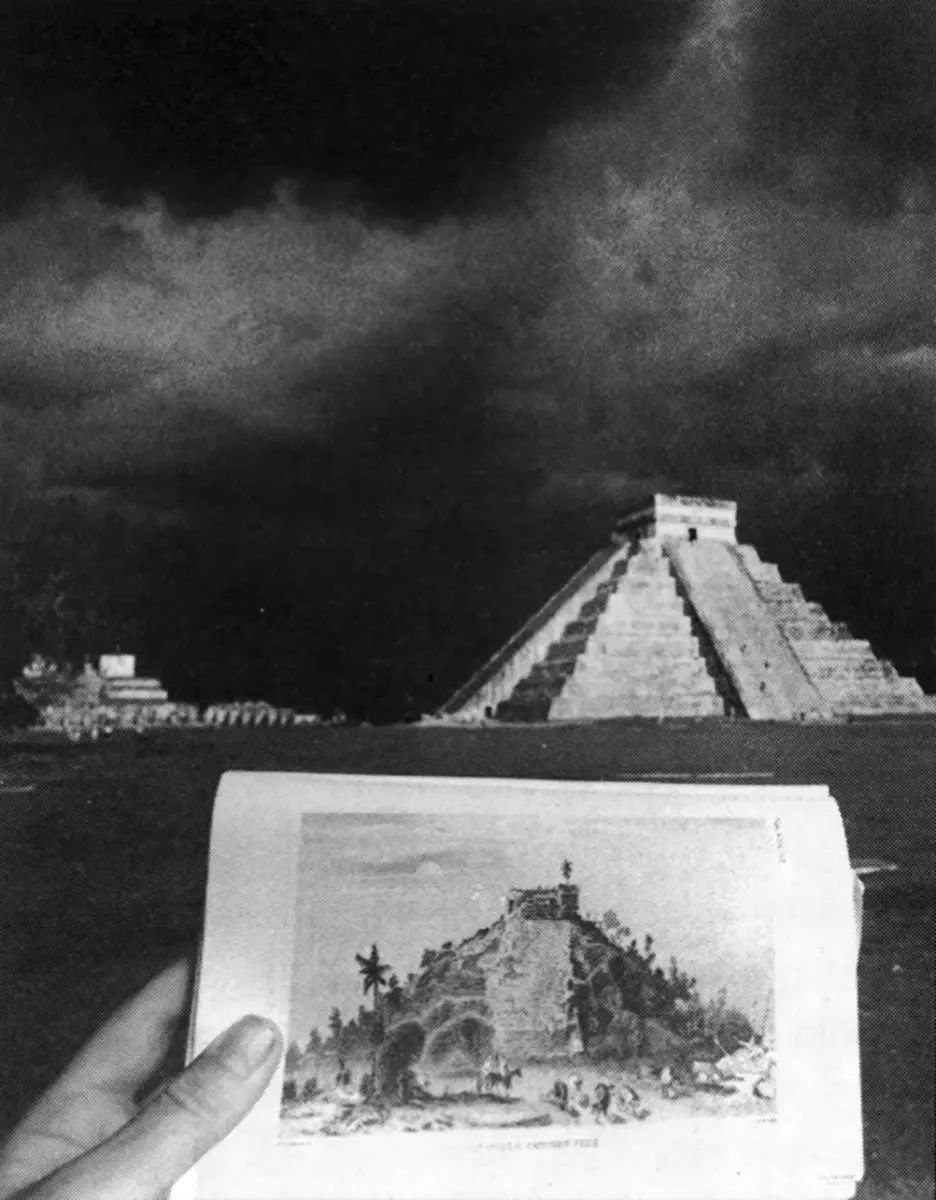
The Catherwood Project exhumes the drawings and prints that Frederick Catherwood dedicated to Mayan architecture. The monuments which the English artist and architect documented with obstinate precision are revisited by Katz, who, camera in hand, set out to reconstruct Catherwood’s view. For this purpose, he placed himself at the same point as in the drawings of the latter, ready to repeat the process.
A series of interesting events occurred during the parallel process, which finally emerged from Katz’s operations. On the one hand, the "photographic quality" of Catherwood’s prints—very meticulous in their detail—is in fact not photographic since it was impossible for the camera to be both close and distant at the same time. In the final analysis, there is no point from which it is possible to view as Catherwood did, but rather several within one. The condition that enhances the "realism" is the freedom of the idea, coupled with the skill of the drawing technique, rather than anything photographic, as one might have initially thought. Perhaps for this reason, in his photograph The Castle After Cather wood (Chichén Itzá), Katz takes advantage of a storm to introduce a dose of pictorialism, which attempts to bring the photograph closer to the drawing in question. In the same way, the shadows cast by the artist himself act as ceremonial elements in the Arch of Labna Ritual for Transfigured Time, and establish a dialogue with the actual entrance of the arch. Similarly, Katz’s hand holding the book with the image of the place being photographed is sometimes a means of signalling a time which can no longer be revisited. Other times, it is the presence of tourists that communicates this discourse in time.
Memory and oblivion are other elements evoked here and which reappear in the second installation: Project For the Day When You Fail in Love With Me. Made up of four independent units, each of which is at the same time part of a more extensive multidisciplinary project, this installation, like the first one, is based on a photograph. In this case, the central element is the photograph of Che Guevara assassinated in Bolivia, a well- known print which shows Che’s body on the sink of the laundry room of the Nuestro Señor de Malta Hospital—a photograph which went around the world on October 9, 1967, the pretext for Katz’s own journey. It was a journey in which he went to the place in Higueras, met the photographer Freddy Alborta, who took the picture, and during which he added fragments of the story of Ché in Bolivia and of the guerrillas who accompanied him at that time.
Once again, Katz is looking for what the photograph does not show, what lies hidden behind the picture—the Uruguayan passport which he used when he was in hiding and in which he appeared as a bald-headed diplomat, with glasses and a beard. Then there are the images of Tamara Burke and the drawings done during torture by a guerrilla who had been captured, in order to help identify his friends—all reference to simulated identities which reaffirm the multi-faceted nature of the context.
But the installation also highlights other aspects. Whereas the Catherwood project reflects on the present time and the distant past, this work seems to refer to a past which ceased to be the present only a short time ago and the future. The future, at least as a source of concern, time as a desire for a possible hypothesis, a recovered hope, and an undemolished myth. In this sense, the title of the work is very significant: The day you fall in love with me is a well-known tango celebrating utopia.
For Katz, the death, pain, and sacrifice implicit in revolutionary processes seem related to the sense of Christian sacrifice, as can be seen from the presence of the Christ of Mantegna or the twelve apostles implied by the twelve guerrillas, as well as by the tango philosophy: "leave my wound alone/everything, everything will be forgotten," which is the price to be paid for the true love to come. These three spheres can also be associated with their mythical constructs. But it is in these constructs that the capacity for utopia is to be found. The day you fall in love with me, life will become joyful, and pain will cease to exist.
*Leandro Katz, Museo del Barrio. Invited Curator: Julia Herzberg
ANA TISCORNIA