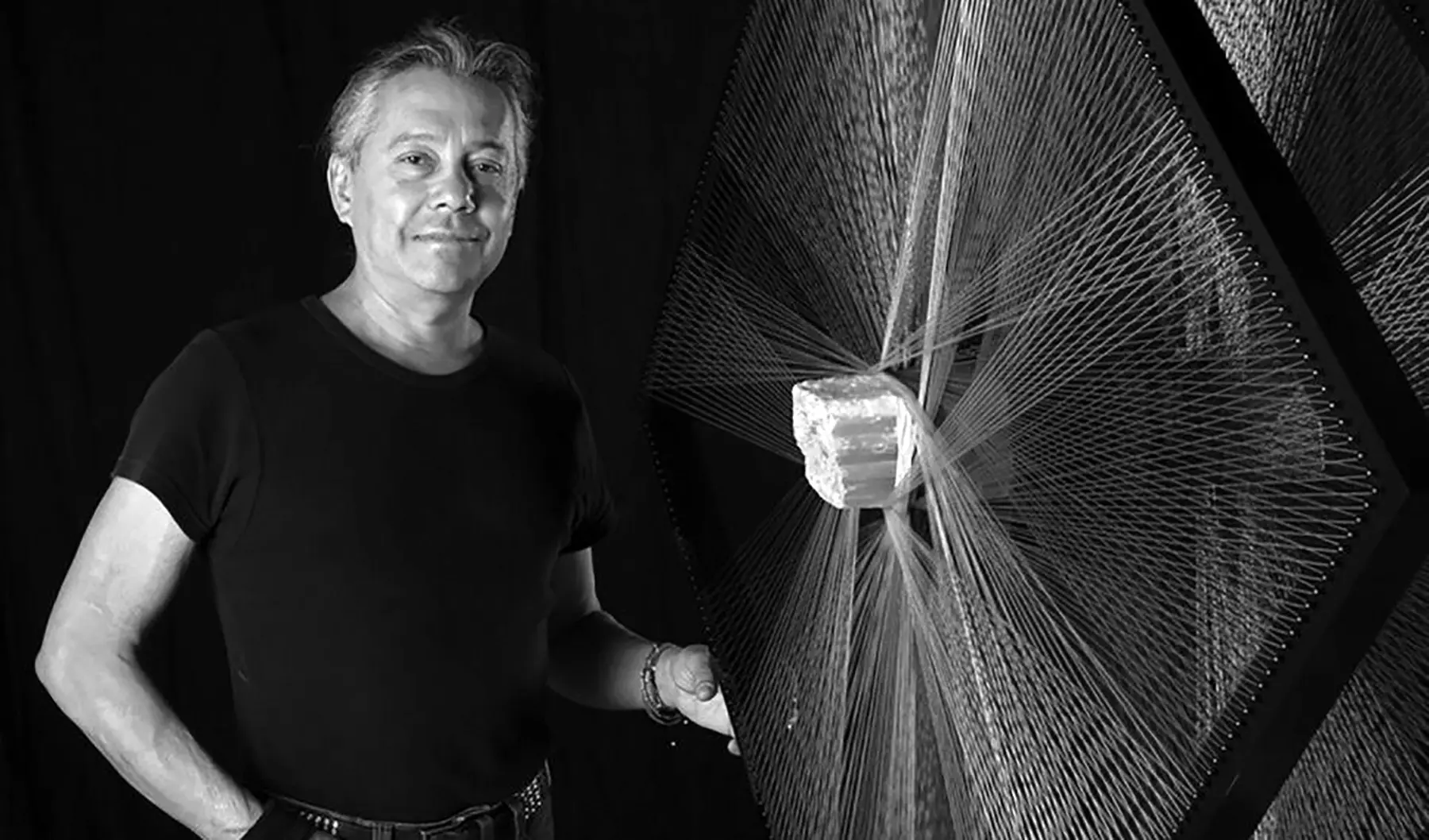
Milton Becerra’s proposals are centered on the creation of a model of identity designed to break the stereotypes of Latin American reductionism. From a universal perspective, he proposes a model of connection between nature and the spirit which emphasizes the redemptive value of the work of art as a possible means of overcoming the traumas and differences which man himself has forged and from which man suffers in his relationship with the cosmos. From the 1970s, Becerra has undertaken, in a spirit of rigor and consistency, an investigation which takes us back to the very origins of creation, through his generous interventions in the landscape and installations in which stone and natural fiber rope are the fundamental means of structuring space. His is an open-ended work, which the artist does not limit or label by such a word as "sculpture," preferring to describe as "relationships" these encounters between matter and space. Without doubt, such "relationships" encompass infinite links with the centuries-old information contained in such materials as rocks. It is precisely memory, history, and the past that emerge the strong presences in Becerra’s work.
Last October, the Sofia Imber Museum of Contemporary Art (MACSI) in Caracas presented the results of his most recent project: Nature and Spirit, the first stage of an exploration and intervention in nature in the El Tamá moorlands in the Venezuelan Andes, where the tributaries of the River Táchira are to be found, a region marking the frontiers between Colombia and Venezuela. Here, at the source of the waters, Becerra brought us face to face with the origins of life.
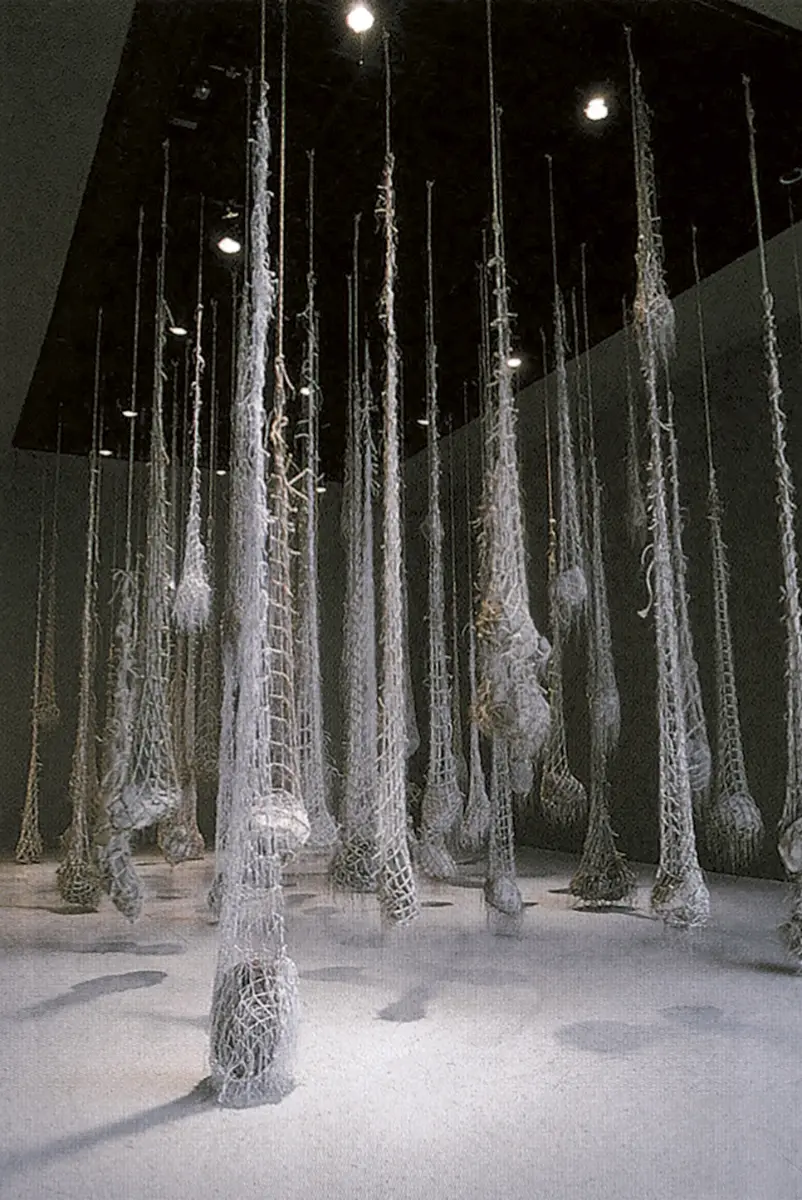
The installation in the exhibition space was composed of two sections ("Nests" and "Labyrinths"), which encompassed different situations in the communication between the sky and the earth, levitation and the road travelled, birth and the development of existence. There was an understanding and handling of spatial dimensions which seemed to go beyond the merely physical connotations to propose a concept of space projected in at least five directions: first, space as a point of return to birth and encounter with childhood, to which the hanging Nests, made of interwoven mesh with nestling rocks, referred; second, the space of open intervention in nature itself, carried out in situ and subsequently reproduced in the Museum space; third, the space of the execution of the work, in a former school of the Andean town, set up as a workshop, with the participation of the local community; fourth, the space of the formal solution, characterized above all by a domination of the scale of the Museum rooms and the creation of a strict, almost minimal composition; and finally, the subjective and perceptive space which the material and their arrangement produced in the spectator, a counterpoint of resonances and semantic modifications which acted as a means of creating mental connections between the work, the myths which it revealed, and the public.
The proposed relationship with the materials was extremely interesting: the stone and rope lost their “material” characteristics and acquired a new kind of substance resulting from their historical and symbolic meanings. In this way, the symbols and the past became formal devices, and the formality of the rock, for example, became a conceptual resource. Here, the associations and possible reconstructions depended on the spectator and inevitably referred back to the myths and legends of the origins of the animal species, the birth of territories, forests, winds, hills, and mountains. Through this plastic use of stone and rope and their symbolic connotations, a work was created which functioned as a means of recuperating the original unity which we have lost, an emblem of the strength of the impregnated Mother Earth. In the final analysis, this signalled the renewal of a pact, an alternative means of recuperating, through the work of art, the sense which can reestablish our contact with the primordial dimension of our being.
The undeniable risk that an intervention on the natural scale might lose its strength and character when transposed to the space of a museum was here overcome with almost rational precision. This is a crucial aspect of the work of this artist, who has always recognized in his art the coexistence of geometry, structural solidity, and constructive symmetry, and symbolic associations of an archetypal or spiritual kind. In fact, the "Nests" functioned like organic penetrables, while the "Labyrinths" became geometric paths destroyed by memory.
This exhibition at the MACCSI undoubtedly evoked a prefigured cartography of memory, an archeology of our fractured existence rewritten in the "words" of the stone.
MARÍA LUZ CÁRDENAS
Venezuelan art critic. Lives in Caracas.