This exhibition by Nicolás Leiva in Coral Gables presented his most recent artistic production. Continuing with the theme of the crosses as an anecdotal element, the artist is developing new narratives that include elements and figures that capriciously come and go in his new pictures. The exhibition began with two works from the series entitled Black and White: Yemayá I (1994) and Obsessive Intersection (1995). In the first, Leiva refers to the Afro-Cuban religious traditions with which he became familiar upon his arrival in Miami. In the second, a cross which completely fills the canvas represents the religiosity and mysticism which characterize the other works in the show.
The houses of Yemayá I are transformed into churches in Obsessive Intersection. The house and its modifications, such as churches, mountain buildings, and basements, are the main theme of Leiva’s work and are inspired by the glazed tiles used in the cemeteries of Catamarca, Argentina, the artist’s native country. Hence, the idea of the tomb as a house, home, family, and history. Leiva’s objective is to "construct history through the house and painting."
The house is accompanied by other elements, such as trees, animals, and man. Anthropomorphic figures, masked beings, embryonic creatures, and skulls are also part of the work’s symbology. The fetus is primordial in this series and is a direct allusion to the pregnancy of his wife Daisy and the birth of their daughter Isadora, as can be seen in Chronicle of an Announced Birth (1995). In the upper part, where there is a kind of cloud with two fetuses and houses around a cross, blue raindrops are falling onto a dark, terrestrial world inhabited by strange beings living in houses and tall buildings.
In Obsessive Intersection, another element appears - the square pattern, which functions both as a source of unification and decodification. Inspired by the rustic walls of the Catamarca cemeteries, the square pattern is clearly defined and becomes a fundamental aspect of composition in such works as When I Remember You (1995) and Codes (1995). Eventually, it loses force and appears tilted, symbolizing the floor, in Half of the Idea (1995) and The Complete Idea (1995). It finally disappears and becomes a starry sky in Chronicle of an Announced Birth.
Leiva’s technique is very particular. He uses thick oils with textures that, in some cases, create a physical sense of three dimensions. In The Complete Idea, for example, the cross is practically dug into the painting. In other pictures, the thickness of the oil camouflages or transforms the symbols, thus becoming a creative element. This aspect is more latent in his recent work, in which the artist uses color, moving from the black and white pictures towards a use of primary colors, with brilliant tonalities. For example, blue represents the sea of Miami, where the artist now lives, and green conjures up the mountains of Argentina. The symbology of color, like that of the other elements in his work, is purely anecdotal.
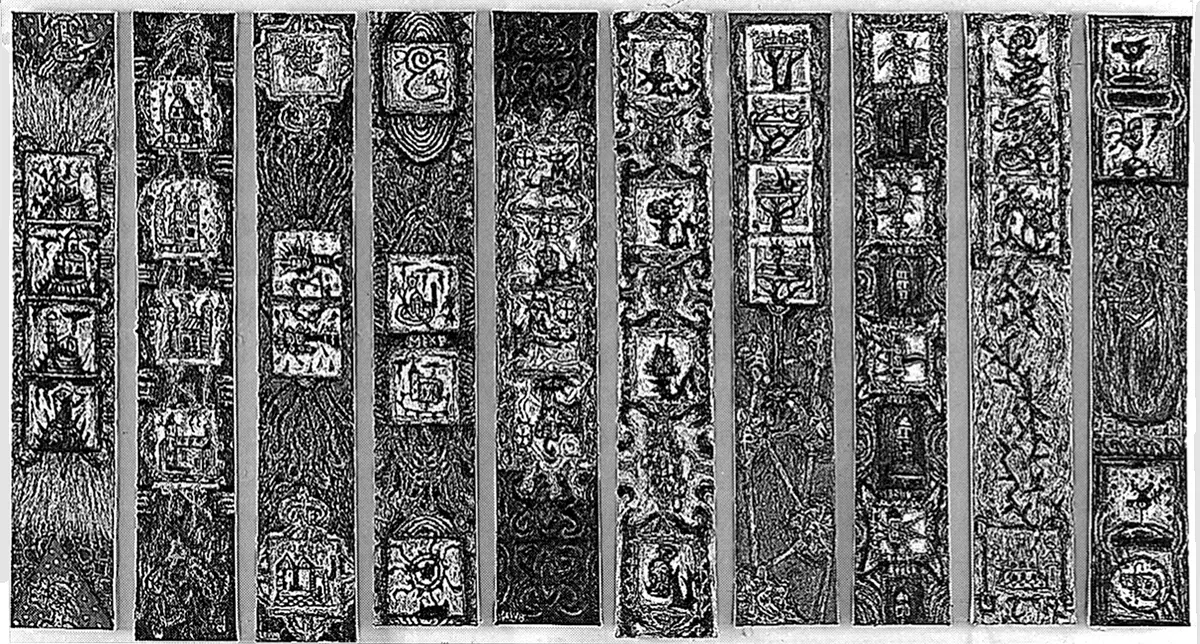
Of the works included in this show, special mention must be made of The Ten Commandments (1995), a multiple work which, in addition to being large in size, was of great interest. It is made up of ten vertical panels, placed in a horizontal line. Each panel has its own narrative, based on various elements which include houses, churches, monsters, and flames. Because of the reduced dimensions of the panels, the symbols are clearer and acquire greater importance. The idea of making the picture into something fragmented becomes physically real in this case, and the fragmentation, as a means of telling stories, appears more clearly.
The novel feature of this show lay in five three-dimensional objects entitled Difficult Times (1995). These are anthropo-zoomorphic heads, done in sculpted wood and decorated with various materials including metal, nails, feathers, and wire. The "heads,” which correspond to the corporeal manifestation of the beings in the artist’s pictures, are rather phallic and carnivalesque. The metal print-making is interesting, since it reworks the symbology of the oils and transforms it into a kind of monochromatic comic strip. Unfortunately, the form in which the "heads" are mounted, on iron tube bases, detracts from their effect and aesthetic quality.
Nicolás Leiva will exhibit his work next June at the Tomás Andrew Gallery in Chile and the David Pérez MacCollum Gallery in Ecuador the following November.
FRANCINE BIRBRAGHER