The Museum of Art and Contemporary Design recently presented its first retrospective exhibition of work by a Costa Rican artist, Roberto Lizano (Alajuela, 1951). Entitled Mid-career Review, the show was the first in a series of exhibitions intended to offer, without any strict chronological ordering, a review of the development of an artistic production. In the case of Lizano, the starting point was a certain stylistic unity which has characterized his works for over a decade of intense activity, and which has resulted in an unmistakable personal style. The exhibition included, in addition to his large format works for which he is well-known, a large number of drawings and notebooks which revealed other facets of his creative activity and provided a broader vision of his work.
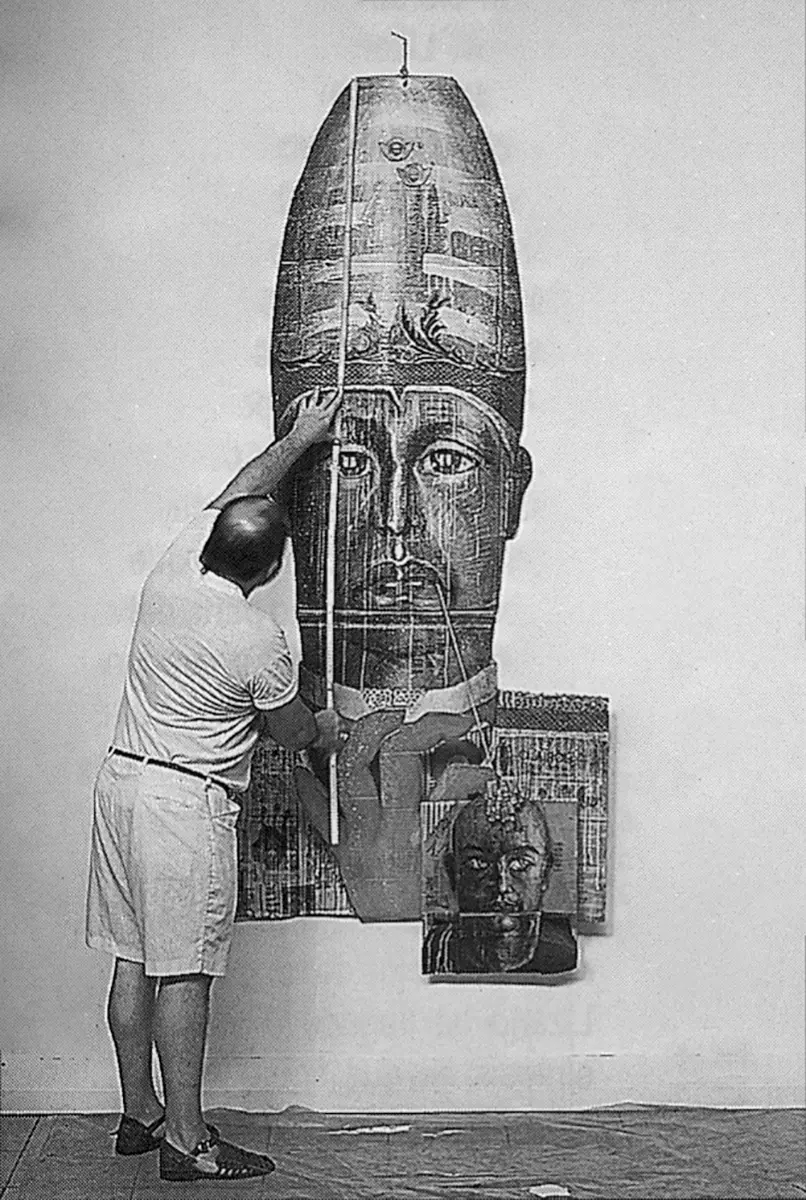
Through his research into the many different possibilities of his materials—color pencils, chalk, brown paper, notebooks, corrugated cardboard, objects from everyday life, and other cast-off materials—Lizano creates an art which transcends definitions. He constructs an "artifact" which combines various pictorial techniques and which destroys the characteristic two dimensions of the medium, with cuts which evoke a sense of depth, transforming the works into sculptures and mobile pieces which transgress space. They are hung, or unfold on the wall or the floor, taking on the appearance of a figure or becoming an installation.
This collage of forms recreates a world in which the human figure is the main subject. But rather than just men and women, Lizano has created his own setting in which well-known and unknown figures are but a projection of the eclecticism that characterizes our contemporary world.
Post-modernity is also a mode of being, a characteristic of post-industrial society which has permeated our countries like a philosophy and set of concepts. Robert Lizano is part of this context, and he unconsciously and intuitively shows the multiple presences which he has absorbed throughout his travels and training. He incorporates them into his very unusual way of looking at the world and, perhaps without intending to do so, reflects on and enriches the cultural cross-breeding which is at the heart of the Costa Rican national identity.
This inclusive attitude also applies to cultures which have influenced Western art, such as those of classical Greece and the Egypt of the Pharaohs, which as a result of Lizano’s academic and sculptural training, began to emerge in his work alongside the landscape of the Atlantic Coast, with small fragments showing geisha girls alongside the nude and handsome Greek bodies of a black person or other typical figure.
A civil engineer by profession, Lizano decided to devote himself to full-time work as an artist at the beginning of the 1980s, when he was living in Limon and followed a course on work with bamboo. It was then that he began to work with brown paper and colored pencils, which were cheap and easy to find. The large format of his works was the result of his desire to expand the limits of his cramped house and to construct a world in which winged horses, harlequins, enigmatic symbols, and naked flesh would change the monochrome color of his walls. Alongside these figures, enormous windows reveal deep perspectives and create the illusion of a heteroclite world as an expression of an individual culture with which the artist identifies himself without prejudice or preconception.
It was not until his trip to New York in 1995 that he began to use in his work the material that was to provide him with his definitive style. His "discovery" by chance of this material illustrates his uninhibited attitude to his art. For Lizano, the sense of play is an intrinsic part of the act of creating a work, and its continuous process is based on the everyday aspects of life.
The anecdote about the Metropolitan Museum in New York is well-known: one day, he arrived with his pieces of cardboard collected from Madison Avenue and began to hang them on the windows. This was the first time he had used cardboard as a support for his drawings and paintings, in a process in which the cardboard became a semantic part of the work. He also did his work on the spot, showing the public how he actually constructed it. This interaction with the public was a continuation of the exhibition process, showing that it was not something definitive, and that the resources used were part of his ordinary life. In this way, Lizano establishes a direct communication that leads to a participatory kind of experience, destroying the myth of the artist’s isolation.
Such an attitude also enabled him to use very different kinds of materials, which are gradually incorporated into the work, which over time ceases to be painting on cardboard; conventional barriers are eliminated as the artist exploits the ductility of the material—it is both hard and flexible—to create sculptural objects which take on the contours of his selected subjects. The same figures are drawn as sculptures through the handling of form, which emphasizes the search for the three dimensions and the shunning of a purely frontal vision, although the latter almost always prevails. One might even say that he has taken cubism towards its true essence: the multiple planes here are not an illusion.
This material has enabled Lizano to create with an absolute sense of freedom, which is communicated to the spectator through a kind of ironic interplay between the undoubtedly academic image and its supports. Lizano begins with an ambivalent attitude, which is reminiscent of certain Renaissance styles or perhaps Picasso during his post-cubist classical period. However, this refinement in the use of iconography vis-à-vis material, which has an iconoclastic and irreverent air to it, is countered and deflated by the cardboard box and its devalued poverty. These boxes have been used for packaging merchandise, and the artist has even incorporated parts of the lettering and wording into his own discourse, which implicitly draws attention to the fragility of contemporary man and the consumer society.
From the eclecticism of his work at the beginning of the 1980s, Roberto Lizano has now achieved a kind of synthesis in his figures. The different references to other countries and cultures appear as attributes and accessories. Thus, a face which seems to be that of every man on the street is given features suggestive of a Pharaoh. The Man with the Red Hand, a well-known figure in the history of European art, appears with pre-Columbian characteristics, or a woman with the face of a Madonna, which also depicts one of Christopher Columbus’s three ships (as in the trilogy La Niña, la Pinta y la Santa María).
His most recent works are based on the same principle in which waste materials, which have their own "history," are contextualized as artistic objects on the basis of their intrinsic suggestions. However, there is a line of continuity in all this, a sense of exploration within the wide-ranging margins of the material and a spontaneous attitude towards creation which is not restricted to the workshop or a fixed work schedule.
Lizano is an artist for whom life and art are on an equal footing, and the way in which this show was conceived emphasized this characteristic. The works were accompanied by provisional labels, placed in a way which suggested that the montage was not finished, the show was not over, or would continue on in time. The catalogue was issued on the official closing day of the exhibition, and it documented the mounting process over the days of the event. The artist installed his studio-house within the Museum, recreating its atmosphere not like a kind of altar at which the visitor could express surprise or veneration, but as a means of breaking with the habitual isolation of the artist. In this way, Lizano’s work becomes participatory—an essential feature of his artistic activity—in a process of spontaneous interaction and communication with the spectator.
There is a certain carnival atmosphere to the artist’s unprejudiced appropriation of different cultural referents and to his use of them to magnify his characters, which are full of humanism and everyday characteristics, changing them into important figures in history. The process is one of festivity in which Lizano uses symbols, architectural references, and styles of well-known figures in art.
The apparent poverty of the supports is offset by details of refinement and collages which include precious metals, such as gold. These contrasts are more evident in the drawings and monotypes of great simplicity, although they are framed in gold and acquire a sense of magnificence which contrasts with the second-hand use to which they have been put by the artist.
Although we might be tempted to speak of a poetics of poverty, in the final analysis, a better description would be the sublimation of human elements. This interest forms the backdrop to Roberto Lizano's artistic endeavor: it is an inclination towards everything which concerns us and the traces we leave in history and the waste around us.
DERMIS PÉREZ LEÓN