The Museum of Modern Art of Bogota and the El Museo Gallery recently presented a large selection of work by the Colombian artist Carlos Rojas, who was born in Facatativa in 1933. The Museum of Modern Art had already organized two major shows of his work: From Cubism to El Dorado in 1984 and a retrospective entitled Carlos Rojas: A Creative Constant in 1990. The current exhibition at the Museum was once again in the form of a retrospective, and included his two most recent periods, Mutants and Because of Painting, whereas the exhibition at the El Museo Gallery contained a selection of work from his most significant periods. The two exhibitions totaled some 270 works, including paintings, drawings, and assemblages from various periods.
It was significant, not to say curious, that two retrospective exhibitions of work by the same artist should have been shown in Colombia within less than five years. But this is to be ascribed more to the precarious kind of research into international and Colombian art carried out by galleries and museums in this country than to the work of the artist in question, work which continues to be topical and important in visual terms and an invitation to the senses. This can be seen at all the stages of Rojas’s artistic development, from his early studies on The Line of the Vegetable World in the 1950s, through his Pasted Papers, reflections on cubism in the 1960s, his Corporeal Structures, a series of women with girdles from the 1960s, Towns, from the 1960s, The Engineering of Vision, from the 1970s, El Dorado from the 1980s, Mater Materia, from the 1980s and 1990s, Because of Painting and Mutants from the 1990s. In the final analysis, Rojas is an artist who has followed his own path through his use of lines, geometry, space, perception, matter —both liquid and non-liquid— and textures, concentrating in his most recent work on concrete surfaces.
The tasks of the curator and the critic are two inseparable activities, and in this case, the repeated return to the past work of the artist in an attempt to fill a void or for commercial reasons meant that a valuable opportunity was lost for engaging in a discussion on the exhaustible value and potential of painting. The recent series Because of Painting and Mutants were given little prominence, although in fact they merited considerable attention, with their concrete and bewitching surfaces —although we know from Wilde down to Hockney that surface is mere illusion— but such a profound illusion that it becomes a source of reflection and an exercise in synthesis.
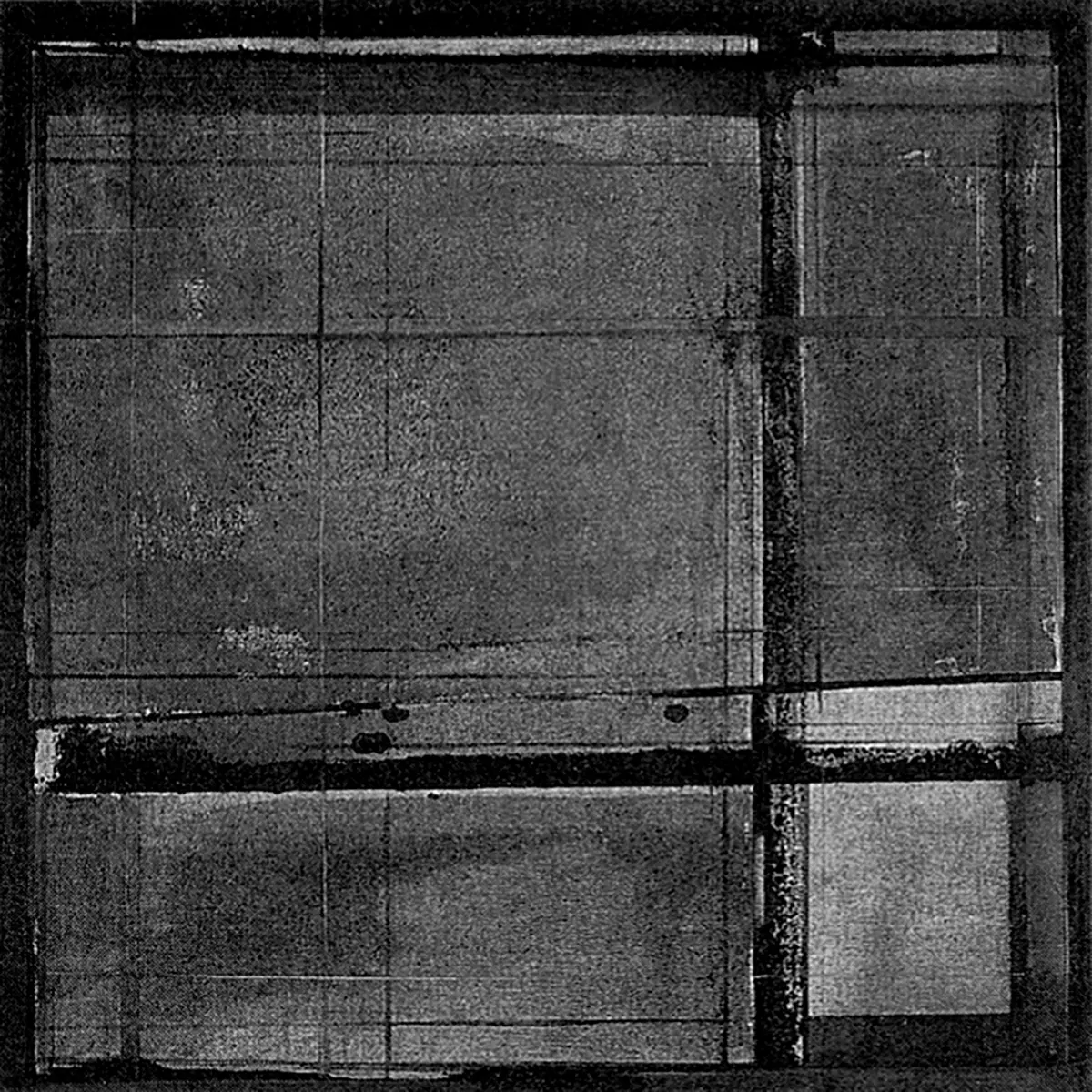
Because Painting is an attempt to rehabilitate the various imprimaturs of painting and urban surfaces, such as placards and walls, without adding more narrative content to the canvas, and is restricted to the initial marks which delineate and consolidate the presence of the surface.
In the case of Mutants, the works are two-dimensional constructions with pieces of wood, windows, pedestals, and tiles, which the artist has taken from reality but from which the accessory elements have been removed up to a point. There remain other references of a local kind, evoking deterioration, the organic nature of the context, elements which have been transformed into concrete objects, i.e., which can be perceived by the senses, impossible to avoid, enchanting. Lorica, San Victorino, or any of the other names of towns and places on the coast or in the provinces thus evoke the visual presence of the collective unconscious.
Clifford Geertz has suggested that "art materializes a mode of experience and emphasizes a given attitude to a world of objects so that man can explore it." Through his research into the various aspects of perception, Carlos Rojas has managed to allow his works to act on our senses. In this case, the wood, earth, and glass, in an almost imperceptible process of change, and with the benefit of a solid sense of geometry, move from the everyday level to the universe of perception. This exploitation of an aspect of sensibility is also an investigation into the formation of a collective awareness, and in this way, the work of Carlos Rojas is also part of our stock of cultural images.
NATALIA GUTIÉRREZ