Clay as a common, multiple and different kind of support, a vehicle of expression and investigation, a notable feature of current art in the Americas —these are the proposals of the critic Roberto Guevara in this Biennial which highlighted artistic creation in communion with nature, “the sensual and primordial contact with the earth,” a reflection on the destiny of man and the religious ideas expressed by many of the works of our artists.
Earth as a synonym par excellence of creation and the home, a journey from one of the continents to the other, through poetics that pay tribute to the activity of man and the possibility of a genuinely American art. Roberto Guevara regularly visits artists' studios and engages in wide-ranging conversations with creators. Curiosity and the pleasure of discovery were two of the distinctive characteristics of this Biennial, where the work of Celeida Tostes was a masterpiece, a symbol of solidarity and fertility.
(We might recall that curiosity was one of the features highlighted by Jean Hubert Martin in the celebrated exhibition entitled Magiciens de la Terre at the Pompidou Center in 1989). This Biennial at the Museum of Contemporary Art of Caracas proposed a stupendous selection of cultured artists working with clay or, in some instances, experimentation based on clay. Some works were permanent, others ephemeral; the scales varied, and in some instances, there was a clear celebration of nature. Some artists, such as Celeida Tostes, Germán Botero, Stephen Cruise, Carol Young, or the Venezuelan participants Milton Becerra, Héctor Fuenmayor, and Ana María Mazzei, had already participated in the first edition—which offered an opportunity to appreciate the continuity of their work and the development of their proposals.
The exhibition as a whole reflected evidence of the theme of a lost Arcadia, whether that of pre-Columbian culture or communion with nature. This was seen from the standpoint of the city and contemporary culture, in the excavations and interventions of Helen Escobedo; in the cold laboratory of Cristina Carbonel; in the ritual offerings of Quilici-Morawetz, or in the very delicate mural drawing of Carmela Gross. An Arcadia without any gods, animals, or fables; just clay and the vestiges of constructions. Earth, which preserved the memory of man (Carlos Uribe, Soledad Salamé), the frenzy of man's myths (Fuenmayor, Botero), or the fantasies of his most recurrent illusions.
If clay is, first and foremost, earth, and in symbolic terms a devotion to ideas and action, we might begin with the pyramid of Alberto Uribe, a promontory which conquers time and engages in a dialogue with divinity. A pyramid in black earth, of medium height, and set against one of the museum's walls.
Sigfredo Chacón wrote in block letters, which made them easier to read, but on earth, which could be blown away by the wind, the timeless words about “Dust to dust…” Irony and certainty thus fused in a work of impeccable execution.
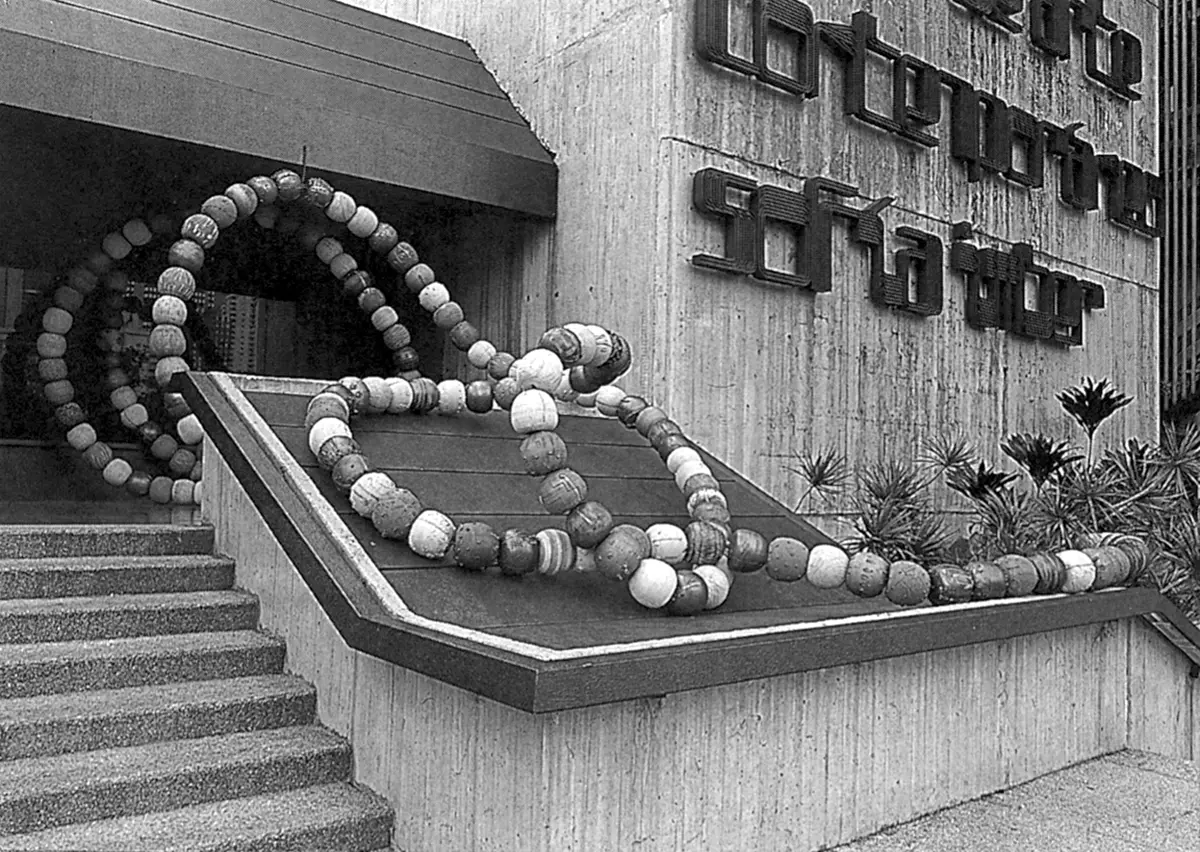
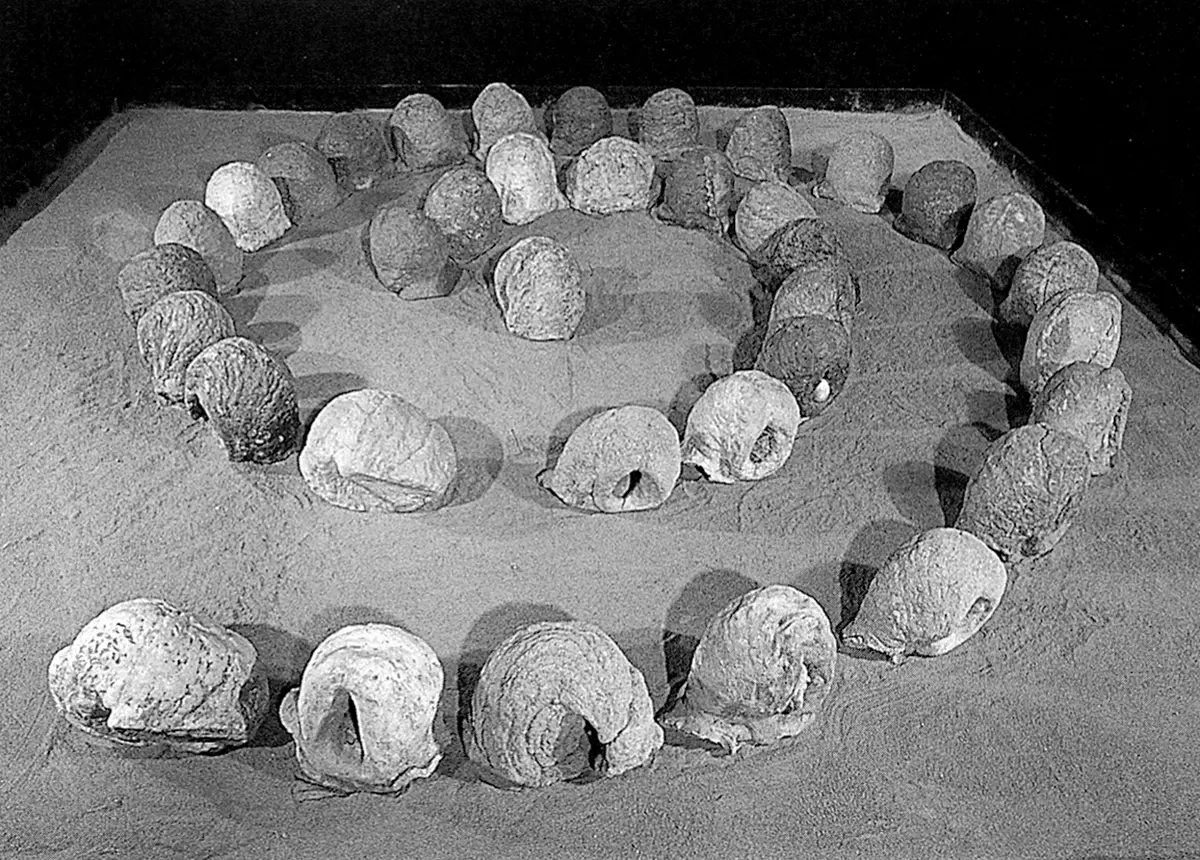
Using earth and baked clay, Celida Tostes recreated the vestiges of man's passage—which sometimes seemed to be man's very bones—in a moving work which went beyond the archeological or paleontological dimensions to become a fine example of contemporary archaims. But the artist's evocative capacity also achieved other effects, through an investigation of the nests of certain birds in the Amazon, made of clay, and which can undoubtedly be seen as the repositories of faith.
Clay is also water and earth, and both these elements were used by Ana María Mazzei, who created a little clay box the inside of which showed the force of the rivers of Guyana in a video, the running of the waters from the historical site, which hides —and guards— the Spanish presence. Milton Becerra presented three barrels with water, with stones at the bottom, and a bulb reflecting light on the water surface; here, the water became arrested volume, reflecting on itself, transparent and profound. For his part, René Derouin combined different disciplines to offer an exaltation of the process of life ending in the sea: thousands of little human figures represented multitudes which the artist ritually hurled into the sea. The entire process was recorded on a video in which Derouin also reflects on existence and art.
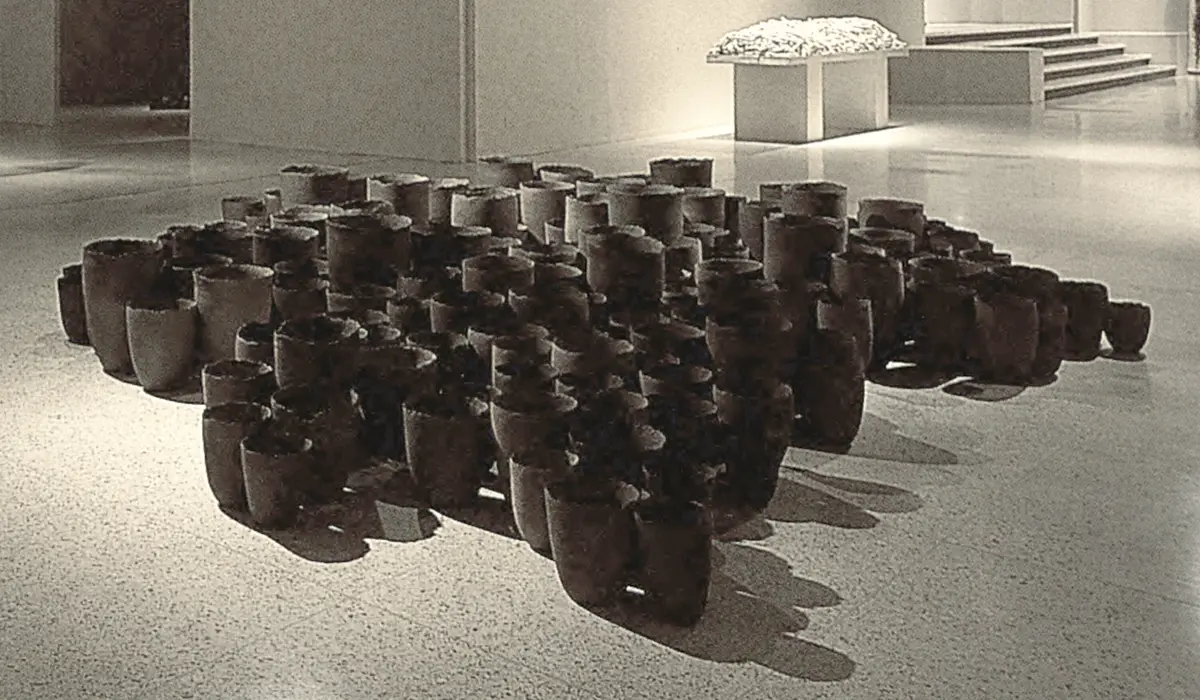
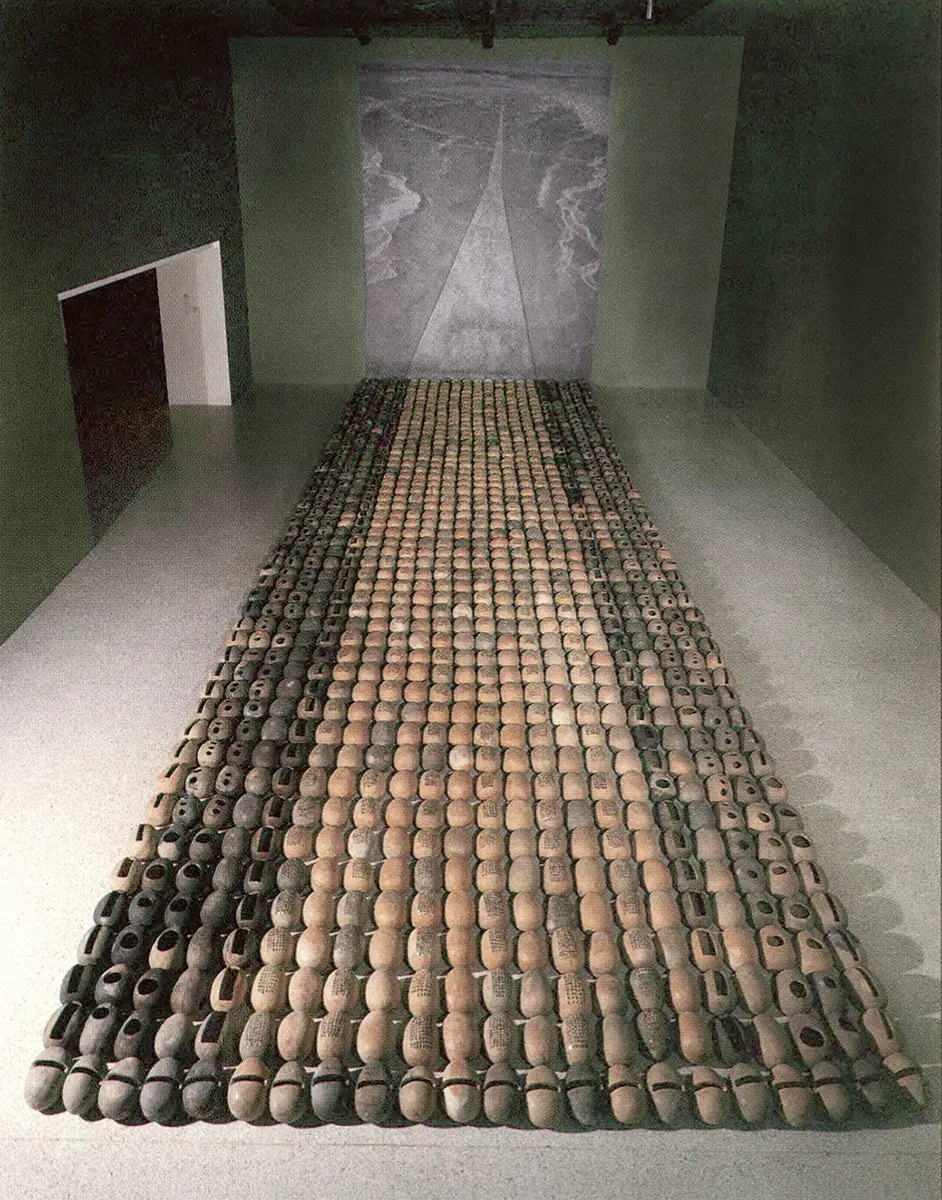
Water may be real or a video, a still mass or violent matter; it may also be a place of confluence where life both begins and ends. Water as a source of life and as a means of purification, in contrast to drought and the end of existence. Water as a path over the land, seen from a distance, where a remote culture lies hidden, as suggested in background mural photo and foreground pots in the installation by Miguel Angel Rios; or water from which the artist springs, as in the case of Nan, whose video shows water moving forward and advancing.
Petrified earth with astral elements within whose sphere and void the spectator enters, to find not so much enormous stones floating in space but the impression of fragments of the human body: such was the work of Marc Chicoine.
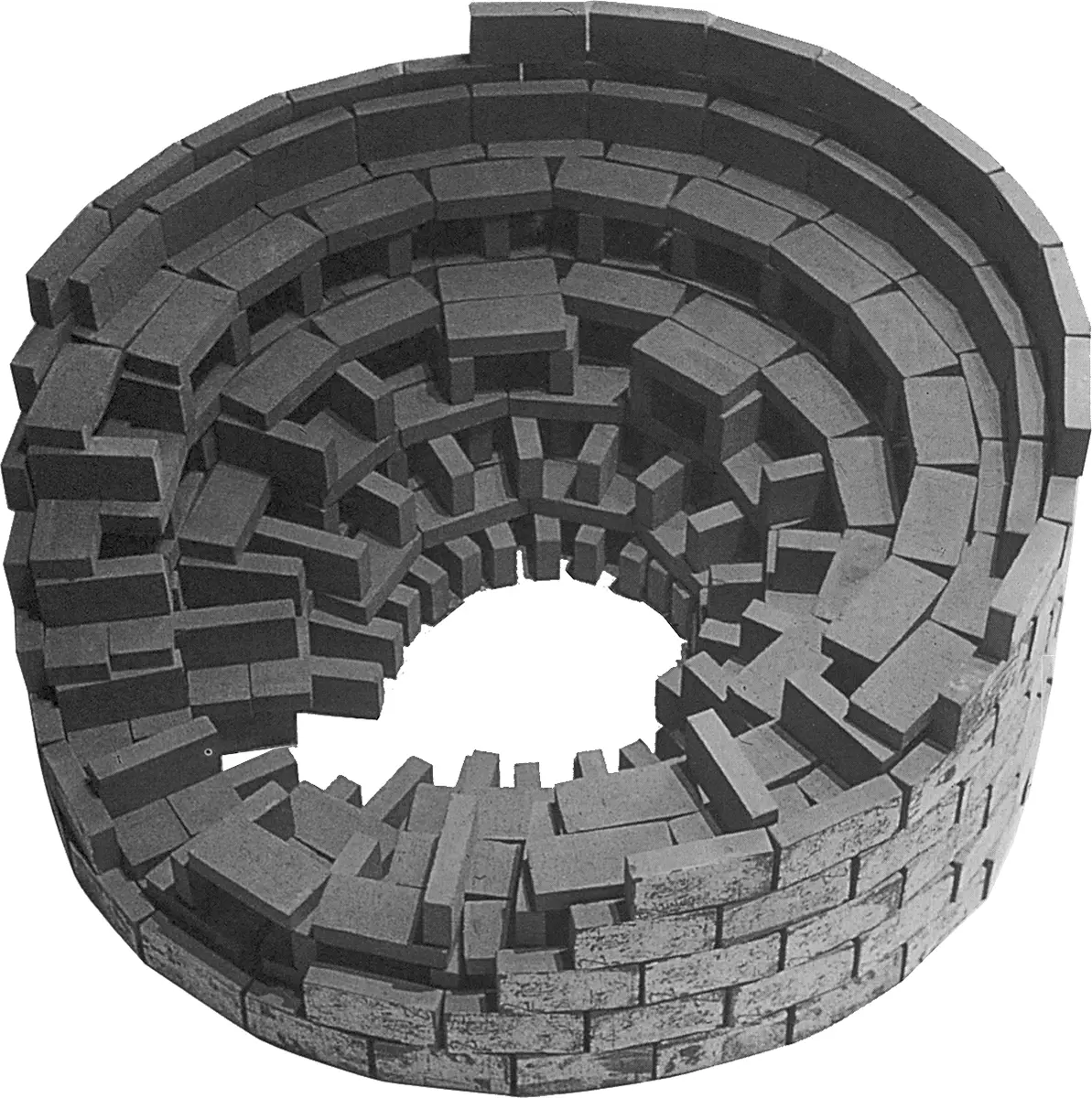
Clay as stone, either tracing a line of mercury which symbolizes the course of a polluted river, as in the simple and moving work by Hugo Zapata, or in the building bricks, placed on the floor with a certain sense of symmetry and evoking the ancient and sacred civilizations of the Americas and the Mediterranean, in the ephemeral installation of Pedro Fermín.
Pedro Fermín lined up bricks over a large space, taken from some demolition site. They were all the same size, some stained with cement and, underneath, a yellow mark symbolizing eternal fire. The vision evoked rows of columns, remote cultures, and a place of worship. The work was presented with a minimum of resources and was an example of intense emotion at both the philosophical and aesthetic levels.
It was this religious spirit which seemed to guide a number of the works at this second edition of the Biennial, including the enormous clay wall by Héctor Fuenmayor, which was altar, Jerusalem and a cross; the large offering dishes by Germán Botero; the circle of earth and figures of Quilici-Morawetz and the colums of Marta Palau, all of which evoked the purest ideas of man.
The work by Héctor Fuenmayor was placed in an outside patio adjacent to the Museum and consisted of a high wall evoking a cross. The artist included an inscription to clarify its content, which was in fact not necessary. The sacred character of the work was so intense that it required no comment.
If clay is a metaphor of nature, the latter may be a tree as such, razed to the ground and yet purified by the clay, floating in the cosmos, as in the work by Reinhard Reitzenstein; or the artist himself, covered from hed to toe with fresh mud, walking through time, as in the video by Nan.
Works which were closer to the traditional rules of the plastic arts, the duality between painting and the objects and installations, included those by Patricia van Dalen, Jorge Stever, Cristina Carbonel, and James von Minor.
Stever took us towards the everyday human space, such as the dining room, but where time has been halted by the grey volcanic ash which covers and petrifies all objects. The table is both a showcase and a place for invocation.
Several Venezuelan artists participate in this Biennial, although this year many of the works proved unfortunate or simply failed. Preference was given to young artists who were not prepared for an event of this kind: for example, Nascimiento copied the objects in a showcase with neon from Jeff Koons (1981), whereas Bernárdez offered a copy in poor taste of Giuseppe Penone's Soffio 6 (1978). Rafael Barrios, a skilled sculptor whose volumes of painted metal seem to be suspended in space and in ascending situations in a way which emphasizes the sense of time, seemed to lose strength and coherence when he moved to a new support in the form of clay.
But this edition of the Biennial was also a challenge for a number of painters who, although not used to working in other dimensions, with other materials and themes were motivated by Roberto Guevara's invitation and managed to create works which fully expressed their own proposals and which might lead them to new posibilities of expression. This was the case with Patricia van Dalen and Mercedes Elena Gonzalez.
Perhaps the work closest to painting was that of Mercedes Elena González, nocturnal landscapes in which pigments, water, and clay created the thickness, sense of threshold, and reflection of some dense setting. The work consisted of several columns of paper depicting the landscape and, on the floor, a similar number of platters, where the clay appeared damp or cracked.
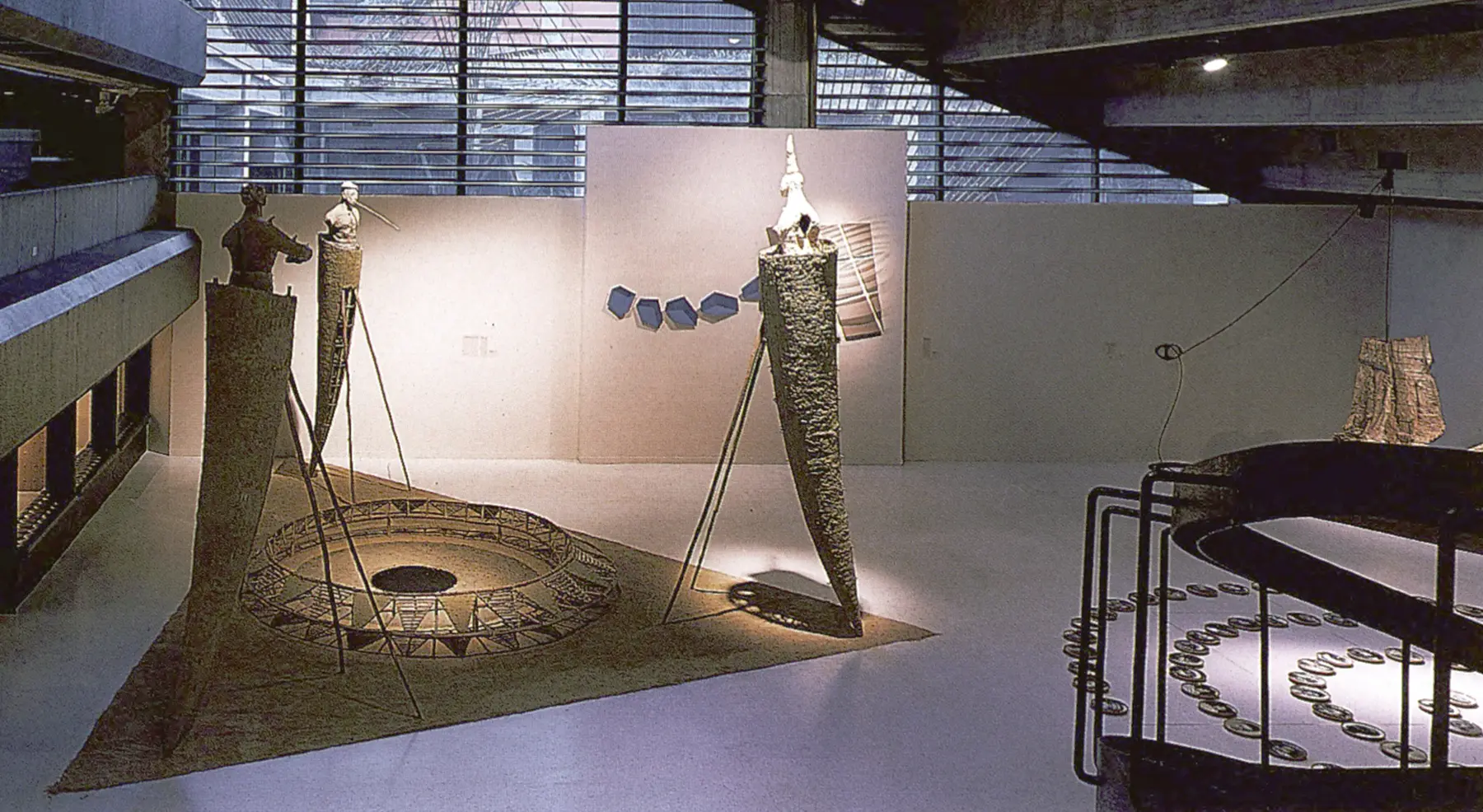
Clay is also synonymous with ceramic work, from the exquisite pots by Carol Young to the serial work by Miguel Angel Rios. For Patricia van Dalen, it is the medium through which her collages acquire the forms of gardens or the sky, whereas for Ligia Reinach, it becomes a large astral ring which comes and goes, enters and leaves, creating a cascade of fantasies. Stephen Cruise uses the mold to repeat the figure of a bird and the shape of a heart. Cristina Carbonel brings time to a standstill in her laboratory, done to scale, in which birds are items to be classified in a final step towards preserving the species. Francisco Brennand covered a house, including its outside patios, with ceramic work and tiles in a kind of vegetable and celestial ornamentation of an anthromorphous kind. Nadín Ospina made fun of the falsification and fetishism of ancient works, while Helen Escobedo used adobe and remnants of pre-Columbian ceramics to take us towards an excavation site, where, in the half light, man, the signs of culture, and the concepts of beauty and faith come together.
JUAN CARLOS PALENZUELA
Venezuelan art critic. Lives in Caracas.