Despite the artistic value and cultural importance of Francisco Toledo’s work, we have few occasions to actually see that work. Thus, it was fortunate that the Arvil Gallery in Mexico City decided to close its current fifteenth anniversary celebrations with this exhibition, which offered a synthesis of the artist’s work over the last 25 years.
Toledo is a figure apart, alone, wrote Luis Cardoza y Aragon. In fact, no one has assumed in such a radical manner the multiple and diverse possibilities of artistic creation in Mexico in the second half of this century like Toledo. The form in which this artist from Oaxaca structures these different possibilities, coupled with his conception of the world, has placed him in a position in which classifications and labels are all rendered invalid by what the ancient Greeks called poiesis (creation).
Under the wise guidance of Toledo, tortoise caparisons, ostrich eggs, wooden folding screens, amate paper, as well as ceramics, sculpture, illustration, print-making, and painting all cease to be about objects in a world of objects and become beings full of life, artistic works.
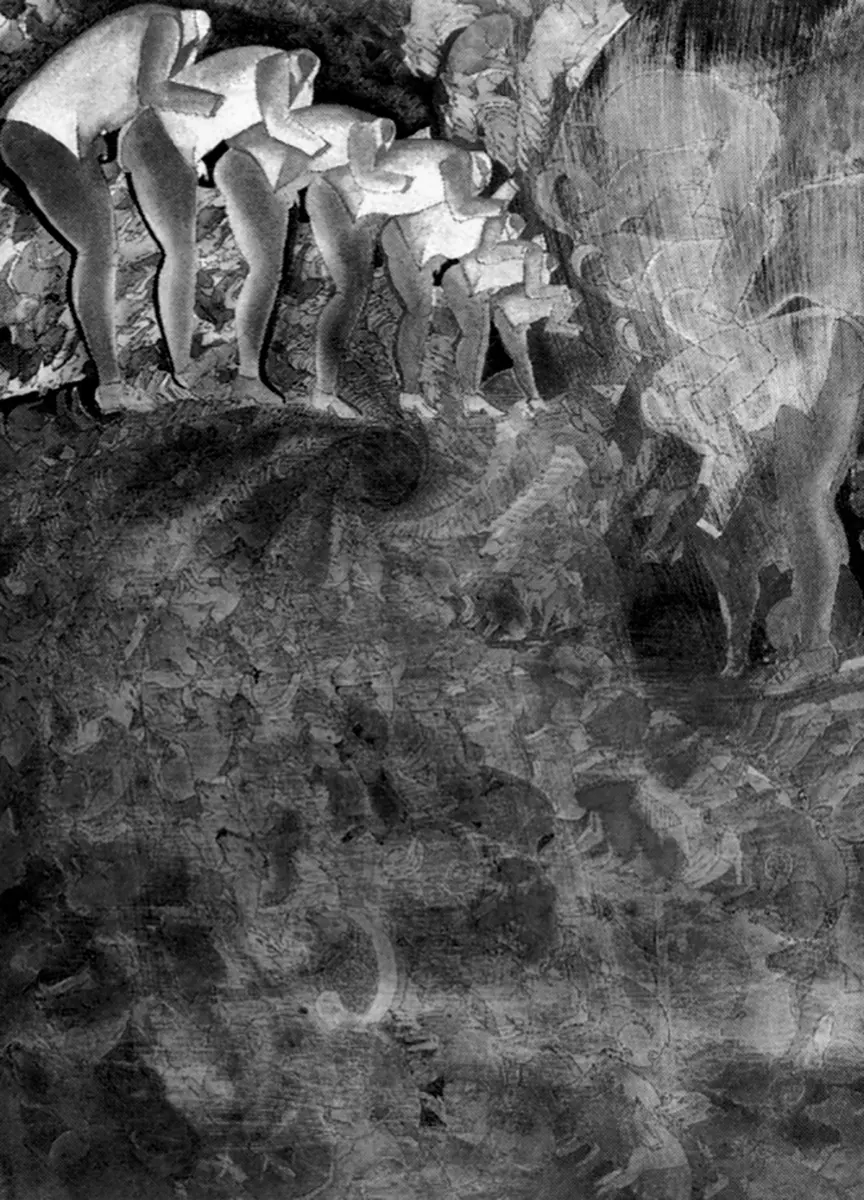
But Toledo does not confine himself to transforming objects. Through his eyes, this world and its beings enlarge and deepen visual possibilities. Thus, a woman becomes an iguana, or a bull; a man is transformed into a fish, his head into a penis; a rabbit might sit down to tell the story of its life and a deer might put on shoes, while a goat becomes a kind of acacia. A cannon turns into an organ of life, while Benito Juarez, the hero of the Americas, swims in the wake of a dead man’s mat.
This is possible, not because Toledo’s world lies in some atemporal mythical time, but because the order of the world and our subjective experience are governed by utility, fear, and the principle of identity. The improbable universe of the artist highlights the tension that exists between the real and the possible, between what is and what might be, and it is precisely here that we can discover its true cultural significance.
Works such as The Red Table, The Visit and objects like The Pot of the Prawns’ Mother and Nábigu are a challenge to our rationality based on lack of satisfaction and egoism, as well as on the instrumental nature of things and beings, rather than the final place, aesthetic indifference, the possibility of establishing various kinds of relationships with nature and with our own nature.
Thus, Toledo’s work expresses fundamental aspects of resistance and protest against technical-economic culture and its instrumental rationality. Through his eyes, the world ceases to be rigid, rough, and monotonous. In the same way, the reason that governs the relationship between man and nature, as well as that between man and the objects of civilization that have, in our modern and late modern culture, been defined in master-slave terms, appears more supple and becomes a means of constructing more satisfactory possibilities for life. In Toledo, reason becomes erotic.
The transformation of human bodies into animals and animals into human beings is not only an expression, as in the German expressionists, of the critical and utopic dimension of the body, but as Walter Benjamin wrote, "the collective is corporeal, the transformation of the world also involves in a fundamental way the transformation of our relationship with our natural dimension." In Toledo, the body loses its character as a “vehicle” to produce pleasure and becomes a place for the full processes of life.
But this is not a matter of looking at nature as an idyllic paradise from the mythical Golden Age in which ugliness, pain, and death are absent, but of establishing new standards which will give the world a new meaning and sense of direction.
Thus, over and above any classifications and labels, Toledo’s work refers back to that of artists who, in their act of creation, have questioned the meaning of a society governed by the absence of any future. His presence on the current national and international artistic scene, which is predominantly confused in its objectives and empty in its content, demystifies the celebration of the so-called “death of art” in its full sense of ideological alibi and reminds us, as Stendhal said, that art can still be a promise of happiness.
BLANCA GUTIÉRREZ GALINDO