There is no doubt that the most unpopular thing among young Mexican artists is the pre-Hispanic heritage of our culture. The theatrical presumption of the modern towards the spectacular richness of this past, the official attempts to convince everyone about a racial equality in question, and the Mexican curios characteristic of cheap tourism have gradually eroded any possible critical articulation of certain ancestral values in the discourse of contemporary culture.
Gerardo Suter —born in Buenos Aires in 1957 and resident in Mexico since 1970— would seem to be engaged on a pilgrimage towards the despoiled pre-Hispanic ruins.1 His early works from 1985, gathered together in From the Archeological Atlas of Professor Retus, captured architectural details —Mayan facades and Toltecan walls— which when framed or faded, were reduced to vestiges of some slow fugacity, fragments of a body silenced like landscape, where it is still possible to feel a sense of loss.
In those prosperous years of the 1980s, new Mexican art was making its triumphant entry into SoHo and Sotheby's with pretty nationalist proposals subsequently denigrated as neo- Mexicanism; a mixture of magical trans vanguardism and urban kitsch with alternating Virgin of Guadalupe and prickly pears, tequila labels and iguanas, three colored flags and bleeding hearts, Mexican horsemen and the Popocatepetl volcano. In such an exultant festive context, the faded photographs of Suter did not seem to fit because of their lack of a present. Their link with the 1980s seemed to be reduced to an apocryphal citation, the fortuitous legacy of these plates formerly belonging to a so-called Professor Retus (Suter), structured as a "testimonial" vision, a simulacrum of post-modern authorship. However, the images were above all characterized by fantasy. Rather than telling us about the unknown photographer, professor Retus, the works spoke of the lasting nature of the eye and the ontological primacy of photography in the emergence —and recording— of the real world. The critics insisted on including him within an impossible tradition from the traveling photographers of the nineteenth century to the classic avant-garde photographers fascinated with Mexico. But Suter's only link with the traveling photographers of the nineteenth century, those "recording technicians, " would be in terms of texture, the strict control of the plate, rather than the anguished presence of time in those photographs. Neither can Suter's ruins be seen in terms of the stylization of modern visuality, from Edward Waston to Laura Gilpin, with Mexico as the subject, half aesthetic fable and half anthropology. These modern photographers directed their inquiries into pre-Hispanic architecture towards a poetics of the primitive (the intervention/anthropological intervention of fetishes or creeds), an towards confirming or giving legitimacy to an emergent "styling," and subsequently, a validation of textures and the articulation of surfaces, the aesthetic intention of which would soon be endorsed by the prestige of abstraction. The emphasis would always be on web and woof, the telluric potential of the object and the oniric setting of the contours. In Suter's case, the themes of pre-Hispanic architecture are very different and are oriented towards the relevance of presence and its expository force as a photographic object. This expository value and its impact as an ahistorical image —achieved through experimentation with the support— were stronger than the cultural register to which they possibly referred.
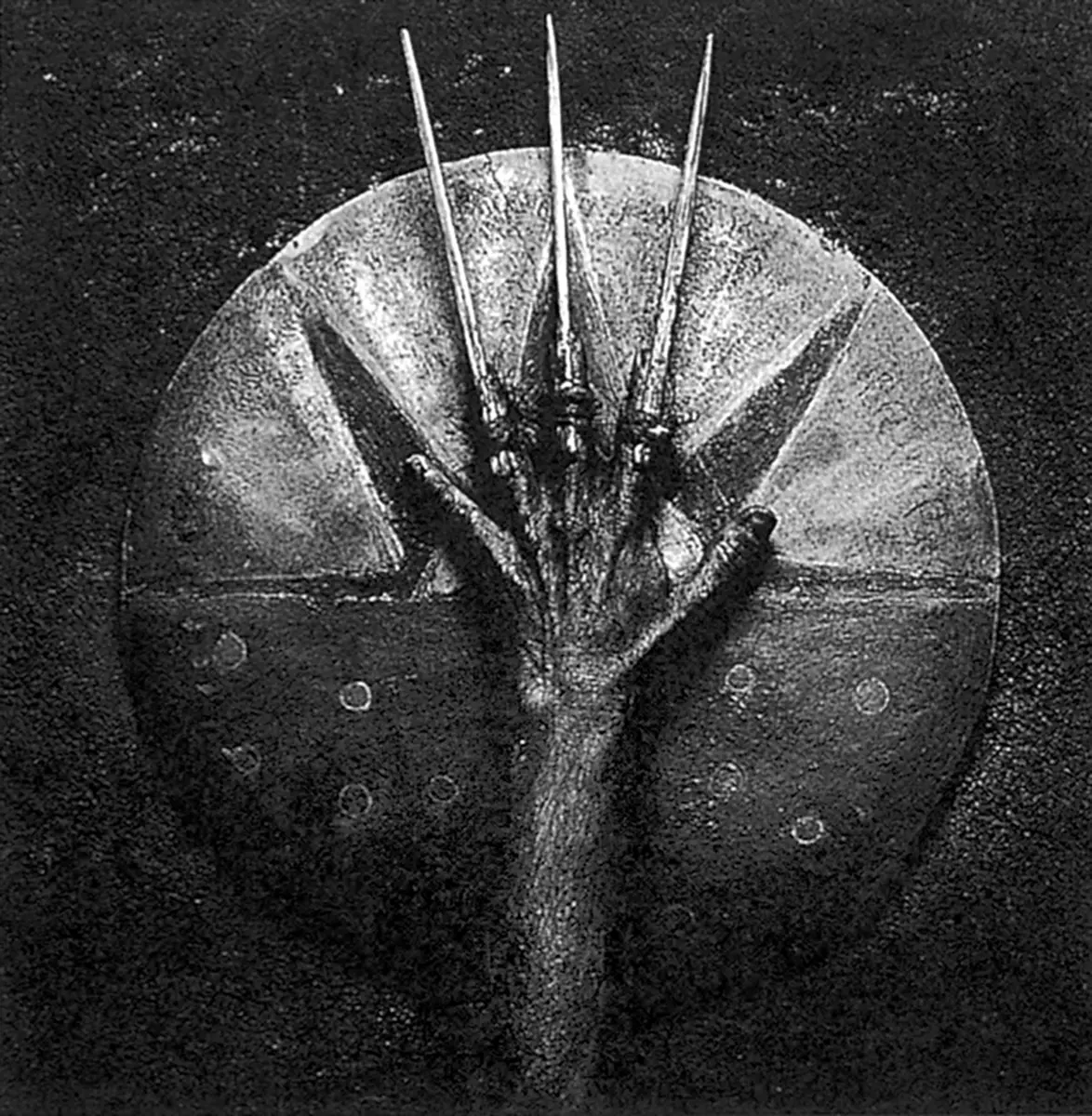
Towards 1988, Gerardo Suter's work, already exploring the phantasmal pre-Hispanic heritage, became centered on two aspects which still predominate in his art: the body, as an emblem resulting from acculturation; and ritual, as a vindication or exaltation of a silent value. Already in an exhibition from 1989 entitled The Labyrinth of Dreams, and then in Códices (1991), Suter's images seemed to raid a key dilemma in Mexican society: the private and public politics of the body, with all the classic and racial paraphernalia of self-repression and self-valuation of an indigenous and/or mestizo body devastated and ravaged by the still living and effective remnants of the colonial system. Of course, in these photographs, Suter also vindicated his own fantasies about the body, and he does so in terms of an analogical reconstruction from truncated and masked sources of identity: a contemporary body, invested as a guardian, is prepared for an imminent ritual of sacrifice.
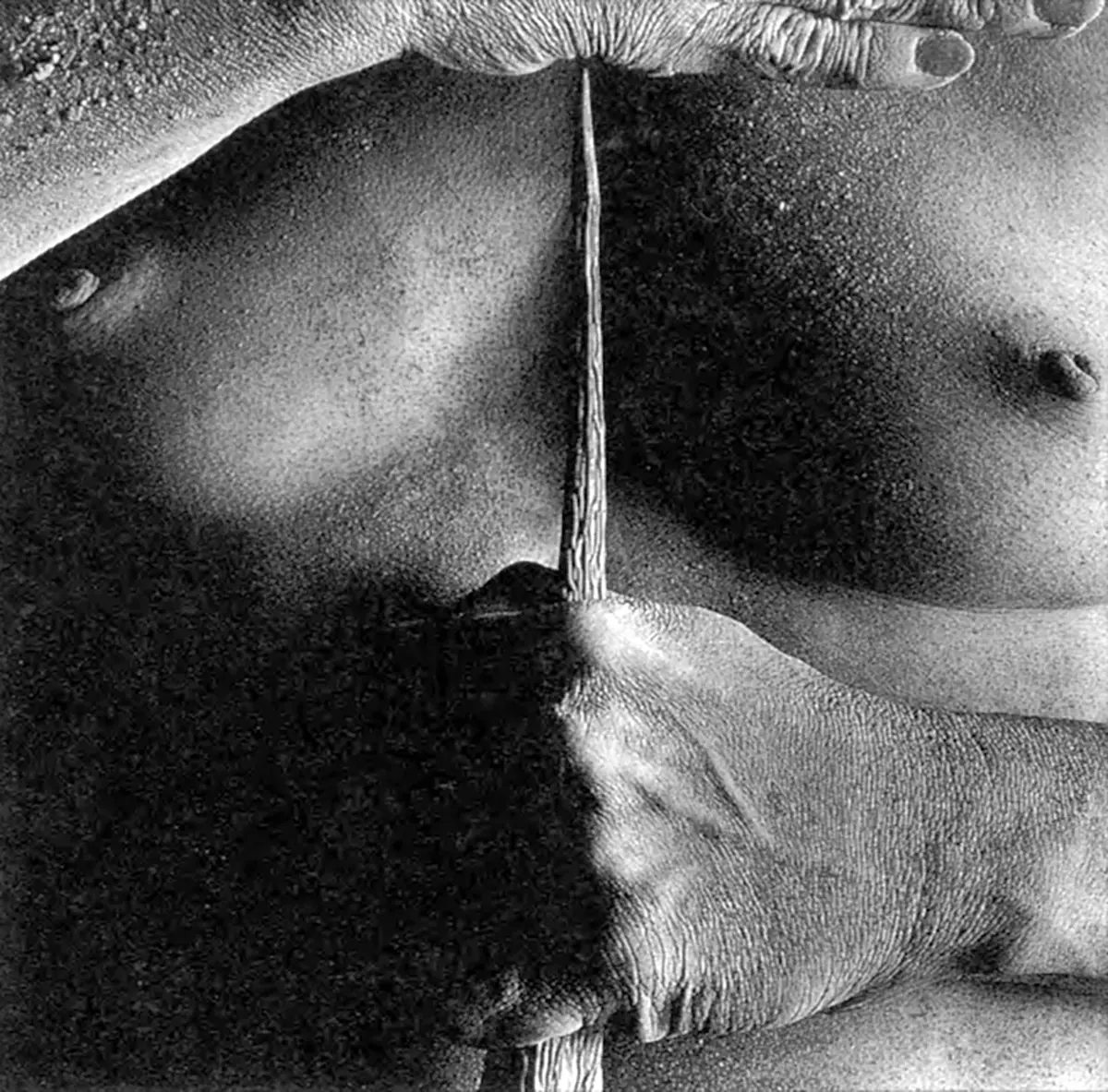
If in the early series there was an intention to subvert the image by acting on the support, on the actual process of development, and on the negative, now the artist turned towards the intervention of the photographed object. The photograph is merely a documentation process. The mise en scène impresses by the ghostly rigor of the pose, where the reiteration of being tied and armed expresses a power struggle. Power exercised on and from which body of culture? It is clear that such ritualistic constructs, with their ethnographic or anthropological after-taste, were seen as common and legitimate representational practices in discourses on the body, transvestism, gender, and inheritance in the art of the 1980s. Even though Suter's work made complex use of these repertories of a pre-Hispanic kind, it can be seen, in a process of involuntary association, as approximating the symbolism—devalued by the citation and manipulation of archaic legacies—of a certain sado-masochistic kind. To what extent are these images faithful to the personal erotic fantasies of the artist? What are they? Anthropological remnants? Patriarchal effigies? Sexual fantasies? Philosophical allegories? At all events, their force cannot be reduced to merely operating on the erotic instincts of the spectator. At least in the Mexican cultural context, these photographs have avoided both the "erotic" cliché as well as the "national" stereotype, by revealing the telluric power of a museified cultural reference where the pacification of the past is the contractual emblem of an imposed silence. In other words, evidence of some kind of social castration. Suter's irony, within the everyday Mexican visual context, lay in the restoration of a utopia of original —pre-Hispanic— identity as a manifest negation of those national values lumped together in the official "contract" as "mestizo" by decree, but with the classic tensions of a strong racial bias. Suter's photographs seem to offer a new paradigm of the body—in seductive analogies of pre-Hispanic guardian forces— in a society which knows nothing of the body of its crossbred nature.
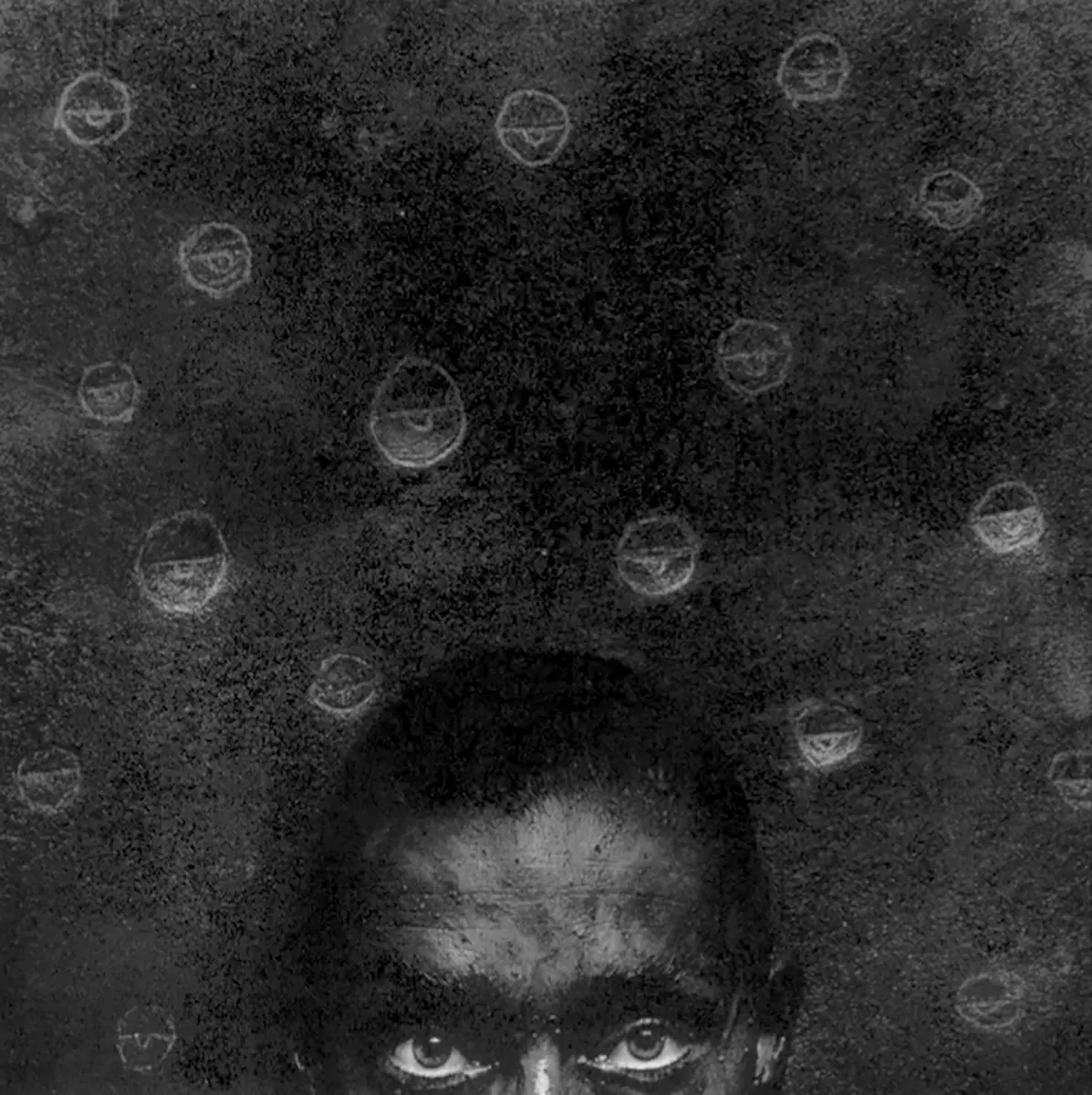
From this point on, Suter began to address the rarification of the signs of "patrimony," in an attempt to deal critically with the cliche of (a)historical identity. The works offered a discourse on this archeological legacy, stigmatized by state nationalism as belonging to the past, a "pre-Hispanic past" which creole modernity managed to relegate to poorly documented glass cases.
With this exhibition, entitled Códices (Arte Contemporaneo Gallery, October, 1991), Suter emerged as a key figure on the Mexican art scene, and for the first time, this occurred in an environment on which the weight of the photographic tradition had delayed the recognition of artists who use photography in their work.2
Works such as Tlapoyahua, Xiumolpilli, and Coatlicue have become classic examples of a new, symbolic visuality in which the agonizing body of a failed contemporaneity intersects with the tutelary forces of a constituent culture. What is surprising in these photographs is not only the rigor of the constructed images, in dramatic terms, but the caustic hue, vibrant with delicate textures and a range of grays, evoking the luxury and morbidity of these aprocryphal rites. The use of masks in these photographs is not directly related to the transvestite display of the bodily image which was so much in mode at the end of the 1980s and early 1990s in photography. Here, the mask emphasizes an obsession with transit, an anguish at the perpetual fugacity of presence. In Suter's work, there is an arbitrary parody of Xipe Totec3 which permits speculation on the poetics of his entire art, although it also evokes a sketchy picture of a utopia of carnality. There is continuous reference to a body which is alien and at the same time self-referential, deified through a skin-husk, flesh-mud, a telluric shroud. The photographer disguises and hides himself behind an image that had been flayed and presented as a virtual attribute.
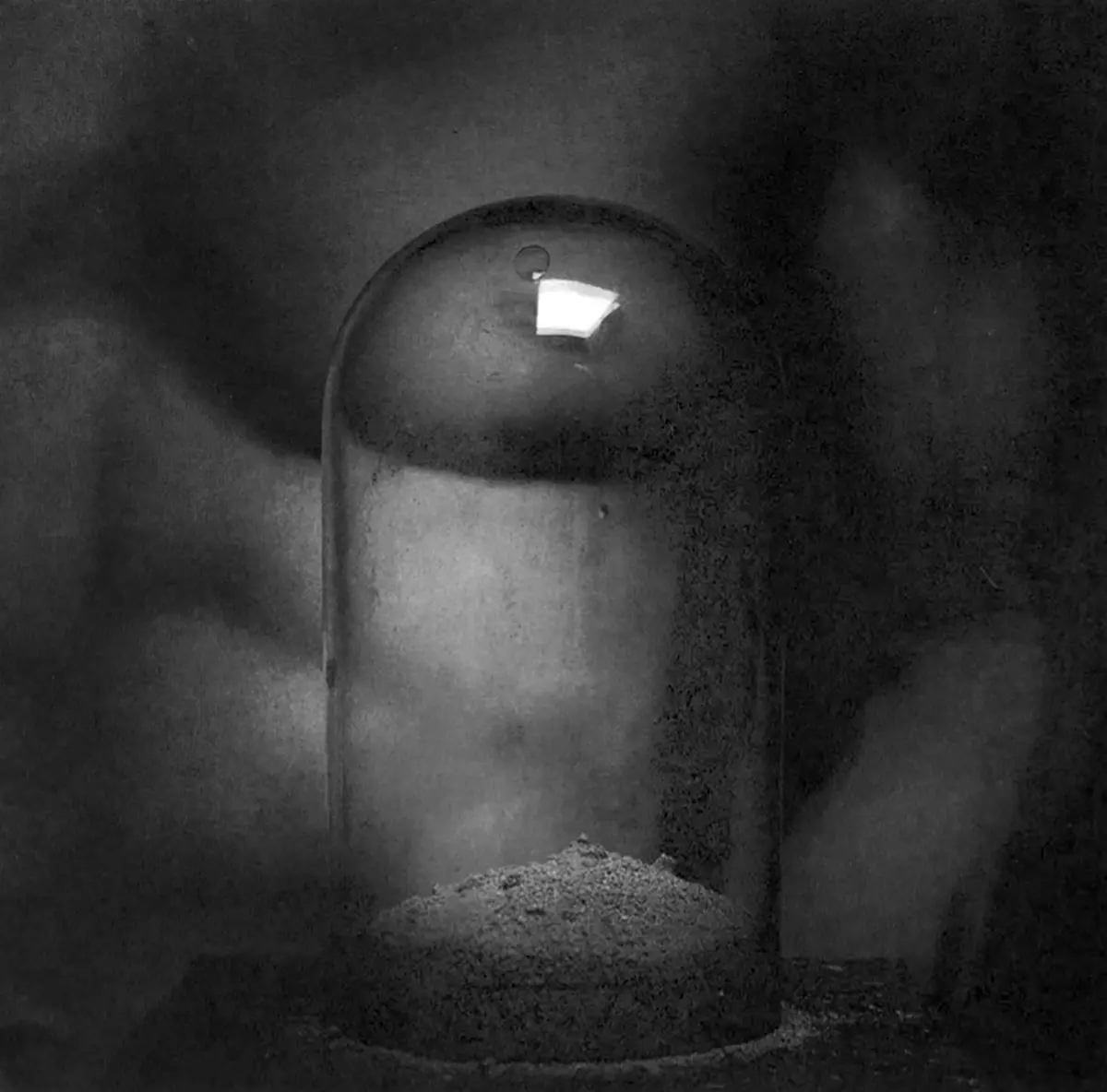
The tensions between the photographic medium and constructed reality lead Suter to question the ontological primacy of construction itself over the results of his manipulation with the lens. The show entitled Ritual Songs at the OMR Gallery in May 1994 allowed the artist to conceive some of his photographed objects as sculptures and installations. Suter also added photographed versions of the objects, along with other photographs of astonishing and virtuoso technique. The exhibition was an opportunity to break with the planimetry of the wall and to place the installation-sculptures in the space through which people passed. However, in general, the overall impression was of very large formats, with controlled colors and certain effects of lighting. In each case, there was an empathy between the texture of the flesh and the mud. Body and landscape fused and reverted to the process which had characterized his early works, in which the landscape suggested bodily powers: from this exhibition on, the body was to become landscape. The textures and the brutal hedonism of the flesh, in the foreground, would become a path, a road trodden over. A body which exhibits its secretions as stigmas of transit; a body full of mud, petrified, lubricated, integrated, immortalized, dissolved... The body becomes masked-demoralized? behind its secretions. The tactility of the flesh becomes prohibited, and the sacrificial exposition of bodily texture is irrefutable evidence of the irreversible nature of time.
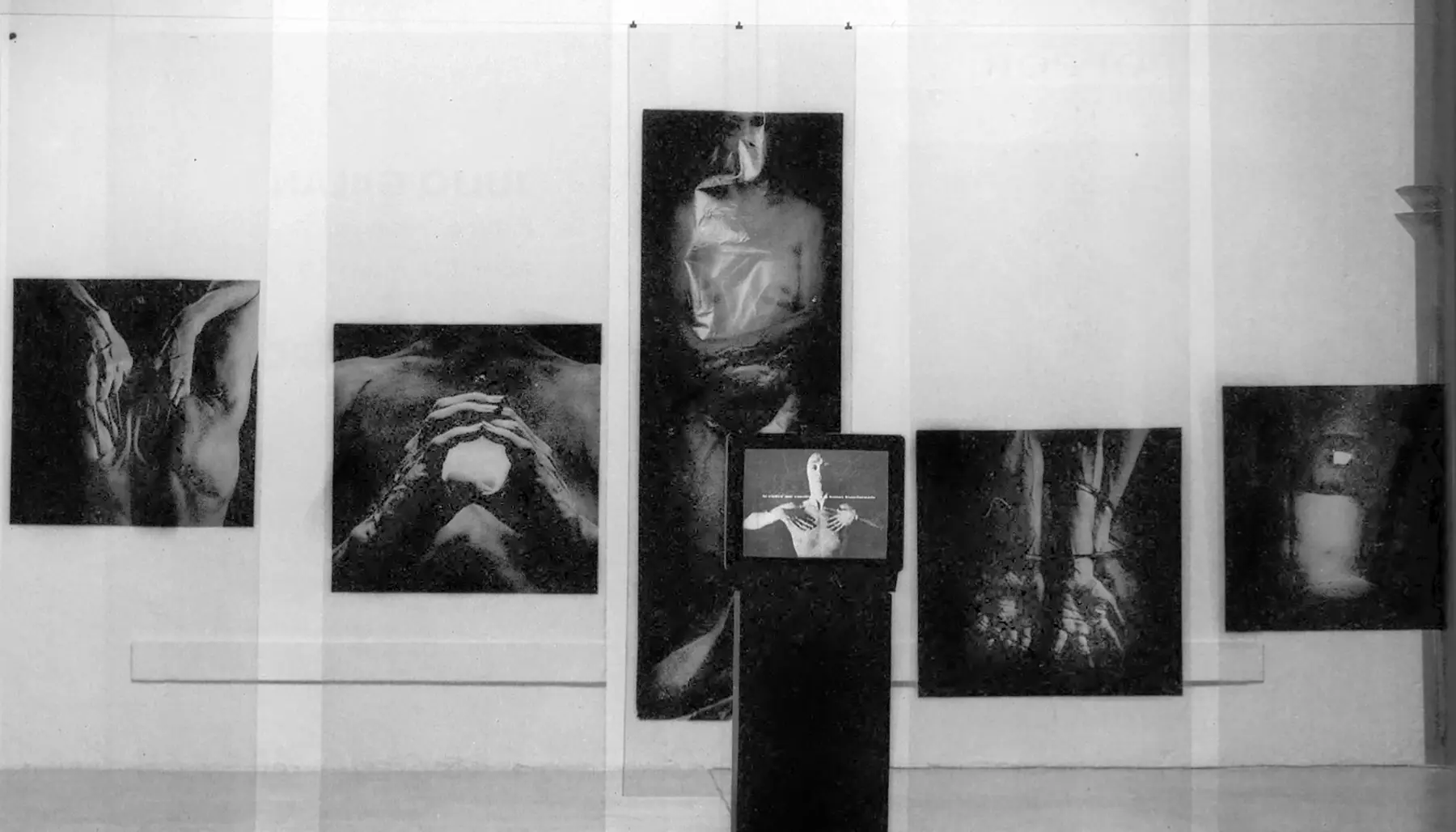
Anáhuac: Radiographies of a Valle (Centro de la Imagen, June, 1995) marked Suter's incursion into new territories, a return to the processes of modifying his supports, as in his early work, but not through the computerization of his images and a detachment from the wall through the use of hanging acetate sheets which created planes of vision throughout the room. These four-foot images were accompanied by videos and digitized image loops. Paradoxically, such a display of technology resulted in a less dense visuality, a minimum kind of symbolism.
The repertoire proposed by Anáhuac as a paradigm of myth seemed to refer to the philosophical anguish of Prince Nezahualcoyotl. The metaphors of death, power, fugacity, transition, cosmogonic journey, sense of existence, and void... encompassed texts and ritual practices which Suter uses to create a poetics of urban anguish, an imaginary critique of the urban body. However, by shunning any kind of historical precision, he recycles without simulation various cultural-vestiges which are still able to speak to us about our existential condition as inhabitants of the planet, an event to do with irony.
However, the works gathered together under the title of Anáhuac do not speak so much about place as about journey, not so much about foundation and fecundation as about fear of death and the metaphorical evanescence of desire, the confused moving of the world. These bodies-maps are a symbolic point which merges origin with destiny, heroic flight and mythical return, the utopia of the social exercise of memory. If the foundation of a home, a place in memory, is a desire to overcome all these discontinuities, the anguish for a perfect realm reflects an inevitable truth: only by traveling do we remain continuous. It is the subject of a journey as metamorphosis, which reappeared in Suter's most recent exhibition.
This new show —at the New Works space of the Center for the Fine Arts in Miami— is a continuation of these ideas. It is also a purification of the artist's use of iconographies of direct pre-Hispanic inspiration, even though the motivating theme continues to derive from that narrative context: in this case, the myth of Chicomoztoc,4 or the land of seven caves, the original nucleus of the cultural diversity of the Meso-American ethnic groups. Works such as Crossroad or Belly, from this new show entitled Geography of Memory, evoke the metaphorical frontiers of our bodily condition, and are an attempt to discover in myth the possibility of relocation (maps) and contract (rites) for the contemporary body, over and above any moral reduction.
Suter knows that the discourse on time is a discourse on the ephemeral nature of flesh and memory. And that the memory of a world and a culture, the discourse of our search for our home, must necessarily involve our search for our body.
NOTES
1. The pre-Hispanic cultures have been a source of study and inspiration for several abstract painters. The works of Gunther Gerszo and Vicente Rojo make a subtle and profound use of certain structural values of such cultures. Of Suter’s generation, only the work of Silvia Gruner—which in its entirety refers to this tradition—and some works by Javier de La Garza—which make ironic reference to the aesthetic heritage—use the pre-Hispanic iconography as a trampoline for exploring the contemporary identities in Mexico.
2. It was not until the mid 1980s —after the fateful oblivion of interdisciplinary works characteristic of Mexican art in the 1970s— that photography managed to break out of the "ghetto of the lens" and become part of an ecumenical visual contemporaneity, thus entering the circuit of commercial galleries, museum exhibition, and attention from the critics.
3. Xipe Totec, "our flayed lord," is the god of the vegetation which covers the earth, symbol of the new harvest, the external face, in the act of sacrifice, of everything that flows, a telluric emblem of the cycles of regeneration.
4. Chicomoztoc is the telluric belly, the mythical place of the founding gods. Tierra de Aztlán Aztatlán, a place beyond the realm of time and space, the dwelling place of the mother Coatlicue, and to which the sorcerers must embark on a mythical return, in accordance with the instructions of the fifth king, Moctezuma.
OSVALDO SÁNCHEZ
Cuban art critic and curator. Lives in Mexico City.