The recently inaugurated Borges Cultural Center has just presented an exhibition entitled Jorge de la Vega: 1961- 1970, which offered an overview of almost ten years of creative work by one of the members of the New Figuration group. The exhibition, which paid tribute to one of the most creative artists of the 1960s, highlighted the outstanding debt to de la Vega, and acknowledged the need for a retrospective show of his work which would shed light on one of the richest and most conflictive generations of contemporary Argentinian art, and on its effects on the current scene.
Jorge de la Vega (1930-1971) was born in Buenos Aires in a family environment that was familiar with the world of art. From an early age, he began to draw and subsequently studied architecture, which he abandoned shortly before graduation to pursue his passion for painting. In the 1950s, he began his exploration of plastic language and held his first one-man show in which figurative works did not mask his interest in abstraction. The arrival of informalism offered him an opportunity to experiment and forge his distinctive imagery at the beginning of the 1960s.
The fresh winds which were blowing in the art world at the time encouraged several young artists to seek out their own forms of representation: in this way, Ernesto Deira, Rómulo Macció, and Luis Felipe Noé joined forces to establish what was known as the New Figuration group.
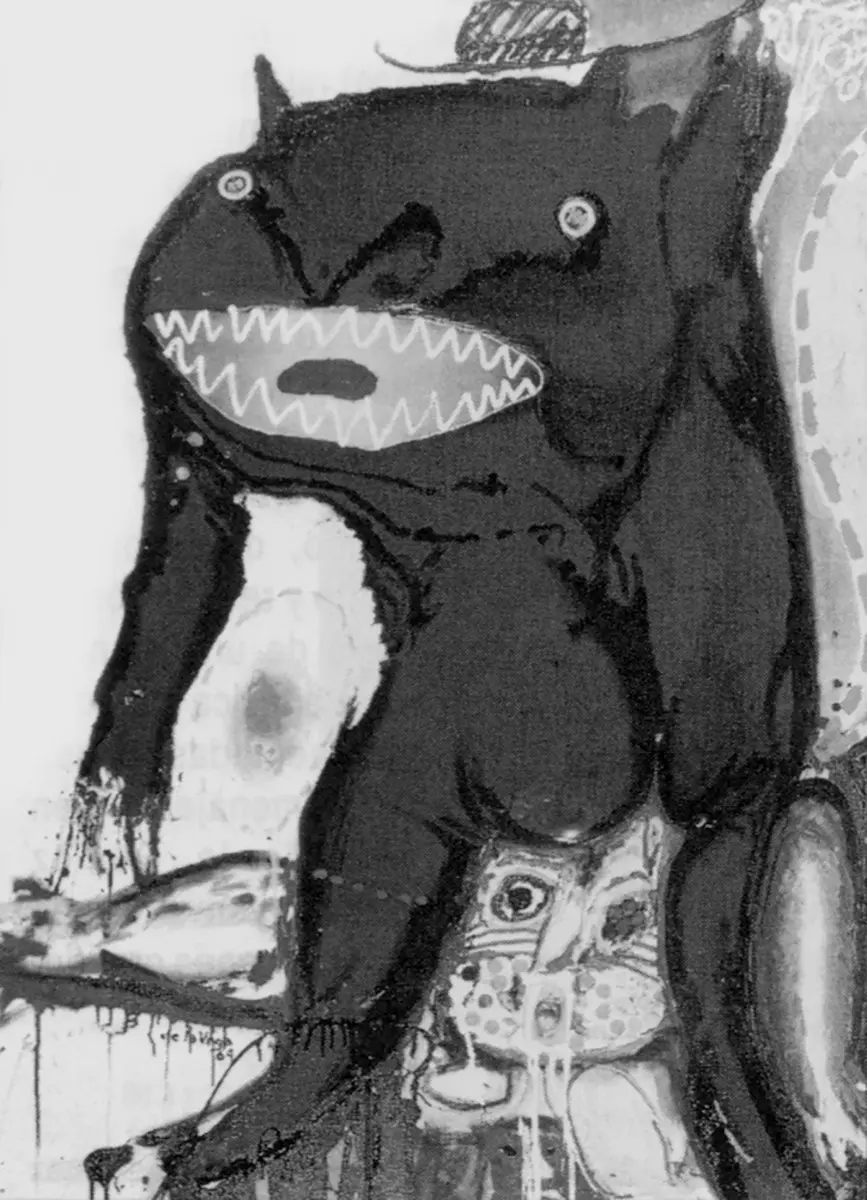
The exhibition at the Borges Cultural Center contained almost 50 works and confirmed the expressive richness and originality of the artist’s proposals. From his Self-Portrait, an oil on canvas dating from 1961, de la Vega revealed a treatment which went beyond any conventional approach to encompass a critique of reality within the depiction of his own image. The interplay between subjective and rational elements acquired a sense of harmony, which was to become one of the characteristics of his subsequent production. The gestual treatment is restrained only by the intention that the artist wants to give to his work, where the sense of play does not mask his interest in irony. In Intimacies of Someone Who is Shy, a large format oil and collage work from 1964, and Homage to Tom and Jerry, from the same year, de la Vega displays not only his rich sense of imagination but two different ways of composition: in the first case, the horror of void, with everything being covered, and where only the variety of textures created by the collage and the vivacity of the colors provide relief to the spectator; and in the second case, spaces which temper the density of the images. From the following year, depiction becomes more graphic than pictorial, with the human figure emerging as a protagonist distorted through an irregular and imaginary mirror. Color is planimetric and clearly delineated, recalling the influence of pop art. Good examples include Mr. Muscles, an acrylic on canvas from 1967, and the acrylic series entitled Riddles (1969-1970).
ALBERTO COLLAZO