The Rotunda Gallery, a not-for-profit space devoted to showcasing the work of the diverse artistic population of Brooklyn, began the new year with a site-specific installation by the Cuban-born María Elena Gonzáles. Gonzáles’s proposal was selected out of 150 submissions to an open call and is entitled House of Games.
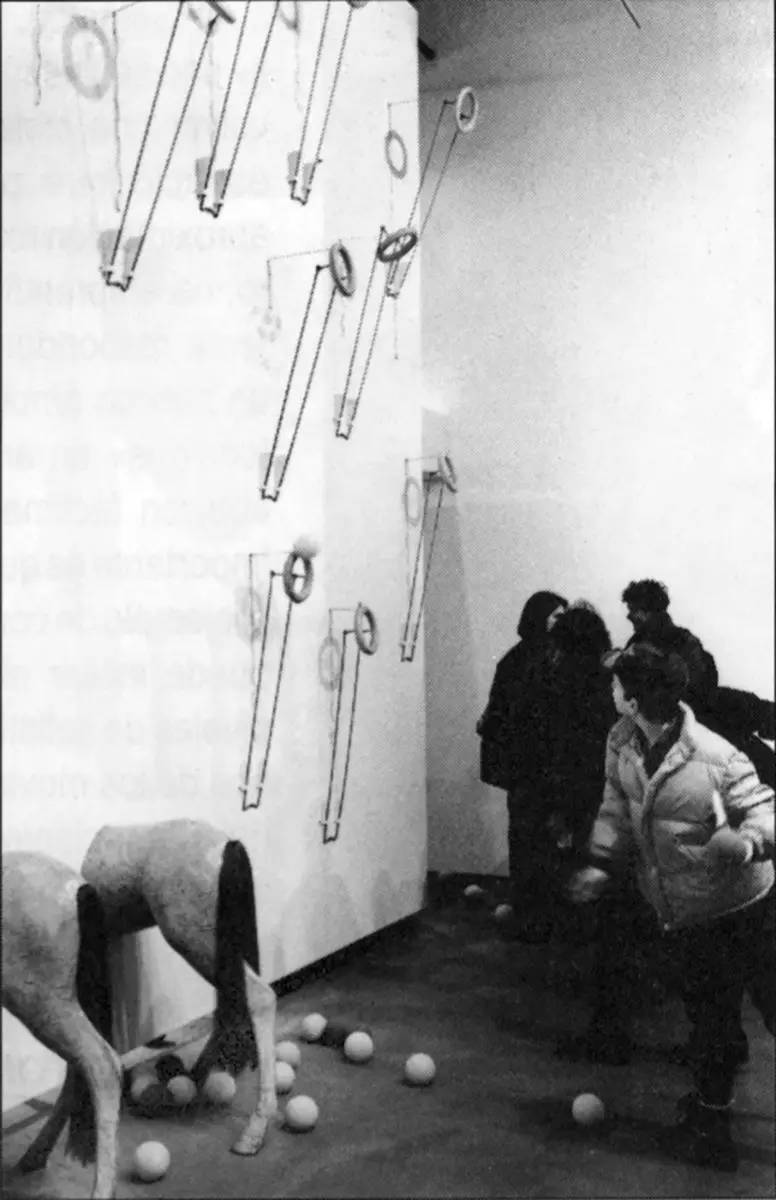
Situated throughout the somewhat irregular space of the gallery, there is no one holistic view to the installation, no central totality around which the disparate elements are organized. One is forced to move throughout the space and engage the work in sections. One wall partition houses dozens of small, intricate red sculptures, the bold primary color on the little forms both playful and sophisticated. To the side of this wall, along one edge of the gallery, is a long, narrow case set low on the floor and covered with blue and yellow foam balls. The line of the case and color of the ball assemblage lead the eye to a far wall upon which is arranged a group of leather hoops attached to what appear to be very long metal brackets, like so many abandoned Eva Hesse sculptures. At the lower edge of this wall are two waxy horse’s rumps, with brilliant purple tails (these tails can be found elsewhere in the gallery). Moving around to the other side of the wall, we see the rest of the horses, joined to the back halves in form but distinct in color. Beyond this point, down a narrow hallway are two shelf constructions, one replicating hairy flesh and supporting a double-hoop sculpture, the other one a wooden form with a glass top upon which rests an array of colored plastic fish, which in another life were soy sauce containers from a Chinese takeout establishment.
Looking at this gathering of objects in its pristine state, there is much to entice the eye and think about. Gonzáles employs an assortment of strong colors and intriguing shapes at each point in her installation. Moreover, art-historical references abound: a series of spoked-wheel silhouettes on a wall reminds one of Duchamp’s mechanistic figures; shelves with appropriated kitsch have long been a device of Haim Steinbach, for one; and as mentioned, the organic, postminimalistic sculptural forms nod in the direction of Eva Hesse. In fact, there seems to be an almost encyclopedic range of ideas present in this work: the conceptual coexists with the pristinely formal; the body makes an appearance, as does the machine; and the discrete, fetishized object is juxtaposed with temporary elements such as chalk drawings on a wall. Looking at this vast assortment of forms, colors, and ideas, one is left wondering if it actually all holds together.
If all one does is look, then the answer is no. But as the title implies, this work is not to be merely watched. Gonzáles has taken postminimalist form and appropriation art a step further by retaining an element of playfulness—many of these works are meant to be played with, literally. Hence, the visual line of yellow and blue balls that leads to the wall of hoops becomes a performative one as visitors to the gallery attempt to throw the balls through the hoops; the ubiquitous horsetails are meant to be pinned onto those sculpted posteriors; and so on. When the installation is thus used, all its parts seem at last to connect and further surprises reveal themselves, such as the row of encyclopedias that are in the case hidden beneath the balls, or a slide carousel that takes on the characteristics of a merry-go-round.
According to Gonzáles, "It is important that visitors are able to touch my work in order for me to communicate at a more visceral level." With House of Games, she has managed not only to return tactility to sculpture, but a number of other things as well. Firstly, she has elicited that visceral response, all the while using the art-honored concept of chance and games to interconnect the constituent elements of the work. Secondly, she has employed interactivity as a means to work out a synthesized installation in a space that seems to beg for a more sectionalized approach. Thirdly, she has undertaken a project that attempts to answer the needs of a diverse audience, from art-savvy adults to easily bored children. And perhaps most importantly, Gonzáles has offered an example of how one’s art can include levels of levity without sacrificing levels of sophistication, and how some of the more conceptually demanding movements of recent art can be demystified without losing their potency.
JOHN ANGELINE