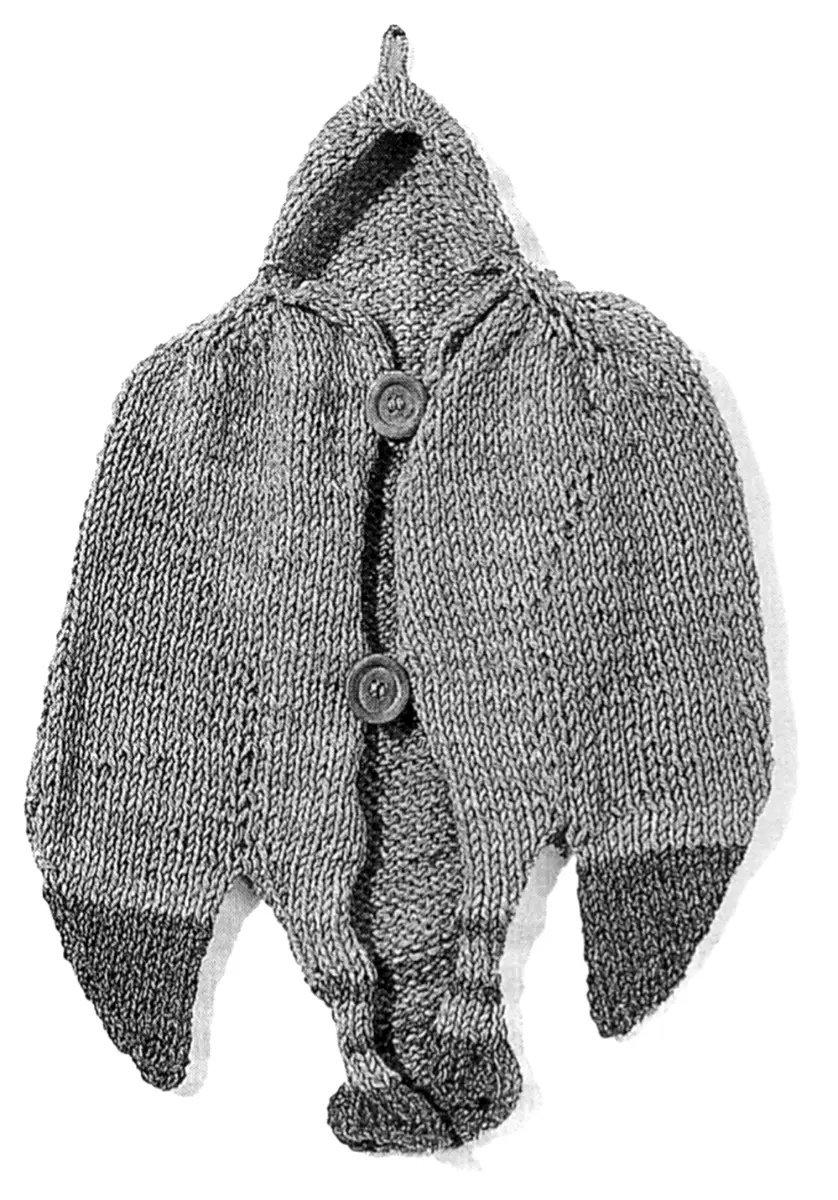
The first impression of this work, entitled Trousseau for a Conquistador, by the Argentinian artist Mónica Girón, at the Kemper Museum of Contemporary Art and Design, was one of a mischievous sensibility. The work consists of a series of individual articles of clothing— gloves, socks, sweaters—woven in wool for use by birds in Patagonia, which are threatened with extinction. The pieces, in delicate tones, are designed in accordance with the morphology of the different species. Inevitably, the playful, child-like aspect of the designs, the manual skills, the formal absurdity, and the intention of protecting innocence all endow these pieces with considerable humor and tenderness.
However, the context that gave rise to these designs was a wider one. Trousseau for a Conquistadors was created as part of a reorganization of the Museum of Patagonia, a vast region in the south of Chile and Argentina. The Museum, established in San Carlos de Bariloche in 1940 to commemorate the military conquest of the region, originally presented scenes of military battles. It also exhibited examples of the geology and animals of the area (including embalmed pieces). From the end of the nineteenth century, as a result of successive colonizations, the region has been occupied by extensive sheep farming ranches, which have threatened the local species of birds with extinction.
Following the restructuring of the Museum, which toned down the triumphant tone of the territorial conquest, Mónica Girón saw an opportunity for generating debate on its functions and meaning. Within this museographical context, Trousseau for a Conquistador abandons the area of play and engages in a reflection on the presentation and portrayal of identity and its meaning with regard to events of colonization, migrations, the interpretation of history, ideology, and transculturation. The fabrics are a metaphor of these stories and their effects on the forging of identity as well as of the sense to be attached to the culture/nature axis in the light of these circumstances: on the one hand, preservation and hybridization, the products of migrations, and on the other, the political backdrop of ecological problems, a further consequence of colonization. The many paradoxes that Mónica Girón establishes in this work avoid any moralistic judgment or tone of denunciation. Girón belongs to a generation of artists who have emerged in Argentina in the wake of a decade of military dictatorship. Her work is a critical response —refined and acute, complex and beautiful— to a process of recuperation.
CAROLINA PONCE DE LEÓN