The Museum of Modern Art recently presented some 30 works, covering a period of 20 years of intense creation, by the Argentinian sculptor Norberto Gómez (1941). The carefully selected exhibition highlighted the originality and coherence of Gómez’s artistic proposals and development from his early period, represented by Untitled 8, done in polyester resin and wood, dated 1976, down to Puzzle, a polychrome plaster work from 1995. The former is an abstract work which combines geometrical forms with others which are almost organic, while the latter uses elements from objective reality with a freedom of composition reminiscent of certain surrealist proposals.
These two different and paradoxical extremes are a synthesis of Gómez’s artistic intentions, where a truculent and at times controlled sense of drama is combined with the irony of documentary and critical figuration, where moments of extreme rationality appear.
From 1978, Gómez began to incorporate organic, visceral forms into his figures. This aspect is closely linked with the political events of the military dictatorship, which ruled the country between 1976 and 1983. Good examples include Grill I, a polyester resin work dated 1978, and Teeth, in the same technique from the following year. From the 1980s, he began to use bone elements with attached organic forms; these works were exhibited in 1983 and acquired a high sense of theatrical drama, as can be seen in such pieces as Crucifixion (1983), done in polyester resin and wood.
The other creative aspect of his art can be seen in the work entitled Pórtico from the same year, done in wood. It shows the entrance door of a distinguished residence, with carpentry full of carefully worked details, molds, and finely sculpted reliefs—an obsession with detail which had not appeared in his earlier work. Similar characteristics can be seen in Custody, Pyre, and Whip (1984), in cardboard and polyester.
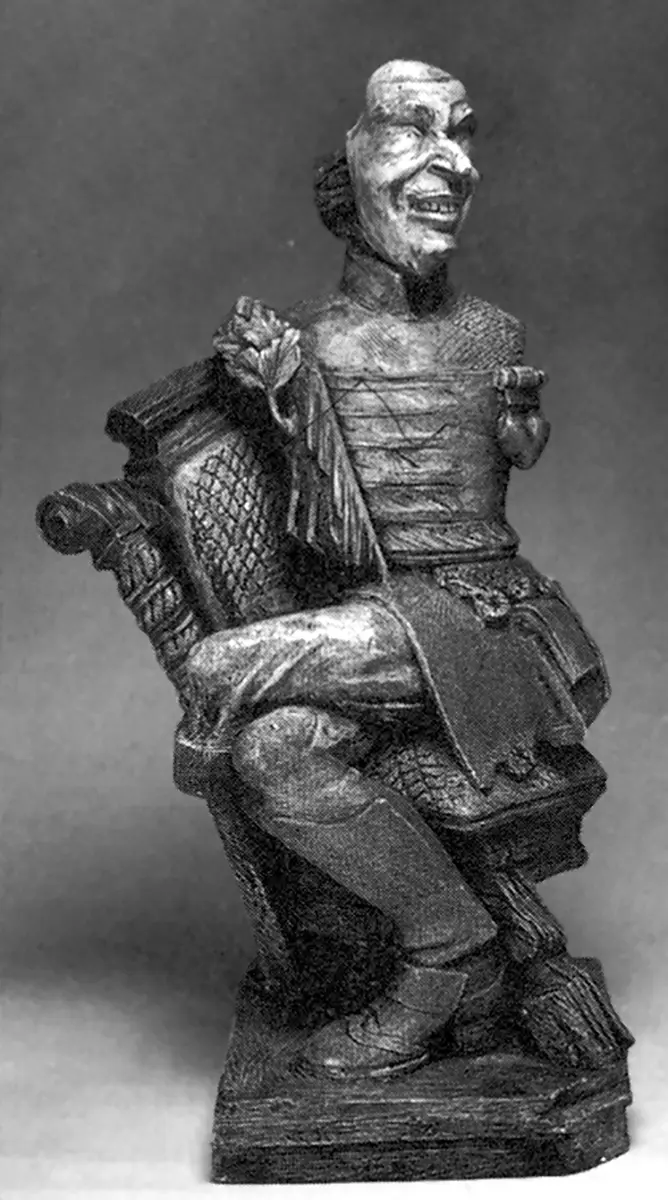
Both these lines of work were fused together at the end of the 1980s in such pieces as Somersault, in polychrome plaster, from 1989, where the human figure appears full of irony. From the same year and in the same technique, The Idiot shows the human figure with animal parts set within architectural forms.
In his work from recent years, the human figure is the protagonist, although the arbitrary sense of composition gives his pieces a certain surrealist air, where the overriding irony is sometimes accompanied by jibes at human weaknesses or the emblematic forms of power, as in Untitled, a polychrome work from 1995.
ALBERTO COLLAZO