The Guggenheim Museum recently presented a major show of work by Claes Oldenburg, one of the main representatives of North American pop art. In fact, it was a relatively complete retrospective (the word "anthology" in the title used for the show seemed rather strange), which proved to be one of the most joyful exhibitions seen in New York in many years. Indeed, Oldenburg, along with Lichtenstein, was a member of the more amusing side of the movement. Warhol, Wesselman, Rosenquist, and Segal, to give just a few examples, devoted themselves to the seriousness of things banal. Oldenburg, without lapsing into superficial frivolity or cheap jokes, managed to maintain a light touch and smile throughout the 35 years of work covered by this show.
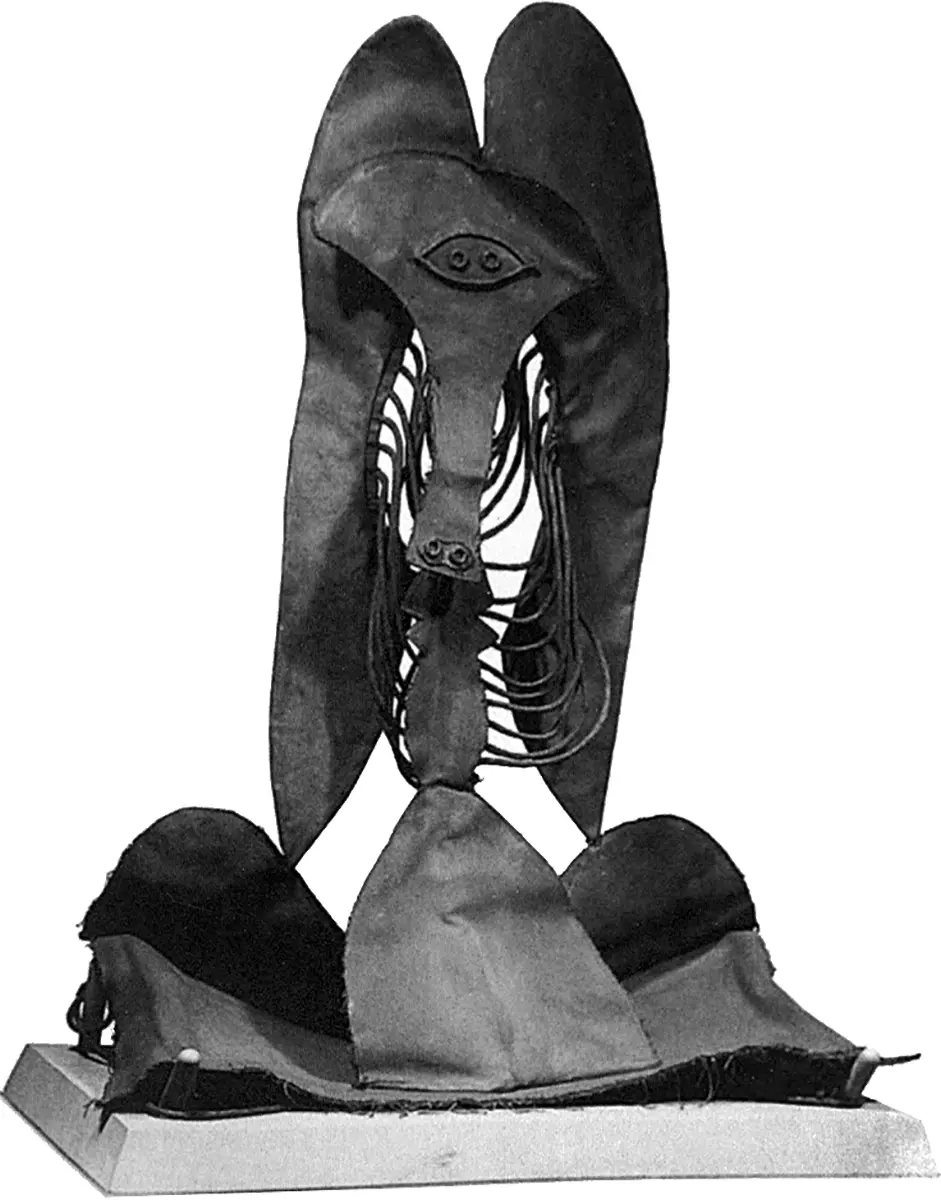
The ideas used by Oldenburg over the years have not been very complex. His strength seems to lie in a childishly simple approach to things, sometimes colored with a sense of megalomania: the need to answer questions about what would happen if a clothes pole were as big as a building, if Picasso's monumental sculpture in Chicago were made of fabric, or if bathroom fixtures were made of cardboard. These are specific instances of other questions, equally innocuous and more general, about what would happen if hard things were soft, rigid things could be folded, or if what was small became really enormous.
But this apparent intellectual simplicity was, in fact, not intended to provide a basis for any major theoretical research. The banality of the theme (or the questions) is in this respect not very different from the case of other artists who choose "motherhood," "still-lifes," or "landscapes" as their themes. These classic subjects have attracted generations of artists precisely because of their non-theme aspects, because they are not really themes but stereotypes which can be used as pretexts for exploring formal and theoretical problems.
At a time when technique as a support and artistic defining factor had, if not disappeared, then at least passed to a secondary level, Oldenburg appeared as a conceptually traditional sculptor. His concern and his spectacular skill lay in the way he looked at his materials and forms. Here, the word "spectacular" is used in both senses of "impressive" and "mounting a spectacle." His identification with his materials emerged from very early on in his career, when in 1959 he collected objects from the street and transformed them—through their mere presentation—into science fiction ray guns. His relationship with the world of entertainment also began during this period (1960), with his first "happenings" shortly after those of Allan Kaprow. To some extent, the Guggenheim show (and any other chronological exhibition of his work) could be seen as a development of Oldenburg's economic relationship with entertainment and spectacle. His early work, done in the relative poverty of an artist who was just beginning, emphasized the use of found materials and activities based on his own persona and friends. As time went by, recognition and economic success came along, the spectacle element gave way to the use of a monumental scale, industrial materials, and the location of a given work. The theatrical element reappeared in 1985 in the II Corso del Coltello, in Venice, although now in the form of an extravagant mise en scene. This was a kind of Hollywood super-production around a Swiss army knife in the form of a gondola, which navigated the canals laden with the Oldenburgian baggage of the protagonist of a complex libretto: Dr. Coltello.
Seen in these terms, the Oldenburg anthology was a kind of story of his economic success. Although this phrase occurred to me after having seen the show, I realize that such a view has in fact been a kind of subtext in my appreciation of Oldenburg for many years. In an excessively simplistic manner, I set his period of artistic break and courage during the first five years of the 1960s and rejected all that came afterwards as an expression of concession and weakening. It is true that this half decade in Oldenburg's work was the most fertile, the period which defined his repertoire and the perspectives contained in the rest of his work, but it does not mean that his subsequent work should be discounted. Quite the contrary. During the period 1959-1969, Oldenburg established his ground rules, and from then on, he played the game, and played it brilliantly, taking advantage of all the opportunities which came his way, including finances.
Paradoxically, Oldenburg never saw himself (or the other pop artists) as making a break with the past. In an interview that he gave me in 1965, he said: “Everything comes from informalism. The mechanism of letting materials go free—that paint flows in accordance with its own laws—was applied to the images and subjects which surround us, and this is what produces the pop imagery.”1 His work from the period immediately before, which was represented in this show by only one piece, a self-portrait from 1958—consisted mainly of portraits of his wife, naturalistic works which were nevertheless influenced by abstract expressionism.2
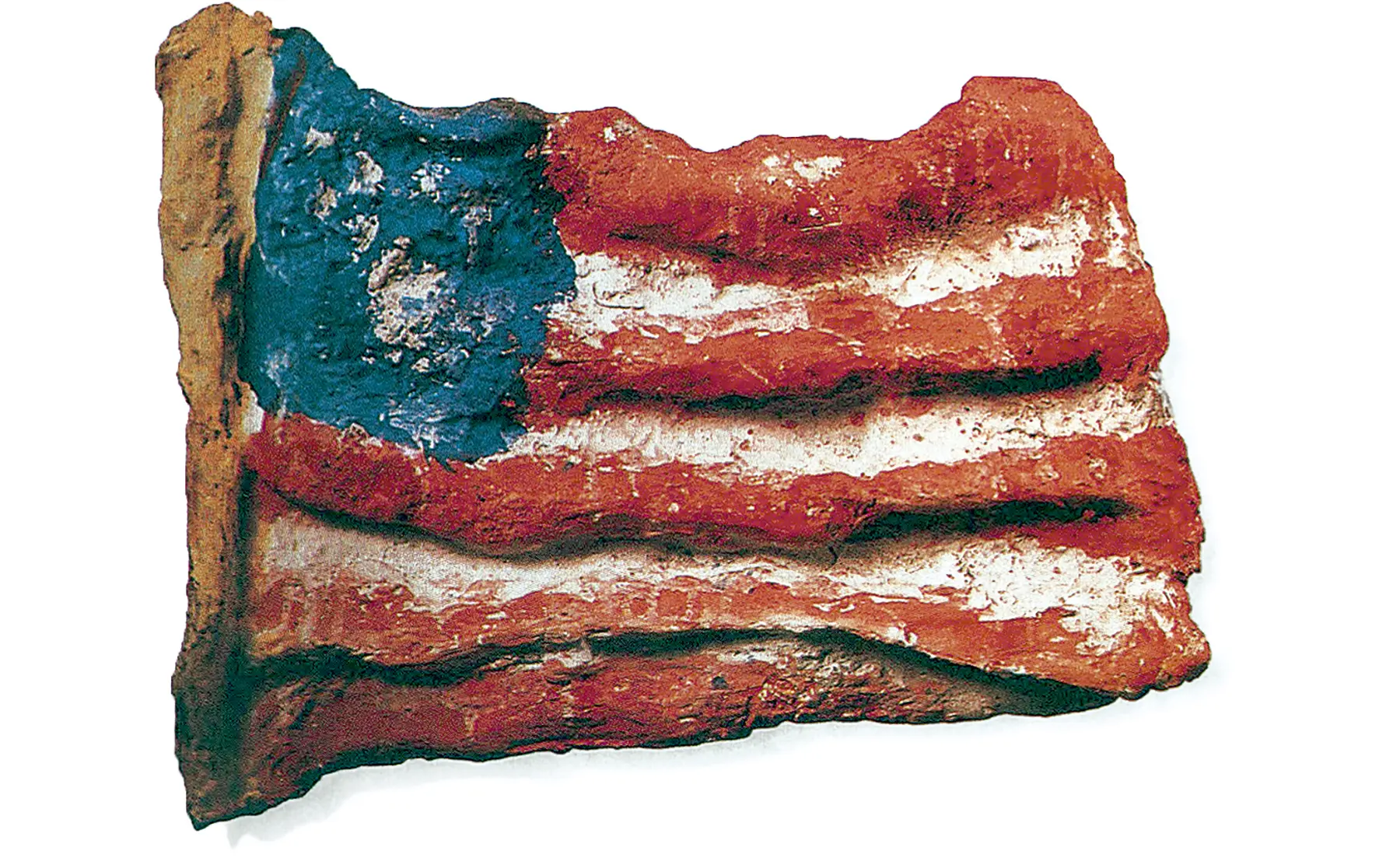
The first works in the show bore the clear influence of abstract expressionism and European informalism, both those done with burnt cardboard and paper (rather reminiscent of Burri) and those in gypsum painted with dripping colors. The real objects used as models were tenuous references for destruction rather than for any re-creation. U.S. Flag (1960) is, for that reason, much less "pop" than the one done by Jasper Johns some years earlier. If there was a break in the history of art with Oldenburg, then it was during this period and with these plaster works, but not so much in terms of formal language, but rather through this destruction of the everyday object.
In his 1961 notes reproduced in the catalogue,3 Oldenburg speaks of his interest in the use, the soiling, and the abandonment of objects. But this was also the period when objects began slowly to take hold of his language, making it cold, and ending up by dictating how they were to be depicted. Oldenburg began to take an interest in a kind of essence of things. In the same interview noted above, Oldenburg describes his relationship with a typewriter, for example: “Moreover, I see the problem of artistic expression in a rather pure form. For example, I make a typewriter. One day, there will be no more typewriters, and we will dictate directly to other kinds of machines. In this new period, no one will know or remember what a typewriter is, and my work will be considered independently of the machine on which it is based. The same is true of a piece of bread or any of my objects. And so, when I do a typewriter, I use a 1940 model rather than the latest model, because informal terms it is more of a typewriter, less related to the future, and more perishable as an object.”4
In Assorted Food on a Stove (1962), there is a mixture of pots and the real oven with re-created food no longer an allusion. In the same year, he also began to do his sculptures in fabric (sewn by his wife) and, by extension, his "soft" sculptures, accompanied by a change of scale in his work. Claes is in fact a miniaturist, his wife said to me during the 1965 interview. Afterwards, she explained that the question of scale was not a philosophical or aesthetic problem, but a way of filling a gallery which was too big for a planned exhibition. The inspiration was provided by a place for selling automobiles which had its exhibition rooms in the same building, where Oldenburg saw the relationship between the cars and the space one day when he was going to the gallery.
But it was not only the scale that Oldenburg gained from this experience, but also the use of space. His Bedroom Ensemble (1963) is one of the most complex and successful works of his career, in which he not only distributed the furniture with the criteria governing the exhibition of cars, but also changed the perspectives and combined textures in display formats. The result is no longer a room for sleeping, but a room transmuted into pure vision, a place in which the wrapping paper has swallowed up the present inside, taking its place without anyone ever noticing.
Perhaps the most constant feature in Oldenburg's work can be seen in his drawings. With a stroke that is minimal and expressive at the same time, he manages to communicate his information, create an atmosphere, demonstrate his sense of pleasure in the linework, and declare his individuality. These characteristics would remain virtually unchanged over the 35 years covered by this exhibition. It was in 1965 that his drawings became crucial in his work, because it was then that he began to think about large public monuments, which, for the moment, were utopian. It was the time when a monumental felt bear appeared credibly in Central Park in New York, when a half- eaten ice cream halted the traffic on Park Avenue, and when a cube with the names of war heroes inscribed on its sides completely blocked the largest traffic junction in New York (Canal and Broadway). Surprisingly, during this period, the use of photographic montage (a perfect technique for his projects) was still minimal, although present. For Oldenburg, it would be a shortcut that would distract him from the joy of drawing.
From around 1965, the paths began to overlap. There is a change in character in the scale of his works. What had begun as a form of decontextualization—a calling of perceptual attention to replace the spectator in front of the everyday object—underwent a qualitative change. The drawings dictated a move from the relatively private perception of the gallery to the public of the monument. The Gigantic Billiard Balls (1967), although they were still not really gigantic (each ball had a diameter of only 61 centimeters), were an exercise in the enlarging of an image with the minimum amount of transformation. It was as if the object remained and the spectator, made smaller like a dwarf, had to revise his own scale under the impact of the external giant. This work was also an extreme in the coldness of his work. It had an immaculate industrial finish rarely to be found in his earlier pieces, and pointed the way ahead for a large part of his future work.
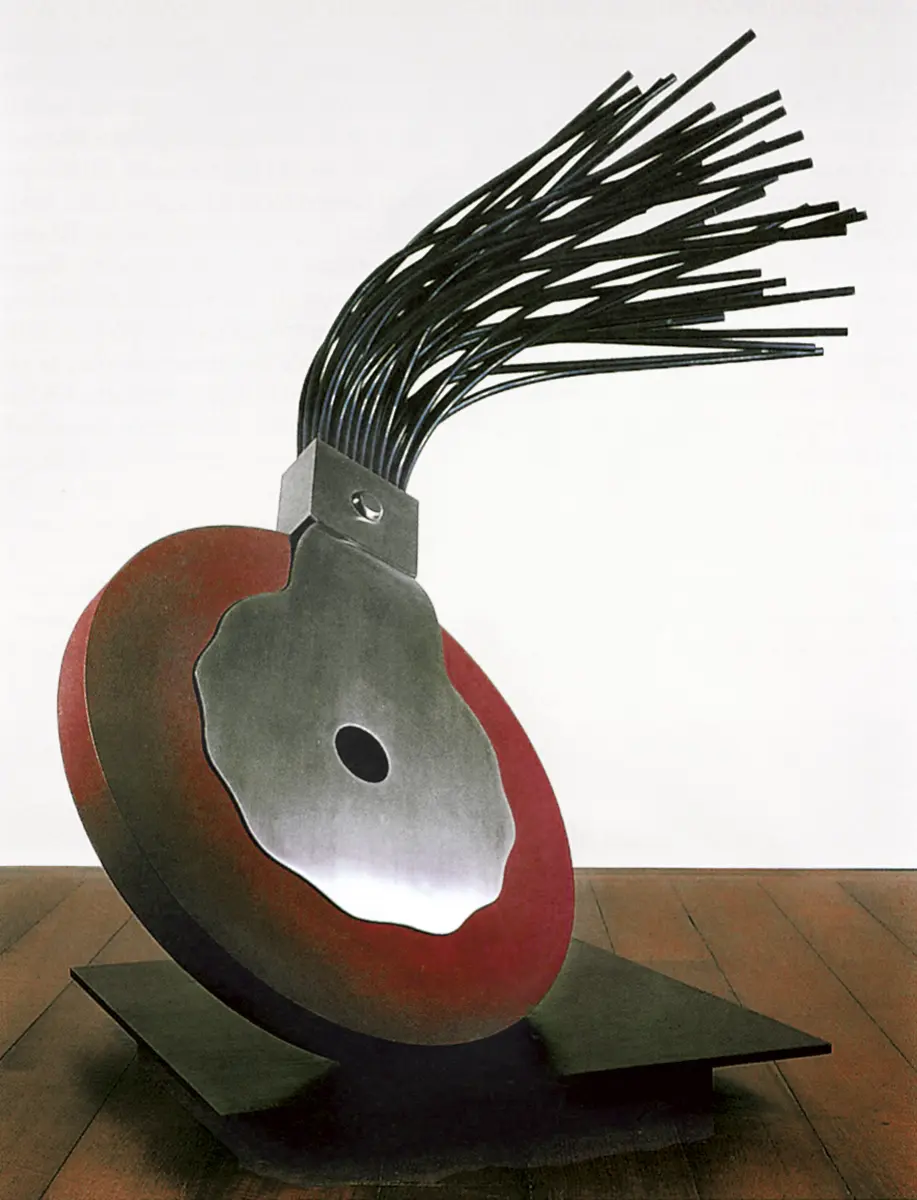
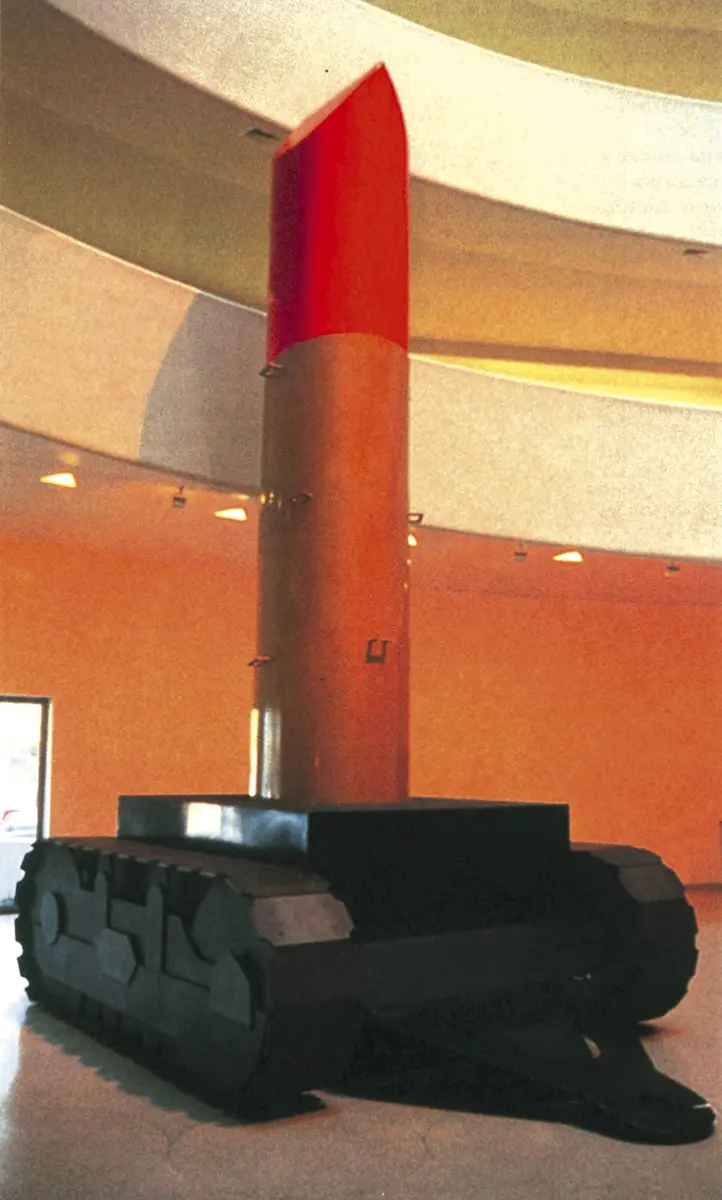
The first installed monument, a lipstick on a caterpillar tractor (1969) at Yale University, was less successful. It suggested a mechanical complication mingled with sexual connotations, which replaced the reference to the object with a literature devoid of interest. Oldenburg's humor is generally visual and uses jokes that function more by their audacity than through the narrator. Here, the effect is that of a clumsily told joke. But from the lipstick on, Oldenburg's career would once again stabilize, and this time the result would be works which were increasingly sophisticated in their handling of scale and materials and with a return to the understanding of objects.
It is at this point, around 1970, that I am tempted to compare Oldenburg with Beuys. Oldenburg never had any pretensions of a shamanistic kind, although the understanding of objects which is proposed in his work does reflect a kind of spirit of things. The certainty with which he chose his materials and transferred the original into its new presence is indeed surprising. The transfers are unexpected and, at the same time, once done, seem inevitable. In his Saw Hard Version II (1970), the blade is folded into three parts, and thus its function has been invalidated (apart from a blunt cutting edge and teeth in a sinusoidal curve), and yet it is a quintessential saw. The Giant Three-Way Plug. Scale B (1970), in cherry wood, hung; or Scale A in Cor-Ten steel, thrown into a garden; or a soft version (1975) and hung from pulleys, still remains the archetype of a kind of protagonist of the North American electrical system. Oldenburg, with the artisanal humility of a traditional sculptor, which he seemed to assume fully during this period, manages to establish an intimate dialogue with things and communicate to us the results of his conversation. During the same period, Beuys's art moved away from experimenting with materials towards more radical breaks with the limits of traditional sculpture than those to be found in Oldenburg. But Beuys opted for shamanism: he felt that this was the focal point of knowledge, both political and metaphysical, and lost himself in the hermeticism of his anthroposophy. Beuys wanted to be a shaman of a primitive and obscurantist kind and blurred the sculptural qualities, which were, however, his forte, without achieving the magic he was seeking. Oldenburg, on the other hand, who distanced himself totally from such problems, seems to have created, almost unintentionally, something like an industrial shamanism. One imagines that a shaman will help us to live. Oldenburg does so by showing everyday objects as magical instruments, and at the same time, accompanied by a good dose of humor. Beuys, on the other hand, submerged and masked his objects in an obscurantist cloud.
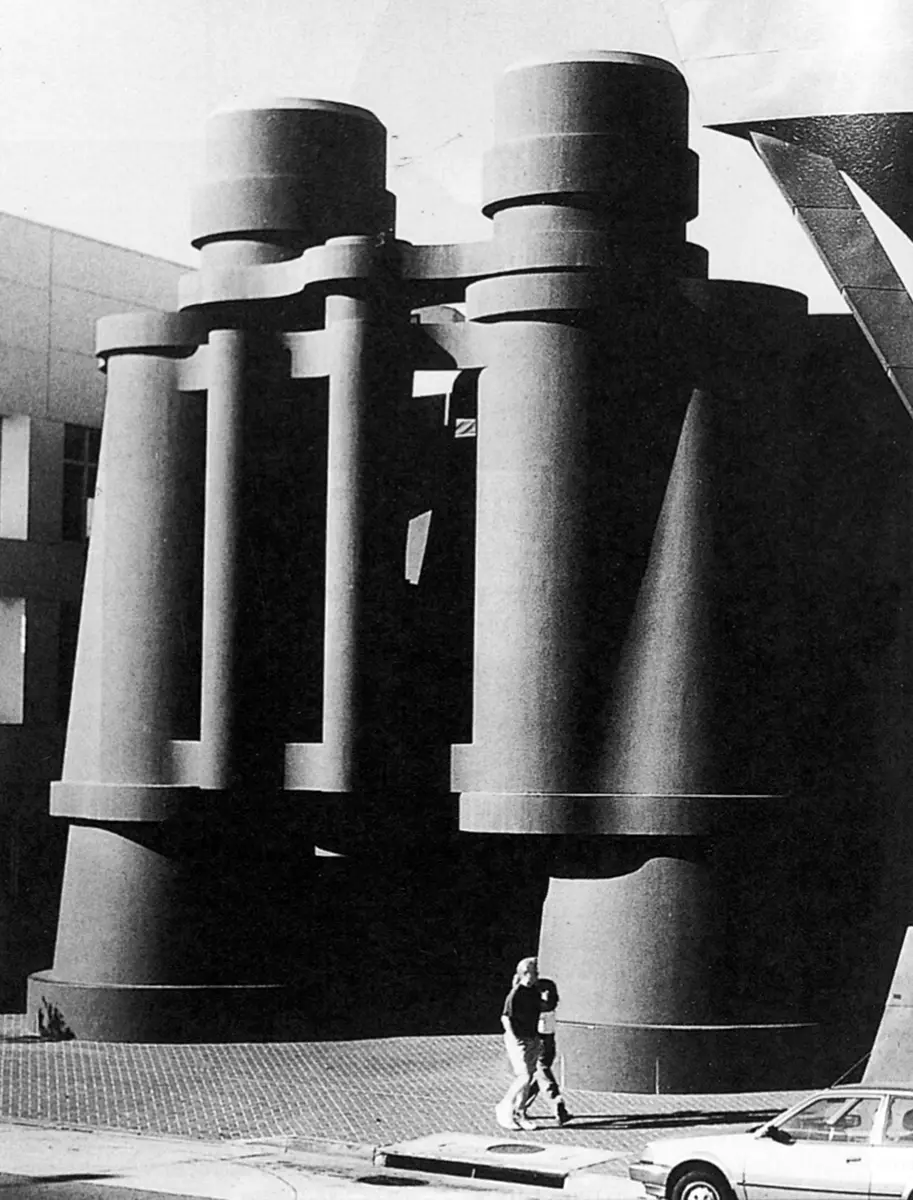
Oldenburg's skill in this respect continued through several projects, which were ambitious in both their scale and technology. Batcolumn (1976) is a baseball bat 30 meters high that was set up in Chicago. But the bat—without any ambiguities—does not simulate wood or even anything solid. It is a kind of steel and aluminum caged structure reminiscent of the filigrane appearance of the Eiffel Tower, but which also harmonizes with the square-patterned windows of the adjacent buildings. Another column measuring 12 meters high (3.20 diameter) is the enormous torch at the University of Nevada. It stands on its bulb, and the floor (with hidden fluorescent tubular lighting) simulates the light overflowing at the edges. The series ends with Binoculars (1991), two telescopes the size of a building and set up between two real buildings belonging to a complex designed in collaboration with his wife (from 1976), Coosje van Bruggen, and the architect Frank Gehry. The work appears to be a feasible kind of architecture and seems to be the closest to that of Lequeu and Boullée, the late eighteenth-century French architects of the fantastic, as Mark Rosenthal points out in the catalogue.5
The development of Oldenburg's work from the 1970s, despite its major achievements, has not been even. There are occasional new lapses into literary allusions which, since they are even more complex than those used in the lipstick piece, take his work closer to stage-sets. At times, the stage-sets are even sentimental, as in Haunted House (1987), Enthropic Library (1989), and Leaf Boat with Floating Cargo (1992). But possibly these almost Wagnerian explosions are necessary to the production of his other icons, such as the burnt match (1987), the unearthed bicycle (1990), or the note bottle (1993). Perhaps the problem lies in the fact that the works which I think are unsuccessful were conceived on a large and complicated scale in Oldenburg's imagination (or that of Oldenburg and van Brugge, since they work together). On the other hand, the works which I think are memorable seem to be the product of a direct dialogue with "the thing" in question. They are subsequently amplified after the process of dialogue and compenetration. The failures would thus be contextualized from the outset. The successes would achieve their strength through decontextualization. This, of course, is pure speculation. But it may well be that Oldenburg's first wife, Pat Muschinsky, was right when she told me that Oldenburg was a miniaturist at heart.
NOTES
1. "Oldenburg", Marcha, Montevideo, May 19, 1965.
2. In recalling this period, Oldenburg noted during the same interview that "we worked for Raphael Soyer." Soyer was a famous naturalist painter who did high-society portraits. When I asked what kind of help he provided, he replied: "My wife posed for him. What did he do? Loaned him my wife as a model." His wife at the time was Pat Muschinsky.
3. Claes Oldenburg: An Anthology, Guggenheim Museum, New York, 1995.
4. Marcha. The 1940 model was also the one he used for writing.
5. Rosenthal explains that Oldenburg saw material by these two architects between 1956 and 1961 while working at the library of Cooper Union College.
LUIS CAMNITZER
Uruguayan artist. Professor in the Department of Visual Arts at New York State University, College at Old Westbury.