According to the catalogue, this retrospective exhibition of paintings, drawings, and objects by Santiago Cárdenas at the Luis Ángel Arango Library in Bogotá between November 1995 and February 1996 contained 139 works. The show has already been seen at the Museum of Contemporary Art in Caracas and will subsequently go on to the Rufino Tamayo Museum in Mexico City and to the Museum of Art of the Americas in Washington. Cárdenas is one of the most important artists of Colombia, and his work, after more than thirty years of development, is one of the most solid at the national level. He enjoys considerable international prestige and, apart from being represented by the Alejandro Freites Gallery in Caracas, he is one of the few Colombian artists to have been invited to the major Latin American art exhibitions organized in recent years: Art in Latin America, in London, Stockholm, and Madrid (1989) and Latin American Artists of the Twentieth Century, which was shown in several European cities and in New York (1992-1993).
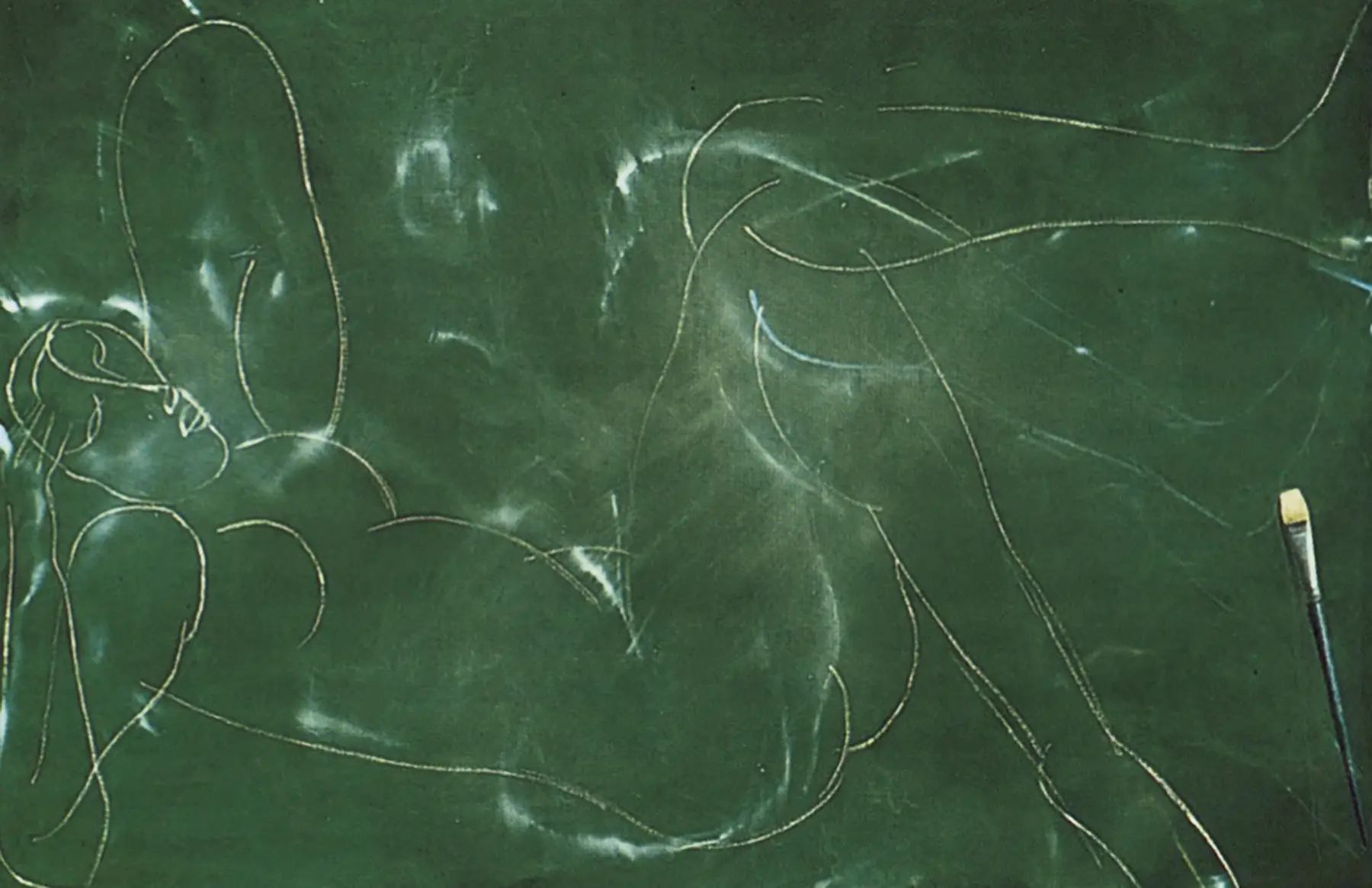
Cárdenas's work is, on the one hand, that of a painter and drawer, and on the other, that of an artist who expresses himself in the most finished manner and also, particularly in recent years, in the freest of forms. He is an artist who has created with realist perfection all kinds of ordinary objects, from men and women's articles of clothing to vases and still-lifes, although it is clear that he prefers objects with surfaces: glass, mirrors, boxes, and above all, blackboards, one of the constant themes in his work. But from approximately 1985, Cárdenas has also been working far from realism, preferring to syncopate representation, alter the traditional perspective, and use arbitrary colors which are sometimes very varied and intense. In both cases, he has produced some outstanding examples—and in the end, it is a matter of taste if we prefer the impeccable finish, which deceives the eye and our sense of touch, of a bathroom wall with a glass shelf and a drinking glass with a little cold water (Glass Shelf With a Glass, oil, 1978) or the more synthetic, unfinished kind of figure, with a skirt made of stains and curves, and set against a green plane, (Tropicana, oil, 1988). Perhaps for this reason, the artist decided, from the mid-1980s, to bring together his two modes of expression and, against a background which recalls the surface of the blackboards with the marks of sketches and rapid basic drawings of female nudes, install realistic objects such as walking sticks, hammers, metal clothes' hangers, pieces of rope, etc.; or more recently, place realistic objects such as tables, chairs, vases, and dishes against backgrounds of paintings, with reminiscences of action painting.
[[IMAGE]]
Whether in one style or the other, Cárdenas always shows his great knowledge of painting and drawing. As a realist painter, he works with smooth brushstrokes, covering his surfaces with flashes of light and shadow. He reproduces exactly the textures of all his objects, and he handles color with a great sense of composition. As a painter of expression, he apparently works with great speed, improvising and correcting, with a lot of stains of varied and strong coloring and open surfaces which divide up the space and give it a sense of movement. As a realist draftsman, he is a master of the nuance of light and shadow, and knows how to create almost imperceptible shadows which highlight the tactile qualities of the images of the objects. At the expressive level, his line-work is sure and elastic, with a wide range of different intensities.
A careful examination of Cárdenas's abundant production in this exhibition - especially the large number of originals, some of them shown for the first time in Colombia, reveals that his pictures are indeed really simple, but at the same time, that only at a superficial level do they seemingly not transcend the simple interest of faithfully presenting the figures of many common and ordinary things. From the beginning of his work in the 1950s, when he was still studying in the United States, Cárdenas has insisted on paintings and drawings which question not only the various meanings of realism in the history of art, but the very concept of reality in the world of philosophy, physics, and so on.
[[IMAGE]]
In any case, Cárdenas's figurative art is related to the history of realist art and, in particular, to the various forms of realism of the twentieth century. Although evocative in some respects of the work of the masters Jean Baptiste Oudry in the eighteenth century and John Frederick Peto in the second half of the nineteenth century, the themes, the treatment of many of his paintings, and his interest in presenting motifs in different ways, (questioning illusionism and literally transfering the appearance of things to his canvases), are all clearly part of the art of the twentieth century and such well-know figurative expressions as pop art or hyper-realism. Anyone familiar with twentieth-century art can establish a relationship between Cárdenas's large production and the work of many other artists from recent decades.
But in his more significant work, Cárdenas does not simply continue along the lines of these artists, but undeniably tries to go beyond them. In the case of the blackboards, for example—Cárdenas's most extensively worked theme—it is clear that he is not satisfied with merely deceiving the eyes of the spectator, but creates a large variety of variants, both physical and conceptual, endowing their apparently anodyne surfaces with a multitude of suggestions. The blackboards appear smudged, with various graphic marks and letters visible on various parts of the surface; they are framed by wooden edges which are slightly in relief or have a protruding lower edge, almost always with a lot of chalk. Then there are the blackboards with words which, although slightly smudged, remain visible. In Rose Color (1976), which won the First Prize at that year's National Salon, the words of the title can be read more or less clearly, although the beginning of the word "horrible" (horrorosa) has been rubbed out. There are also vestiges of what was written a bit further down: Life is rose colored in Colombia. Or against a background which has all the characteristics of the surface of a blackboard, now without edges, figures can be seen, some of which are very rapidly done, elementary or even clumsy, as though drawn carelessly. Sometimes, the blackboards show patterns of light through windows which extend vertically or horizontally. It is perhaps not redundant to say that all this description is exclusively painted. It is a painting which makes a mockery of the division between realism and abstraction, and Cárdenas is undoubtedly familiar with the history of abstract painting, especially abstract expressionism, post-pictorial abstraction, and minimal art. Thus, a blackboard becomes transformed into an attractive object, full of details which show considerable perspicacity, which makes painting into something ambiguous that can be seen as a synthetic space full of linework and figures or as an illusory support of falsely tangible objects.
This retrospective exhibition of work by Santiago Cárdenas was an enriching experience, which offered a relatively complete review of his production and at the same time, presented a number of pieces from private collections or which had never been seen in the country. It was a good way for the Luis Ángel Arango Library to close its 1995 season and bode well for the program scheduled for 1996.
GERMÁN RUBIANO CABALLERO
Associate professor of Colombia’s National University. Founder member of the Editorial Committee of Arte en Colombia/Art Nexus.