
Correct me if I am wrong: the bonds of friendship between Mexico and Colombia are much deeper than they seem, and I believe that Mexico, as a country in the north but which is really in the south, has always treated its southern neighbor with a kind of paternalistic condescension. That is, many Colombian writers and plastic artists have preferred to live in the Aztec metropolis, but there are, for example, Mexicans who have chosen to live in Colombia. I make this remark because it is time to reverse the roles and recognize the fact that there is a multiplicity of extraordinarily vigorous artistic languages flourishing in Colombia, whereas in Mexico, we continue to cultivate an almost puerile kind of solipsism.
For many Colombian readers, the contemporary art of Mexico is well known, thanks to the dissemination provided by ArtNexus in recent years. Our gratitude must also go to Poliéster, which published an article on the art of our country, as well as to the Boletin de Curare for a number of reviews, and a few other publications in this sea of increasing cultural journalism.
The contact which the Mexican public has had with Colombian art of the1990s hasbeen the fruit of two excellent exhibitions: the first was Point of Support, which was curated by Ana Sokolov in1994, for the Ex-Convent of La Merced in Guadalajara, Jalisco, on the occasion of the Third International Forum on the Theory of Contemporary Art, a parallel event to Expo Arte 94, and which presented only Colombian artists.
The second was an adventure on which Paloma Porraz and Rosalba Garza embarked for the El Chopo University Museum in 1995 and the Luis Angel Arango Library in Bogotá in 1996, which focused on similarities in artistic proposals produced in different cultural contexts. This exhibition presented work by ten Mexican and twelve Colombian artists.
The Colombian visitor to the show entitled The Spirit will Speak for My Race: Colombia-Mexico Artistic Exchange at the Luis Angel Arango Library in Bogotá will be surprised by the selection criteria in the general context of the event. Let us begin with the most obvious points. Neither Carlos Salas nor Fernando Garda Correa belongs in generational terms to the main group. Their investigations into one of the most formal and closed languages, abstraction, did not need to be presented here. Carlos Salas's mastery of his means of expression is obvious. His large-format piece, entitled With Space, mounted in three parts in one of the rooms, reflected a formal concern with color, the three-dimensionality of the pictorial planes, and the tables, where his artist's book was presented, and which offered a playful view of his ideas on painting. On the other hand, the two polyptychs by Fernando García Correa seemed to be rhetorical games.
When I say that they should not have been included in this show, it is because the general emphasis was placed on works of a narrative kind, in which the common themes were ecology, political violence, identity, and the recuperation of a primeval world, among others.
All exhibitions have their own poles of attraction. Here, in the Luis Ángel Arango Library, the two sculptures by Yolanda Gutiérrez, the installation by Juan Manuel Romero, and the simulacrum by Nadín Ospina stole the attention away from the surrounding pieces, which does not mean that the latter were mediocre or bad, but simply that artistic luck is governed by these kinds of caprices.
I shall begin with Juan Manuel Romero, who had presented in Mexico a controversial installation, ambitious but flawed, in which he tried to evoke Van Gogh's palette by placing more than three hundred striped fish, the aggressive proximity of which was intended to generate the sought-after colatura expressiveness. The work totally failed in its Frankenstein-like attempts to control the forces of nature. (The catalogue photo shows a detail of this unusual canvas).
Romero found it difficult to swallow the criticism and, in the Luis Ángel Arango Library, he decided to show his critics just what having vision and ambition is all about. Yoke is a medium format installation, which begins with a small transparent acrylic box containing a striped fish from which there emerges a structure that grows upwards and outwards, in the form of a magnet or horseshoe, and which then decreases in the same way to end up in another transparent acrylic box, with another striped fish. The reading proposed by the artist is that it is a work about intuition. Others might see it as a metaphor of how a human being endeavors to control nature, placing a terrible yoke on the fish.
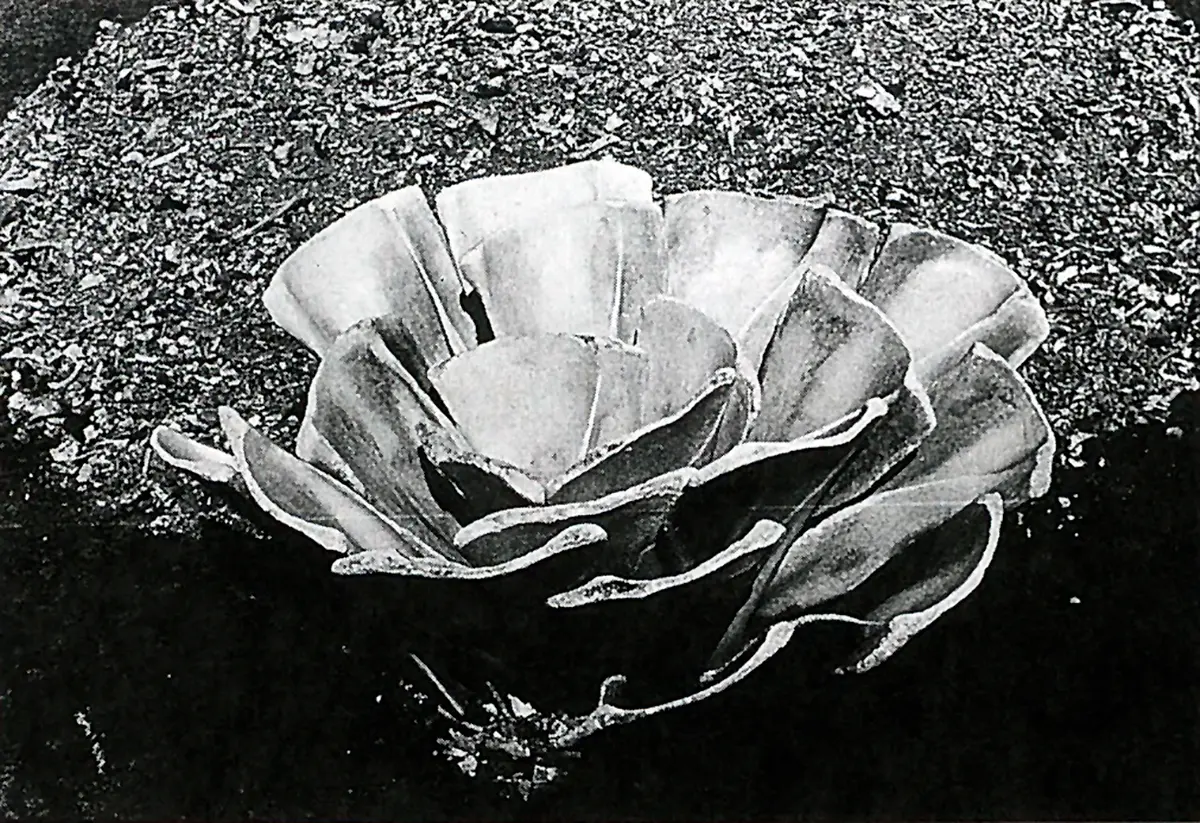
Yolanda Gutiérrez's sculptures have a powerful and poetic tessitura. The use of such unusual materials seems to be the only way of resolving her proposals concerning the opposition and/or complementarity of the cycles of life. Yolanda Gutierrez uses bones and ashes in her piece entitled In Essences, in which she presents elements that are apparently dead, lotus flowers, which in the Hindu religion are symbols of reincarnation, and an example of the fact that life and death are merely stages in the same process. In a small sculpture entitled Stripping the Leaves from My Soul, the dried intestines of a pig simulate a delicate flower on the butcher's brutal hook. Yolanda Gutiérrez knows that life and her materials are suspended in a delicate balance between the idea and the object represented—hence the force of her visual metaphors.
Nadín Ospina continues to use museum presentation cases as an ironic support for his sculptures. It is true that the ceremonial theatricality which he deliberately courted when he won the prize at the National Salon in Colombia with his false pre-Hispanic figures has now become a refined game of sounds and pastel-toned walls covered with little black balls presenting his ritual ceramic pieces. In The Great American Dream, the urns, gifts, and staff of command have been restored and transformed into new pre-North Americanized Hispanic figures from our remote present.
We can eclectically say that María Teresa Hincapié, Miguel Ángel Rojas, José Alejandro Restrepo, Francisco Fernández Taca, Carlos Uribe, and perhaps Yolanda Paulsen make up a group of artists whose concerns seem to focus on an attempt to recuperate our earthly origins, our indigenous history (in the broad sense of the term), our Latin American identity, and to reaffirm those values which identify us as Indo-Hispanic Americans.
The first two Colombians in this group were invited as representatives of the continuity between the previous generation and the central nucleus of the exhibition. Here, there seems to have been a curatorial error, since invitations were not extended to the two Mexican artists who, if not in age at least in spirit, are the counterparts of these artists in Colombia. But this was not an obstacle to our appreciation of the splendid and thought-provoking work of Hincapie and Rojas on the common history which our two countries share.
María Teresa Hincapié's performance, like her most recent work, focused on recuperation and a return to the sources. In Mexico, her encounter with the Huicholes had a great impact on her sense of personal introspection and artistic investigation. For hispart, Miguel Ángel Rojas simplified the elements of the installation which he had presented earlier at the El Chopo University Museum: Pacal and Pascual (The Conquest Must Continue) was presented with a minimum amount of elements and acquired a strength which in Mexico had been weakened by its excessively baroque features. Here, the marks left by the Conquistadores on the Mayan Indians are the only trace of pain visible in the work and in our history (that of Mexico and of all of us).
Jose Alejandro Restrepo's video-installation, Humboldt's Crocodile, is not Hegel's Crocodile is a euphuistic commentary on the famous dispute between the Eurocentric Judaic-Christian culture and the peripheral, Indo-Hispanoamerican culture. It is true that Alexander Humboldt, like Albert Durer two centuries earlier, was one of the few European scholars who wanted to learn about the Americas. But Hegel's crocodile does not live in Europe (except in circuses), but in Africa, and Humboldt had to be told that our lizards are called alligators. To each animal his own jungle...
I believe that Colombians must be tired of seeing the Com Mountain as the non plus ultra work of Carlos Uribe. The dramatic photograph in the catalogue did not match the piece on show at the Luis Angel Arango Library, which looked like a little pile of corn on sale at a marketplace. The catalogue version was a majestic mountain, worthy of imitating the pyramids at Teotihuacan, which, paradoxically, were in fact an attempt to copy the surrounding mountains. The work presented in Bogotá needed many more tons of sacred cereal and a more appropriate, larger room, as well as more dramatic lighting.
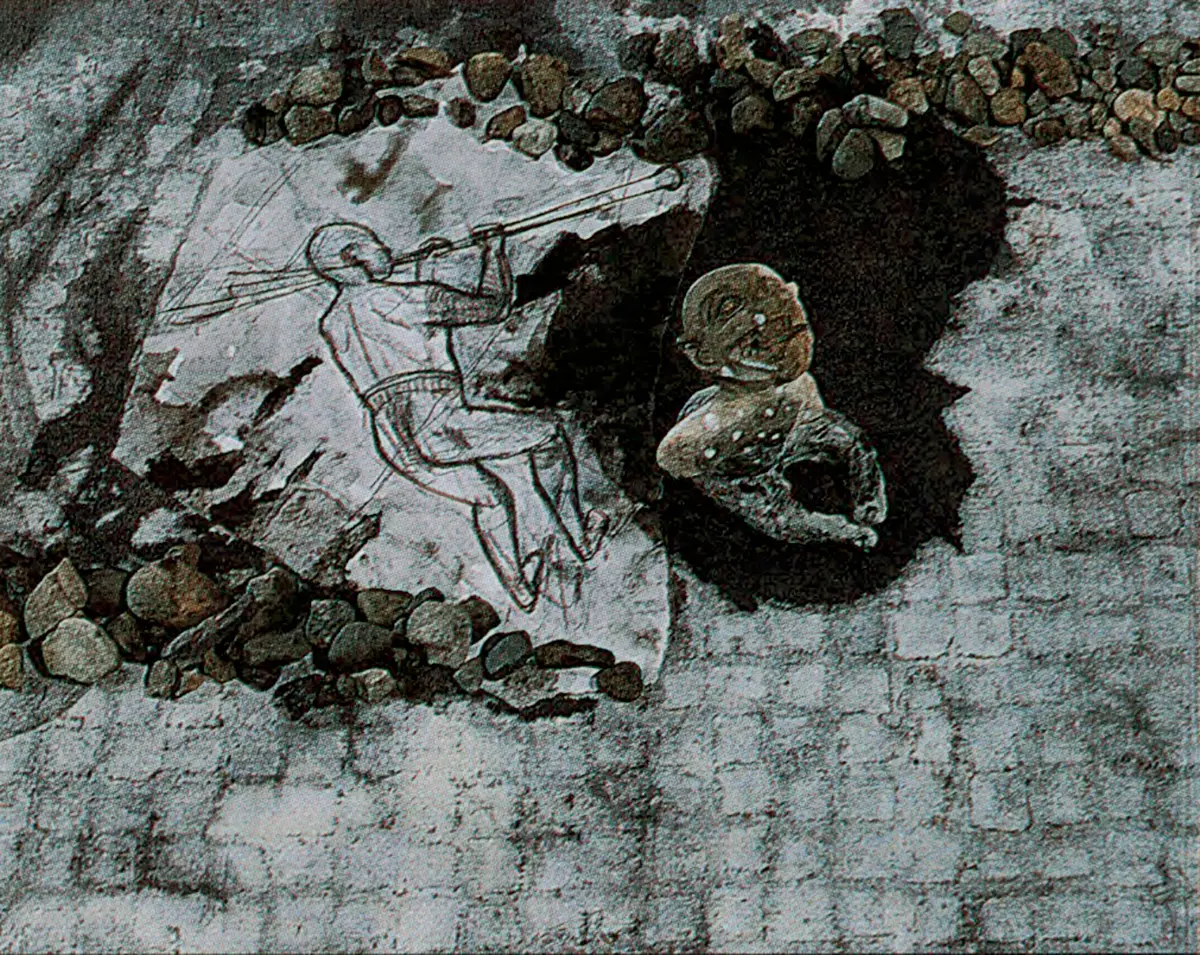
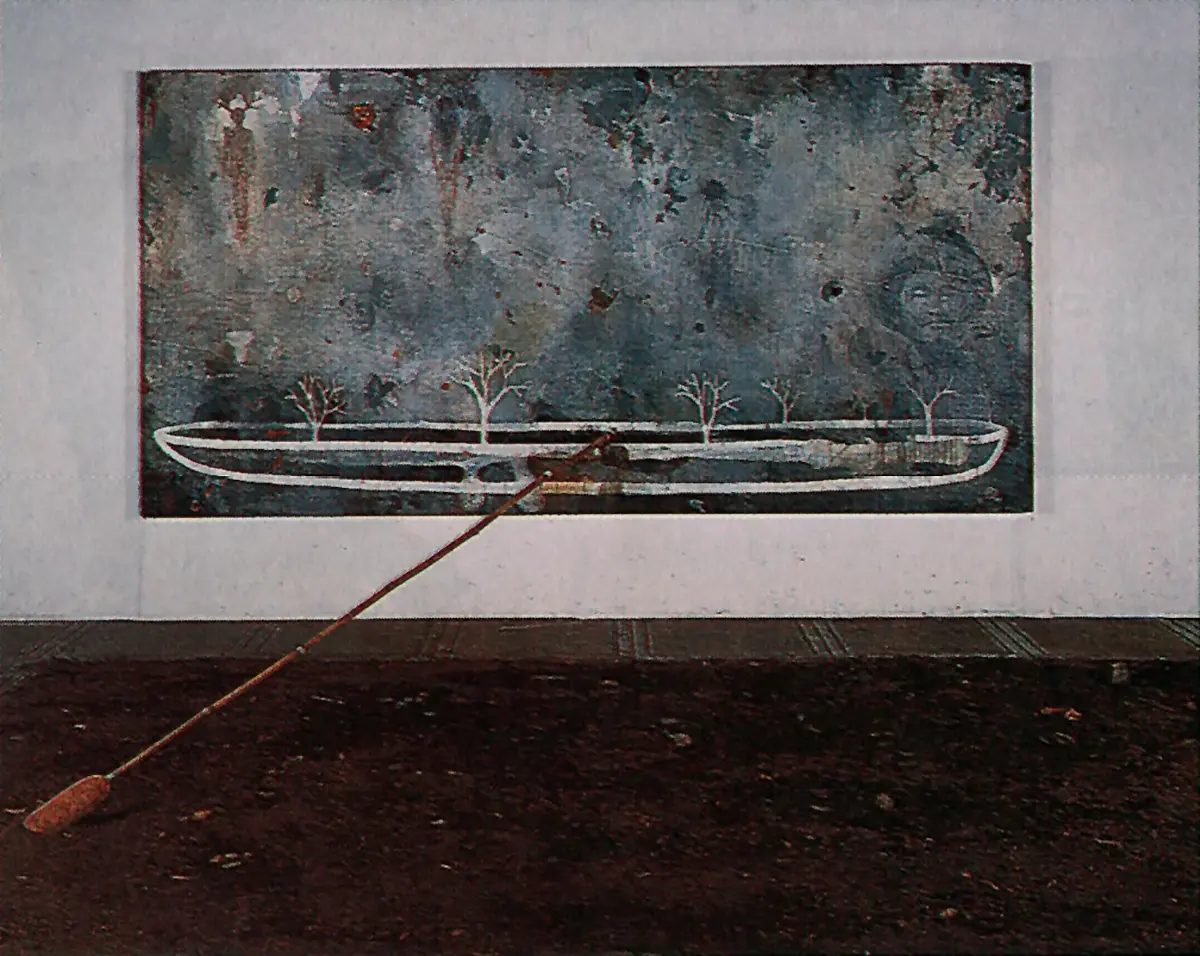
Francisco Fernández presented two very provocative canvases on the recent past of Mexico. With earth scattered on the floor as an integrated element, the works recuperated signs from the Huichola culture, pictorial traces, and graphic elements evocative of the magical divine. The hikuri, a figure of a deer with human features, is the peyote divinity that accompanies the Huicholes during the ritual crossing, and it appears in Fernandez's work as a figure of protection.
One of the paintings shows Ludo Cabañas, a Mexican guerrilla from the state of Guerrero, who died in the 1970s, a reminder of the fact that, although Mexico has always tried to deny its political violence, the latter has always been a driving force in history. The earthy colors, the scant range of narrative resources, and the combination of pastiche and true intention make Francisco Fernández one of the most interesting painters to emerge at the end of the 1980s.
There is no need to stress the masterly skills of the four Colombian painters, Catalina Mejía, José Horado Martínez, Rodrigo Facundo, and Rafael Ortiz. It is, however, worth looking at the relationship that the curators tried to establish between these painters when set along Nestor Quinoñes, Francisco Fernández, Betsabée Romero, and Roberto Turnbull—a breeding-ground for a number of misunderstandings. Why? Although each artist has followed his or her own path, there are some shared common characteristics in the language of these artists, such as the internal texture of the work, the breaking of pictorial planes, the recuperation of everyday nostalgia as a ritual mythological factor, or irony as a driving force for painting.
What is undeniable is that Rafael Ortiz's installation, entitled What Did the Doctor Eat ? lost some of its force when it was presented at the Luis Ángel Arango Library. In Mexico, the white coats were placed on a metallic structure in the form of a cross, which suggested the image of a household dryer, increasing the ironic aridity of the coats whose centers contained a metallic mesh reticle with the remnants of "those meals." In Bogotá, they were all placed on a single metal tube and in an isolated area, which suggested that they were not part of the exhibition and reduced their sarcastic impact.
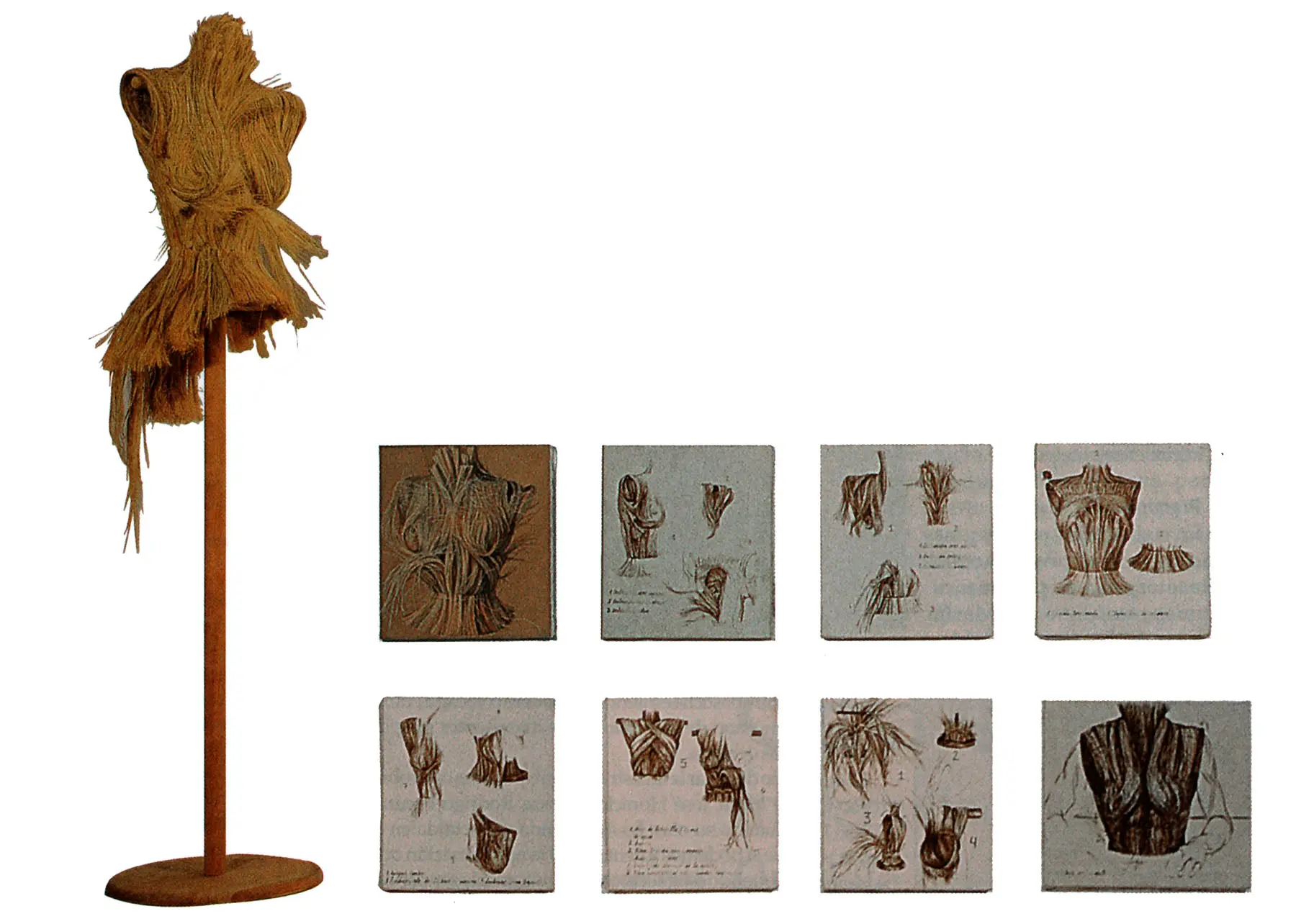
Two other artists presented paintings that subverted their own readings as such: Mónica Castillo and Néstor Quiñones. Castillo has spent a fruitful period of analysis of the condition of women. She does not use the self-portrait as a means of glorifying her own persona, but rather as a mask to engage in a critical review of the roles of men and women, as in the series of portraits with shirts. Production of a Manikin is a masterly and painful piece. The pictures show how to construct a female manikin, and then we see the sculpture; however, the work as a whole depicts a broken kind of femininity. Néstor Quiñones continues to explore the metaphysical line that has characterized his recent work, breaking the two- dimensional structure of the picture and integrating sculptural elements, although the palette retains its earthy tones, and the questions raised about permanence and change continue to be framed within a context where the veil both conceals and protects.
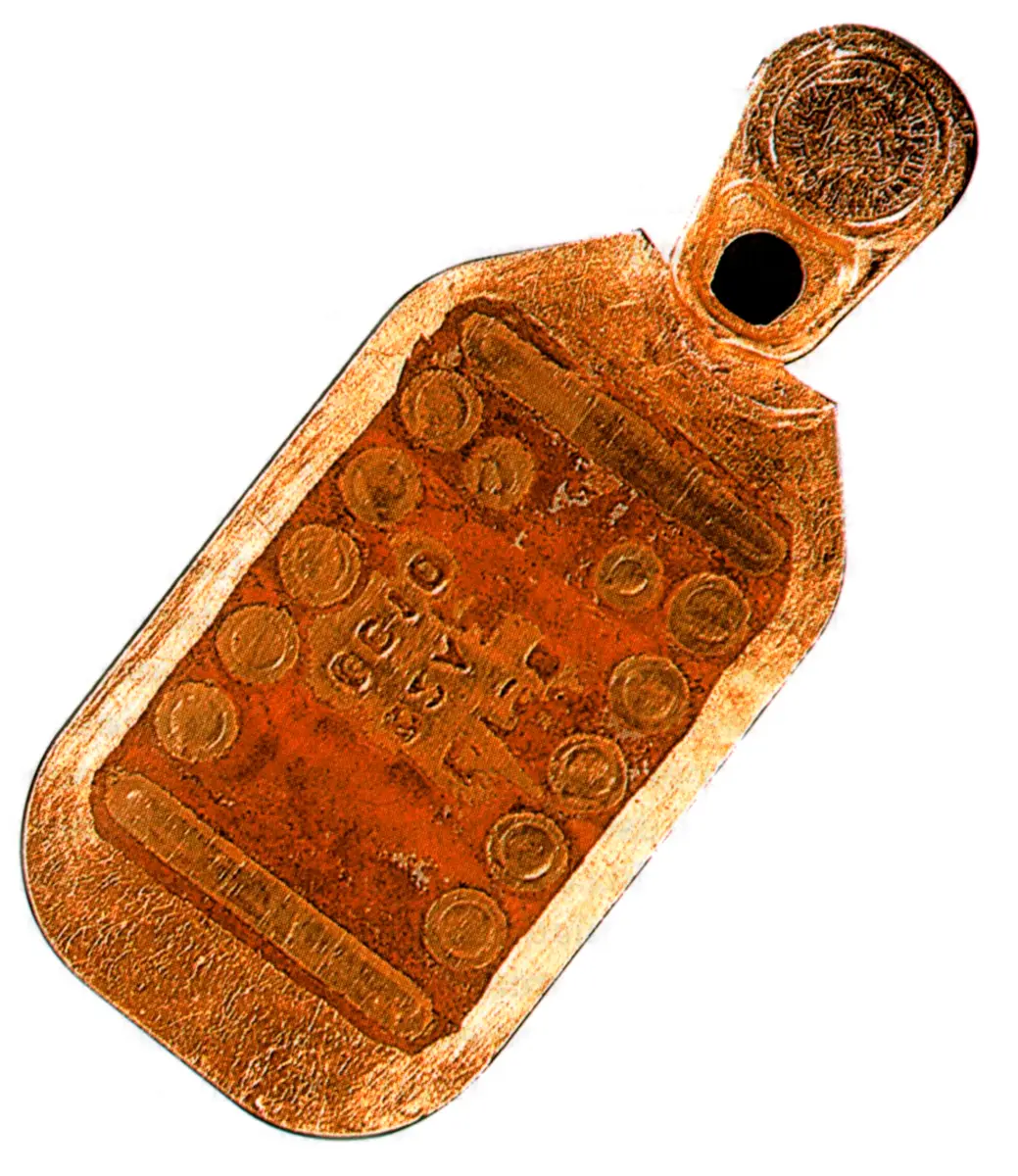
The excellent installation by Pablo Van Wong, which caused such an impact in Mexico, lost a lot of its force in the Bogotá version, where it appeared like a metal box with light. The work should have been shown with zenithal lighting, which would have personalized and dramatized each of the boxes. It should not have been divided into an L shape, which destroyed the visitor's impression of visiting reliquaries in a church.
Delcy Morelos was one of the most impressive Colombian women painters at the Mexican version of the show. In the Luis Ángel Arango Library, she presented part of her Four Thousand Three Hundred and Eight Times, which, despite its fragmentary nature, produced a considerable effect at the entrance to the exhibition.
The great achievement of this event was that it gathered together artists from two countries with great bonds of affection. The friendships, symbioses, and mutual encounters with each other resulted in a genuine sense of dialogue. While the earlier show at the El Chopo University Museum resulted, according to one writer, in a 2-1 lead for Colombia, this time, the exhibition at the Luis Angel Arango Library can be best described as a friendly and very satisfactory draw.
CARLOS ARANDA M.
Mexican art critic. Resident in Mexico D.F.