
Spirits, Archangels, and Ancestors was the title of an exhibition of installations by Arturo Lindsay inspired by the African slaves of Panama and their descendants, organized by the Nexus Contemporary Art Center, which will be presented at various venues in the United States.
The journey in the slave-dealer’s boat led not only to the abrupt arrival of the Kongo, Mandinga, Fon, Yoruba, etc. into a different geographical, social, and cultural environment, but to their separation from their original environment. One of the greatest acts of violence committed against those men and women was to tear them from their landscapes, societies, cultures, and families and turn them into "negroes." This racist term eliminated any kind of diversity, reducing everything to a bipolarity between the dominator and the dominated. Even the very idea of "Africa" is nothing more than a European generalization.
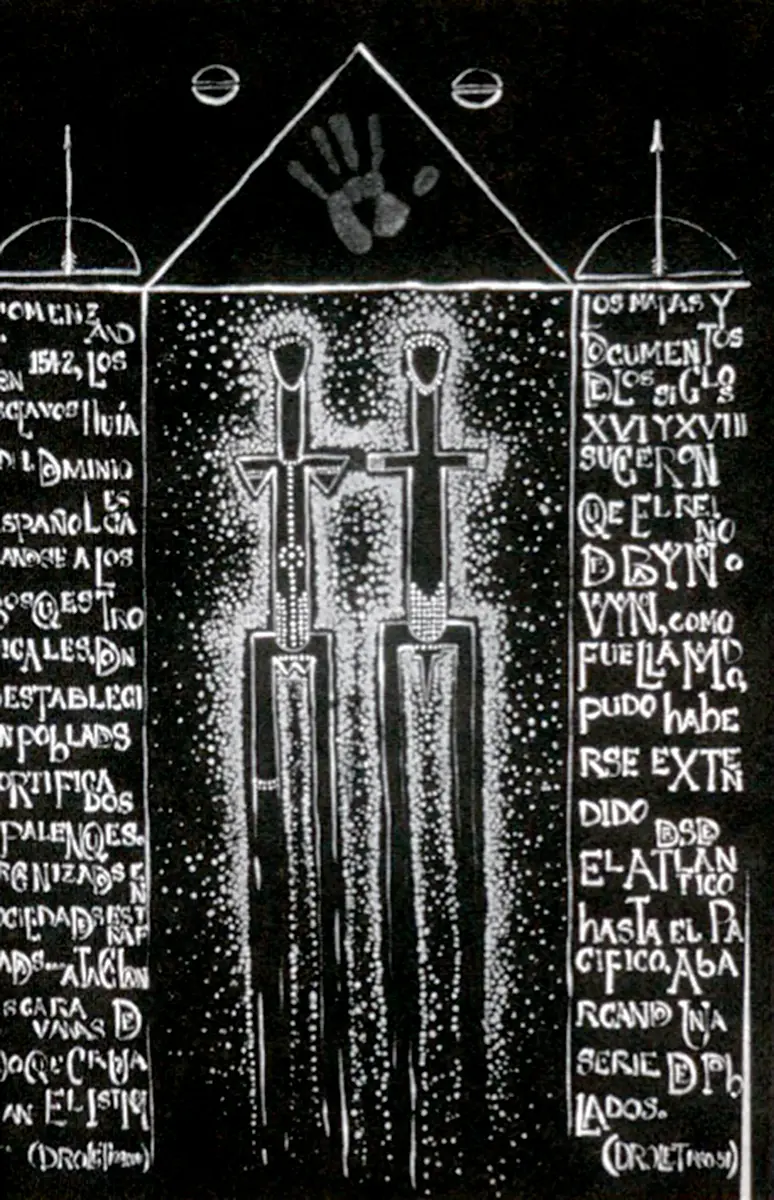
The slaves not only maintained their original cultures and adapted them to the new situation: they made them into one of the most active components of what we now call the Americas. This brilliant negotiation under the whip was one of the greatest spiritual exploits of all human history. While in Brazil, there was a certain ebb and flow between both coasts of the Atlantic, and in the Catholic south, the process was rather propitious, although brutal. In the North, it was rather more difficult. Thus, a frequent feature of African-American art in the United States is the construction of an identity vis-à-vis roots on the other side of the sea. These roots are generally unknown: an enigma between the waters, as the Cuban poet Nicolas Guillen said. But it is they who explain—and ensure—the difference. For this reason, they need to be investigated as well as invented.
Guillen, a mulatto with a Spanish surname, wondered about his real name: Am I Yelofe? Or Kumba? Might I be Guillen Kongue? A good deal of current African-North American art reflects a search for and construction of the unknown name, an Africa which is both mythical and decisive in the affirmation of identity. The case of Arturo Lindsay is an unusual one. He is a mulatto of Panamanian origin who grew up in New York. Is he African-American? Hispanic? Native American?
His search for his African roots took him to Panama, a typically «crossbred» country of the Caribbean. Here, he came into contact with a peasant community of Kongo origin. James Clifford has noted that "perhaps there is no return for anyone to a native land - only field notes for its reinvention." On the basis of his experience there, Lindsay uses his art to recreate a lost family memory, with the structure of the altars of the Afro-Caribbean religions serving as a means to summon up his known and unknown ancestors. In this way, he pays homage to his family and cultural tradition in a mystical convocation and at the same time recreates it from within the mystery.
These altars have an ecumenical meaning and remain open to both the African and European aspects of their lineage. This is an idea that is difficult to accept in the United States, where you are "black" or "white," in accordance with a very Western mode of thought based on oppositions. The inclusive posture adopted by Lindsay is very Caribbean and is based on the inclusive character of the altars, which have always been spaces for dialogue and the semantic reworking of very diverse or even totally opposed elements. The installations inspired by Afro-American altars made by many artists are facilitated by the fact that these altars themselves can be seen as postmodern installations avant la lettre.
Another important aspect is the creation of a history of people without any history. Lindsay imagines the faces of the lost heroes of the slave uprisings and pays homage to them through his art. The works themselves are characterized by a fusion of pop language—associated with advertising and the media, sculptures of traditional African inspiration, real Catholic religious, and Afro-American objects, video, earth, and offerings. The dialogue of meanings is therefore based on a sum of visual and symbolic resources. Using these combinations, the artist creates the iconography of an anti-official history, devoid of images, combining the aura of art with the religious power of the altars to give legitimacy to the marginalized art of his country of origin. He identifies his heroes with angels and archangels, in yet another mixture of cultural perspectives, and at the same time, romanticizes history through a sense of closeness which, as in the case of his homage to his ancestors, reveals a very personal sense of affection.
Lindsay echoes the process of creation of religious imagery, which is an invention of art, including the faces of Buddha and Christ. His "country notes" are minimal: afewgenericfamily names, legends, and a few documentary references. This area of historical silence becomes very moving in his memorial to the millions of slaves who died during the crossing, of whom there remain no images nor names. The work of the artist makes us conscious of how hegemonic the stock of iconography is that we have available. Many of us do not know our ancestors, our histories, or our faces. But as Guillen said, "without knowing ourselves, we shall recognize one another."
GERARDO MOSQUERA