
"When we humans have disappeared, the concrete will prevail, and only the remains of beings produced by that civilization will be left."
The most recent work by Carlos Bermúdez (San José, 1968) recalls a certain passage from Michael Ende’s Neverending Story in which Atreyu, the child warrior, comes across some ruins and discovers with surprise that his own history is depicted on the wall, as part of a distant past which is also his unlived future. This is exactly the sense of Bermúdez’s silhouettes on concrete: they speak to us about the present seen as a past in the future, but in a pessimistic and apocalyptic manner.
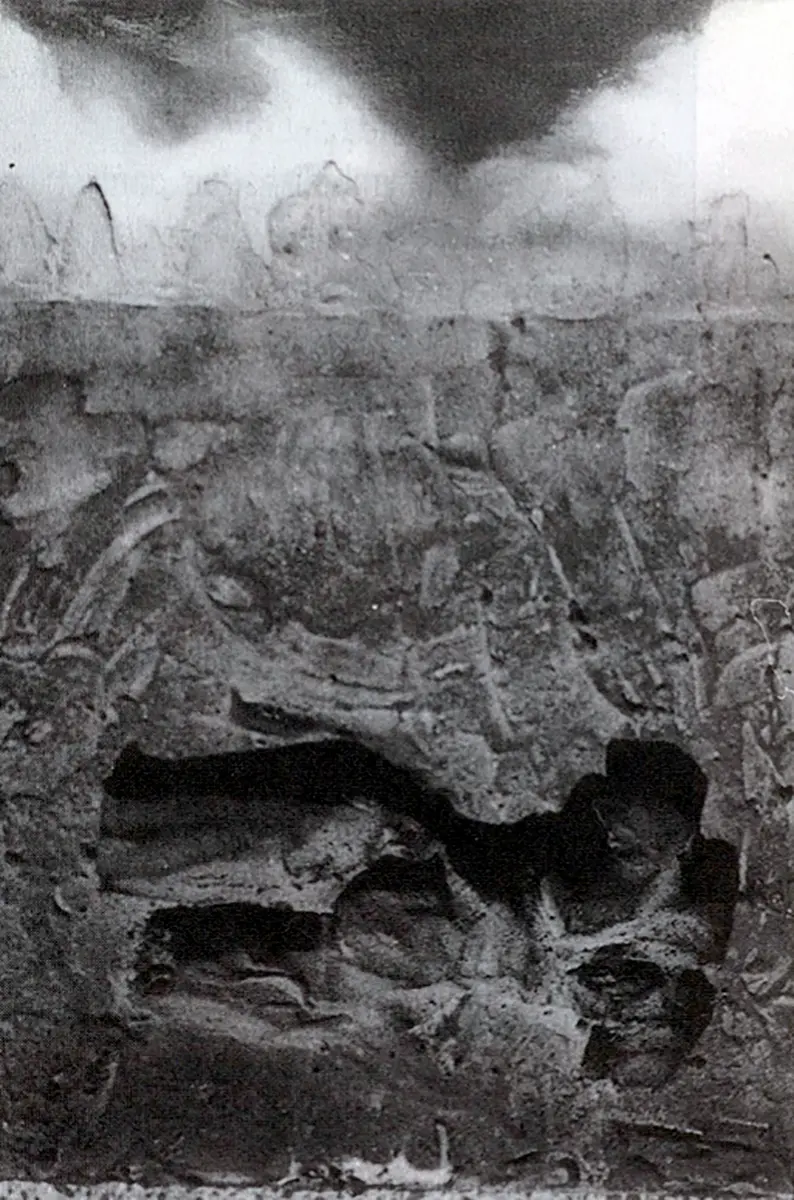
Arranged sequentially along the wall, figures of well-known characters from comic strips, soldiers, and fragments of the human body seem to be trapped in the wood and canvas covered with cement, which acts as the support. Some, burnt by blow-pipe, appear to have received radiation, while others, in polyfoam, emerge as reliefs against something which seems to be a mud or concrete wall. All are remnants of a culture in which we are plunged, a de-hierarchized and schizophrenic world which combines various cultural referents without any scale of values. Bermúdez has constructed a new kind of symbology based on a particular interpretation of mythical figures from mass culture.
At a first level of interpretation, we can recognize Batman, Superman, and motifs taken from the Costa Rican pre-Columbian petroglyphs; in the first three, well-known classics appear in sculptural poses, while the final pieces are treated like comic strip figures. These concepts acquire greater complexity when we realize that the artist is deliberately recontextualizing his creations like hierarchized figures, that is, they are conceived structurally like works of art, not in the way of Lichtenstein, who "reproduced" the comic strip itself, but as symbols of what they represent for all those of us who grew up with them.
Is this attempt to review the symbology of mass cult figures or the "confusion" of comic strip figures with the Venus de Milo or the Discus Thrower an indication of kitsch? Bermúdez is conscious of his use and handling of comic strip images, and rather than kitsch, this work is in fact a parody of sophistication or things recognized as classic, the banalization of cultural paradigms, and their mass application at levels similar to those of the comic strip.
At a deeper level, Bermúdez’s work reflects a certain kind of perception, a way of apprehending the globalizing reality of our times. Bermúdez comments on the experience of a given individual who might be one of us and for whom culture is something generalized and made up of fragments; its consumption is moreover filtered through the various mass communication media, which reduce everything on offer to the same level.
A local television ad mixes Jack’s pizza with Michelangelo’s David, the Roman Coliseum, the "camorra," and the Mona Lisa. This lack of judgment in the complexity of meanings and messages offered by a masterwork of art creates gaps in knowledge, which void these expressions of any content. Perceived in terms of their external appearance, they can be reduced to any image that lacks a structure of profound values and meanings.
For Bermúdez, the pre-Columbian petroglyphic figures are at the same level of reference as the comic strips. In this way, his interpretation is subject to his own experience, and his appropriation appears extrapolated, taken out of context, and integrated into a global discourse in which all iconography appears as a remnant of some society that existed and whose traces are these symbols engraved in concrete, a material which is the representation par excellence of our environment.
The culture of cement, fiberglass, plastic, and the problems of pollution seem to be present in each fragment of his work. However, over and above what those fragments depict, for Bermúdez, concrete is an image synonymous with his childhood and adolescence, the house where he grew up, and the unavoidable mud wall with its bits of broken bottles, which separated him from his dreams. The series on the parts of the human body in relief against the gray and rough texture is a comment on the sense of deprivation and depauperization, and on those who grow up behind each wall and facade. In all this, there is an act of aggression, a violent gesture captured in the concrete.
The wall symbolizes this conflict, but at the same time, the wall itself is also a victim of aggression. It has contained and repressed desire, and the artist, in almost an act of vengeance, attacks it, restoring the humanity which it had deprived him of when he was a child, leaving his marks and those of others for the future.
DERMIS PÉREZ LEÓN