
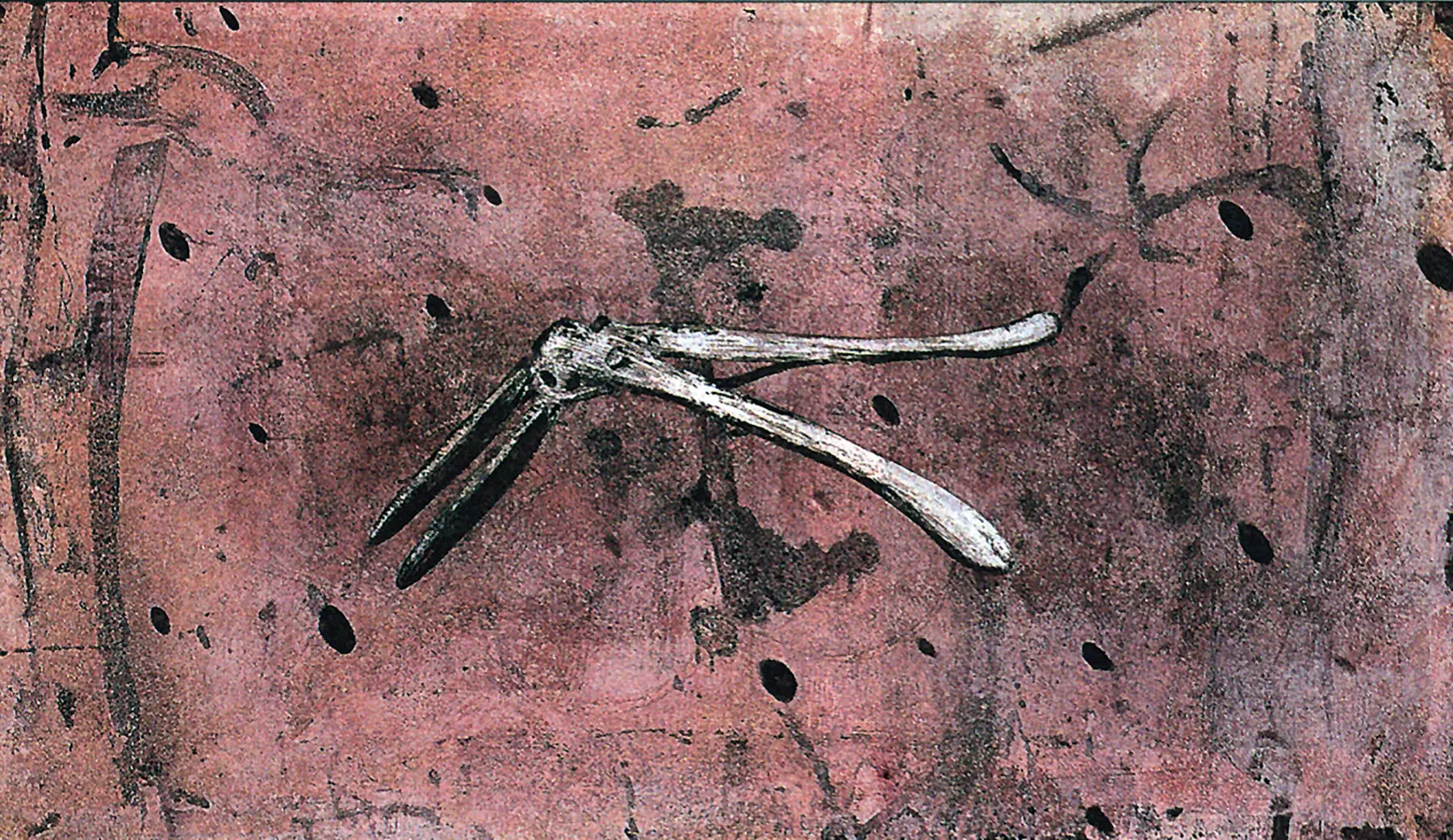
It is ever so difficult to begin. Very much aware of this, Brazilian painter Daniel Senise (Río de Janeiro, 1955) has developed a technique of forging a history onto his support, which will allow him to initiate and subsequently perform other inscriptions. At least since 1988, the majority of his paintings follow a distinct method as regards their first lines. This mock historical work process has been concisely described by Fernando Co-chiaralle as follows: "Cretonne is stretched on the studio floor and then covered by an [layer] of pigmented glue and allowed to dry. It is then lifted and together with the canvas, comes all his pictorial substance —paint spots from other paintings, fibers, leaves, etc.— which had been on the floor.1 Such a method recalls a certain construction of (the painting's) history — how it is written and counterfeited— with one gesture alone seemingly fashioning layers of inscriptions." Daniel Senise's paintings reveal another concern with history, which requires further consideration. These, after all, are times when the historical discipline, along with its idea of progress and linearity, its neat articulation of time and events, has been called into question. The writing of History, as we once knew it, with its claims of representation and recording, totality and universalism, has been discovered to be unattainable. Forever partial and biased, the traditional activity of the historian has had to be rethought in terms of fragments, partialities, and, yes, fiction.
It would appear that Art History, or most of what is produced under that name, has been reluctant to take these issues into consideration. The History of Art, for one thing, remains highly modern (despite its flirtation with the postmodern). The desire to translate, organize, and record (such modern desires after all) persists in both academia and in much of the art press. The work of Daniel Senise does not evidently address these issues, although (as I have written elsewhere)2 his paintings tell us that it is impossible to be certain. In this unsettled context, the artist draws from several sources, engaging not so much in a postmodern appropriation (as in the case of Sherrie Levine or Jorge Luis Borges), which questions authorship and originality, but rather in a tactical and ill-behaved usurpation of the archive.
She Who is Not [Here, There, or Present] (1994), for example, is a series of paintings made after a Giotto fresco. Senise usurped from the fresco precisely what was originally not there: a patina of detritus which history, in a vandalistic fashion, had deposited on it. The series is emblematic of a certain outlook vis-à-vis the history of art, the archive, which the artist at times reveals: it is the detritus itself that interests Senise, what has been left aside, what is devoid of any value, she3 that is not (t)here: the junk of (art) history.
The palimpsest: a manuscript, typically of papyrus or parchment that has been written on more than once, with the earlier writing incompletely erased and partially legible; an object, a place, or an area that seemingly reflects its history. As a metaphor for Senise's paintings, the palimpsest signals the several layers of pictorial text that have been inscribed, obliterated, and erased from the thin on cretonne. Furthermore, it evokes the ultimate indecipherability of the painter's writing, the unattainable certitude. The palimpsest, however, both typically and conceptually, bears true marks which reveal the true history of its support. In Senise, however, the text deceives us; the paintings reveal signs of premature or simulated aging, often torn and stitched due to the severe treatments they have undergone, they peel off and, here and there, have their skin patched.
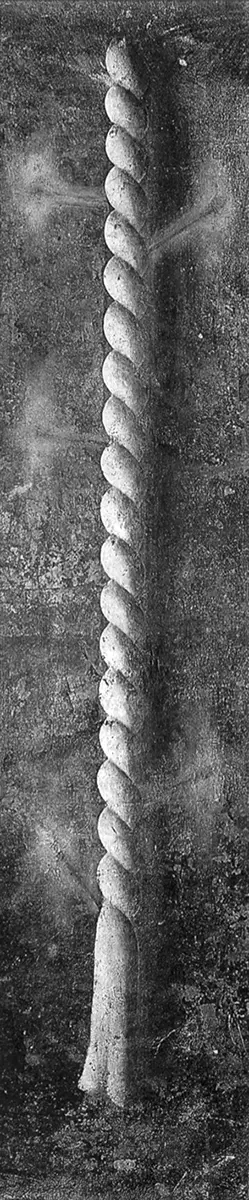
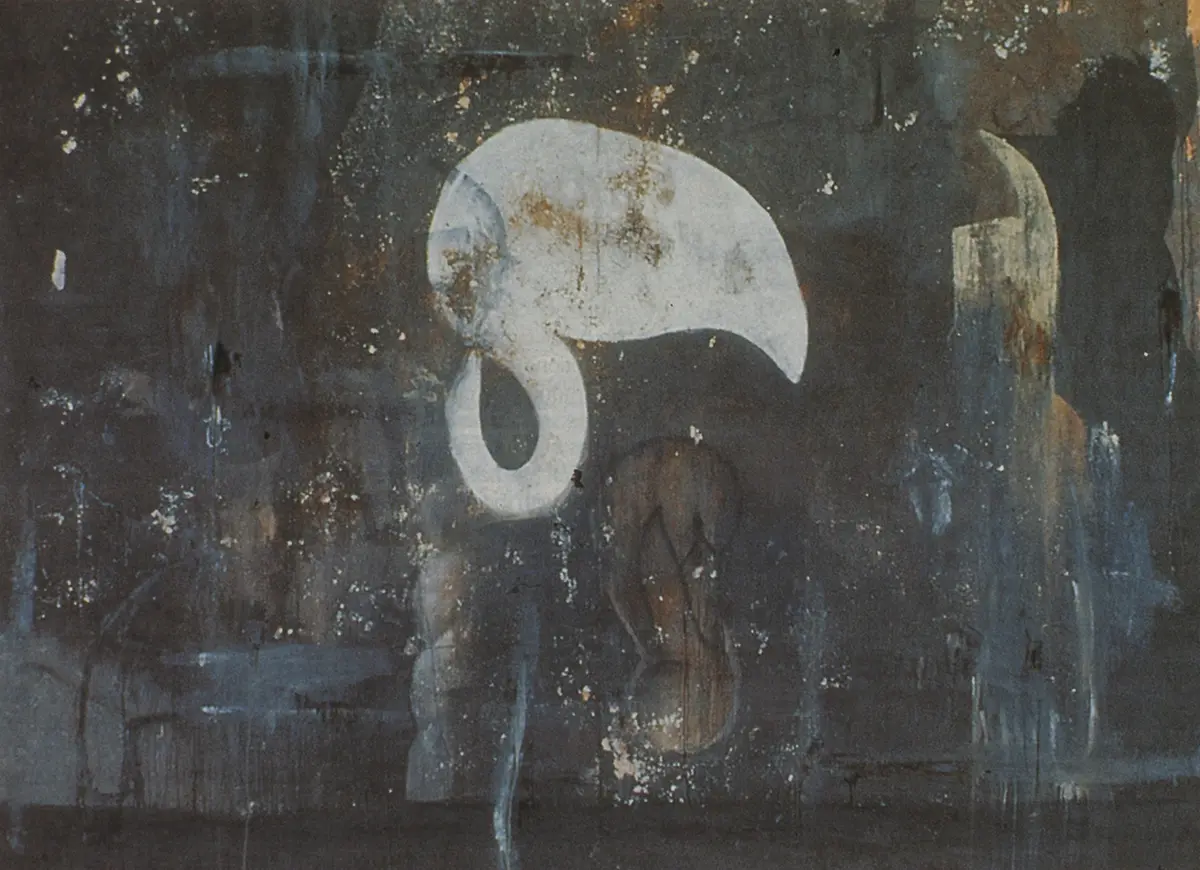
Take Beddangelina (1989), for example, the central figure is obviously the inverted, flattened, whitened, and translucent image of a swan. A symbol of classical beauty, the swan may also elegantly announce death (of history, of the archive, of the author), and Beddangelina means literally "the tomb of Angelina" in the Welsh language. If the swan predominates against the somber background, we can nevertheless attempt to perceive other elements in the planes behind and in front: hammers, a twisted column, clusters of unrecognizable detritus, bits and pieces that have fallen from or adhered to the painting's surface, layered under and over dark or washed-out spills and drips of paint.
Death, history, and the palimpsest recall yet another metaphor for Sen- ise's paintings, one that has in fact been invoked by the artist himself and others:4 the sudario (in Portuguese the shroud, veil, and also the sudarium of Christian mythology, the cloth which bears the imprint of the face of Jesus). Here, the sudario establishes another interplay with history: between memory and forgetfulness, true marks, and fictional ones. Much like a fossil, the sudario has been marked, pressed, and monotype with the negative image of the body it once held. The technique of the monotype itself is often used by Senise: not just when the cretonne peels off the detritus from the floor, but also when the painter places metal objects, such as nails, for several days on his paintings, which will then bear the nail's rusty marks and their memory. In a direct reference to the metaphor, Senise's Sudarico (1990) bears a translucent white cloth in the center of the canvas with larger-than-life nails pointed at it against a cave-like background. Where is the true mark? The sudario here is draped in such a way that we are unable to unfold it, face, and discover the true imprint it holds.
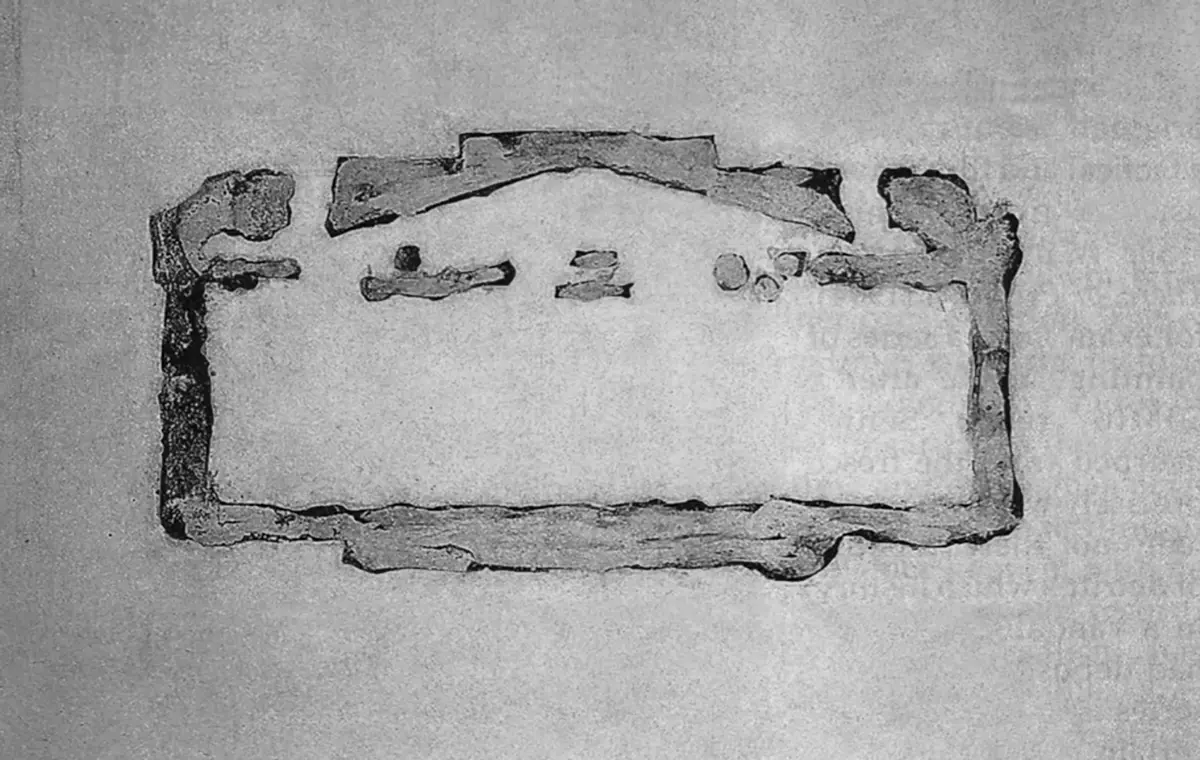
Truth: complete assurance and unfailing certitude are characteristic of an encyclopedic desire. In modern and enlightened terms: to record and translate everything into an all-encompassing book. Senise's Everything That Exists (1989), is a play on such terms. A painting first exhibited at the 1989 São Paulo Biennial, its quasi-figuration may suggest disparate elements in a landscape or a seascape: a silhouette of a bird, the fine neck of a swan, architectural motifs, and full and outlined circles. In the painting, however, these elements are played off against the background. It is indeed a challenge (as in many others of Senise's paintings) to distinguish clearly where the latter begins and the former ends. The formal play extends beyond the skin-deep game of the figure-ground relationship when the account is taken of the painting's caption. As is so often the case, the title of the work is conceptually crucial and changes the reading of the painting. In different bluish tones, as well as with white, gray, black, and a dash of red, Senise paints everything that exists; a futile encyclopedic task elsewhere, but here fully achieved due to the title, which art alone admits. With Buddha, all that exists is a composite that one day will dissolve.
Senise's works may have a distinctive contemporary quality. However, their author seems less inclined to represent the specific conditions of his time and place in history. Brazilian? Carioca? Late XXth century? The 80s, the 90s? One can never be sure. In fact, coupled with the paintings' contemporary quality is a fin de siecle mood, rather decadent (with regard to the fine arts and histories), painfully melancholic, yet reluctant to desist.
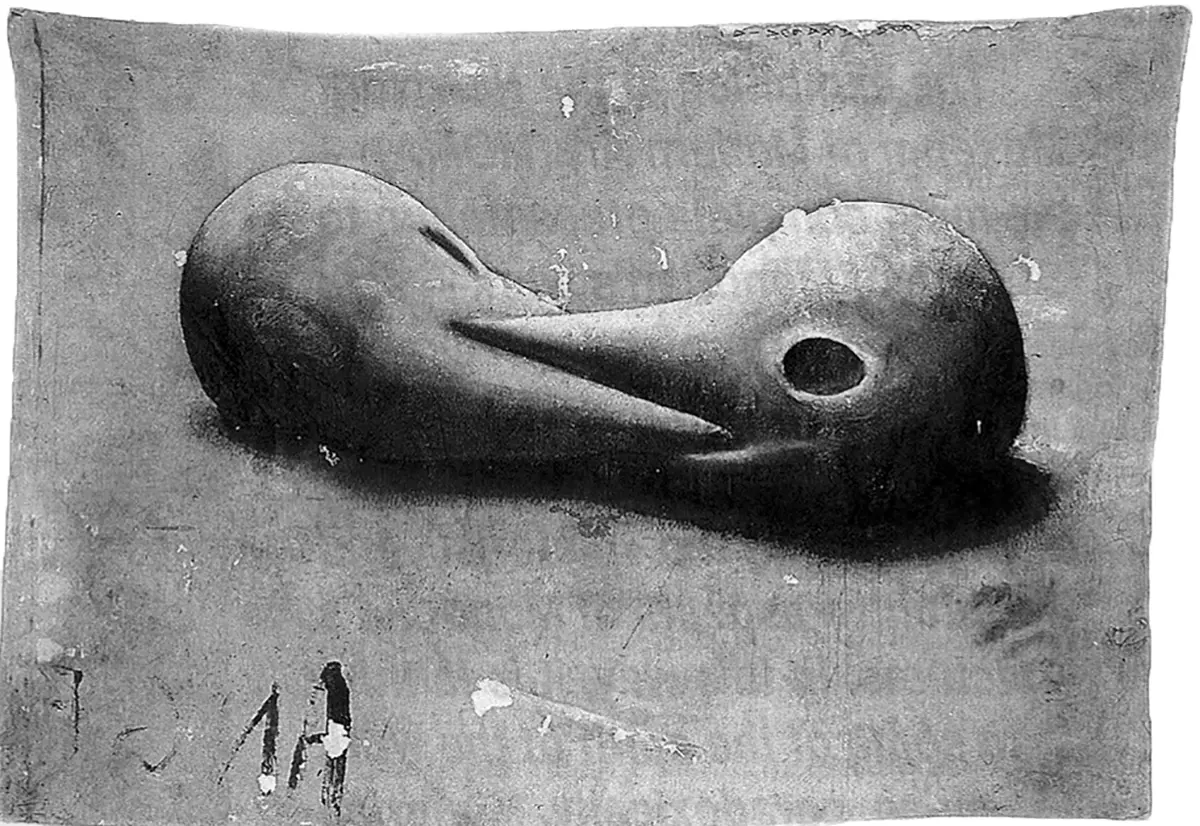
O beijo do elo perdido (The Kiss of the Missing Link, 1991) is an eloquent symptom of this mood. Two fantastic skulls are locked in a never-ending kiss. This deadly pas de deux is painted in earthy tones and defined in somber shades. Rendered over an infinite background, it may be seen as a double portrait or a sterile landscape. The resulting image recalls the very symbol of the Infinite, which may in turn point to the endless links of a metaphorical chain of signifiers (which ends in death alone), or the fatality of primal love. Once again, we are never sure.
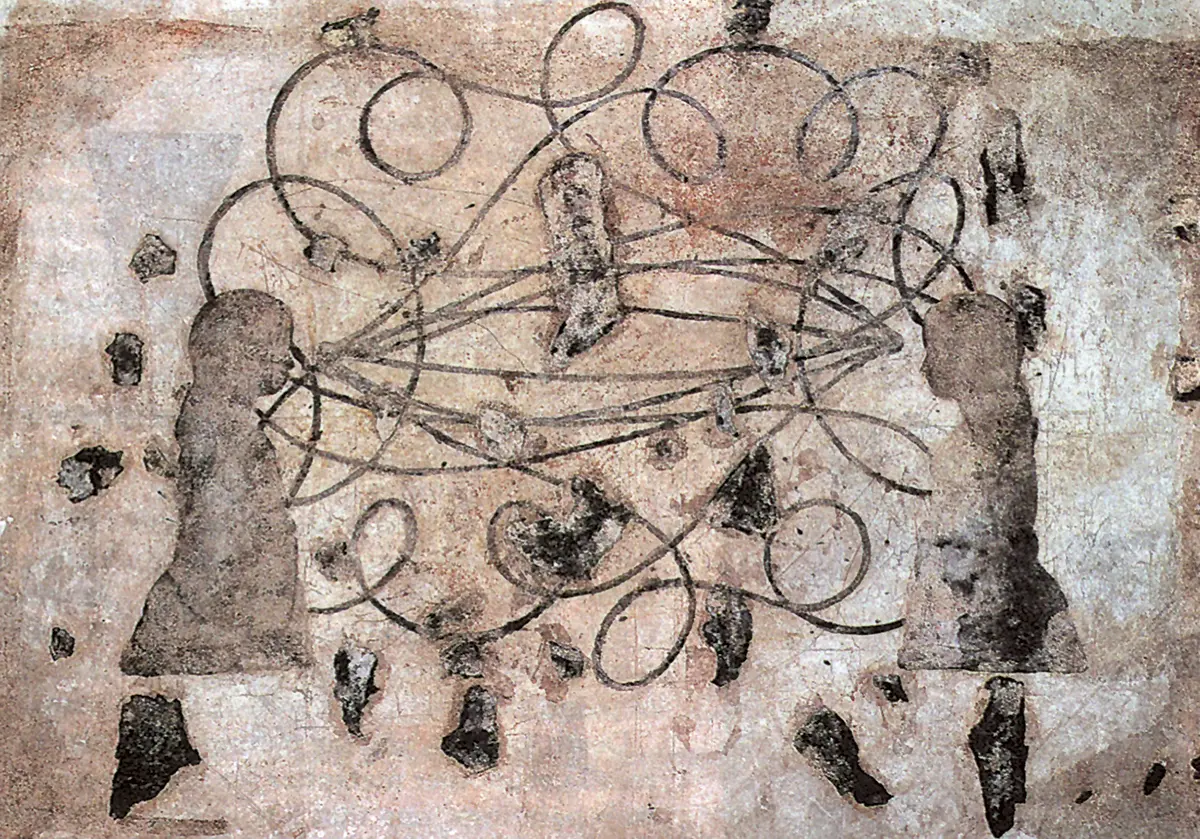
The uncertainties of writing and history constitute the unfolding of an earlier uncertainty, which is suggested by Tres caminos (Three Paths, 1995): seeing. In profile and silhouette, two girls face and stare at each other, and the different possible paths their gaze might follow are illustrated through sinuous serpentines. The noise that obstructs their clear vision is indicated by several slabs of detritus which float around and between them. Clearly, there is no cloudless, unimpeded trajectory. The painting would be a plain illustration of the trickeries of seeing if we were to forget the subject which, although materially absent from the image we see, is inescapably implicated: namely, ourselves, the spectators of Three Paths. Can you see it?
It is difficult to perceive, yet our memory of the gloomy images that Daniel Senise inscribes on his sudario and palimpsests is very much at stake. Hammers and nails; swans, ducks, birds, and dolphins; columns and shells; brains, skulls, and bones; mothers and little girls; clouds and smoke; landscapes and seascapes; shrouds and votive offerings; the infinite —the indecipherable image- repertoire. If it is impossible to forget,5 it is even less possible to remember (we are thus brought back to the fundamental questions posed by Freudian psychoanalytic theory). Among the infinite uncertainties about everything that exists, Senise's work signals an anarchic usurpation of the archive (which is, in fact, a symptom of the death force)6. If it is ever so difficult to begin, it is no less difficult to end.
NOTES
1. Fernando Cocchiarale, Daniel Senise, exhibition catalogue, São Paulo: Subdistrito Comercial de Arte, 1989, XX International São Paulo Biennial.
2. Adriano Pedrosa, "Dura norte/Hard death," in Daniel Senise, exhibition catalog, Rio de Janeiro: Pago Imperial, Thomas Cohn Arte Contemporanea, 1994.
3. History, in the Portuguese language, is a feminine word: historia.
4. See, for example, Paulo Herkenhoff. "Sudario e esquecimento," in Daniel Senise exhibition catalogue. São Paulo: Galeria Camargo Vilaga, 1993.
5. See Paulo Herkenhoff, op. cit.
6. Cf. Jacques Derrida, Mai d’archive, Édition Galilée, Paris, 1995.
ADRIANO PEDROSA
Brazilian artist and writer. Lives in Rio de Janeiro and Los Angeles.