
In a move reminiscent of Marcel Broodthaers, George Sánchez has transformed part of Franklin Furnace into a specialized museum. El Museo de los Balseros is an installation of objects that relate to the history of Cuban refugees who have constructed makeshift rafts and set off upon the ocean in the hope of reaching America. According to official estimates, in the past 30 years, only one out of every four rafters has survived.
The "museum" consists of roughly three main sections. The largest and strongest part is the display ofthe actual rafts themselves. The rafts, all labelled Untitled, are in various states of disrepair and damage, and the wall label dates them and lists the number of survivors, if any. Some are placed on the floor, and others have been hung on the walls. Facing the raft displays are some cases full of artifacts: old food tins, navigational tools, Catholic and Santeria fetish objects. The third element of the installation is a bulletin board with clippings about repressive policies in Cuba and news reports about rafters.
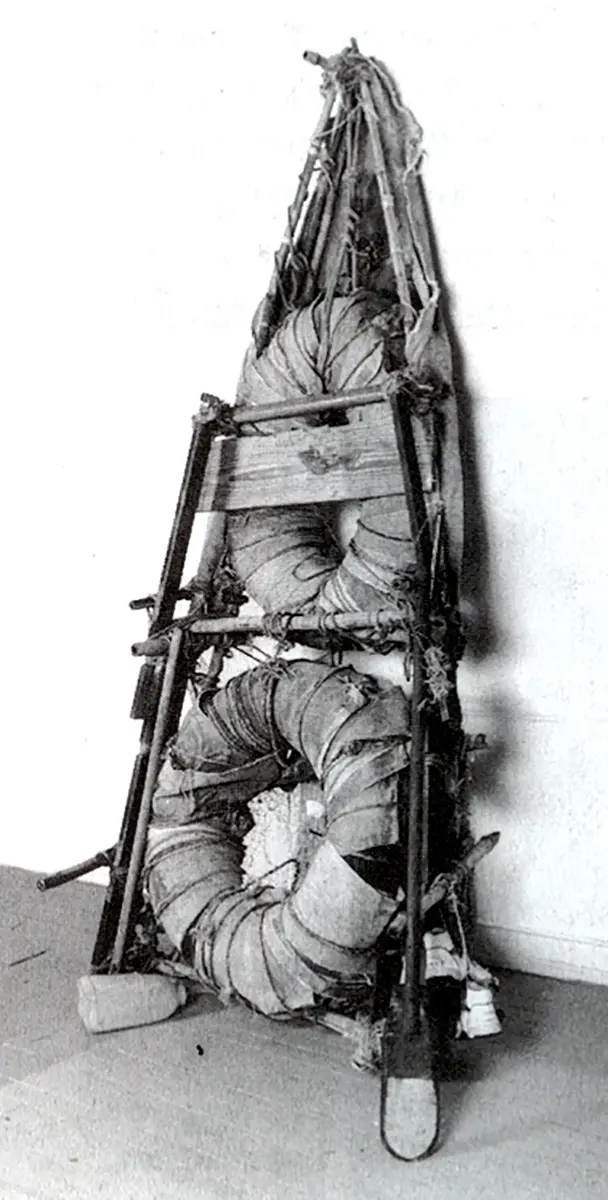
As powerful as this presentation may be, it is highly problematic on many levels, the first of which is the very concept of using a museum setting as the means for telling this particular story. After all, Sánchez has taken the time to compile information packages intended for distribution to libraries and organized a symposium in conjunction with the exhibition; therefore, what does this display add? Despite Sánchez’s intentions, the objects on display remain historical artifacts and do not serve as works of art; in order for found objects to have status as art, some sort of transformation must take place. These rafts, however, remain rafts. They sit and hang as mute documents to one particular socio-historical phenomenon, and as such, they take on an unsettling resemblance to misunderstood ethnographic artifacts. This, in turn, makes them one step removed from immediate reality: they become traces of the other, objects of some distant story.
The story itself is a highly slanted one. Instead of employing a museum’s strategy of surface neutrality and unlike the projects of some of the artists that Sánchez invokes (such as Broodthaers, Haacke, and González-Torres), which allow for ambiguous or multiple readings, this undertaking is unequivocally an anti-Castro diatribe. Without providing any background narrative, which would risk including such potential complications as the initial impetus for the Cuban Revolution, the U.S. reception of Cuban refugees, or the backgrounds of many who attempt to flee, Sánchez insists upon one version of the situation. This is further compounded by the disclosures on the bulletin board. In addition to chilling details about the Castro dictatorship, it has a news blurb on the four pilots who were recently shot down by Cuban planes. While the actual details of the event are still in question—whether or not the incident took place over international waters, the fact that the four men were agitators who flew missions to disseminate anti-Castro propaganda—Sánchez chose only the clipping that rendered them as heroic victims on a rescue run. Despite his overt claims of not having an agenda, there is no mistaking what we are expected to think.
The largest issue raised by this project is the role of museums and what we can expect of them. If such a presentation was meant to bring this situation closer to home, given the intimacy of the objects, in fact, the opposite happens. Indeed, the museological treatment tends to historicize what is a current and ongoing phenomenon. Moreover, not only does Sánchez’s stated goal of turning these artifacts into artworks fail to work, but it is also never clear what is to be gained from considering them works of art in the first place. While other artists have managed in the past to achieve the goal of didacticism in a museum, achieving the transformation of found relic into art and creating art with effective social impact and effecting a museological critique, this particular undertaking falls short of these goals. There is an undeniable force to this project, and it lends a strong voice to the history and debates about the Cuban refugee crisis, but polemical strength is not the only necessary ingredient for an effective art exhibition.
JOHN ANGELINE