
Gerardo Mosquera once said that he was surprised by the number of Latin American artists who were willing to "exoticize" themselves to win a place in certain markets and discourses of the First World. Even in New York, there is a surprising number of young Latin American artists who continue to embrace the tired but very sellable models of cultural exoticism. We only need to glance at the unfortunate list of "Latin" exhibitions presented last April: two individual shows of recalcitrant neo-Mexicanists, Cisco Jiménez at the Carla Stellweg Gallery, and Arturo Elizondo at Anina Nosei, and two dreadful collective exhibits—Spanish is as Spanish does, at the Eighth Floor Gallery, and Domestic Partnerships at Art in General, with their prescribed quantity of altars, candles, and slogans against Yankee colonialism.
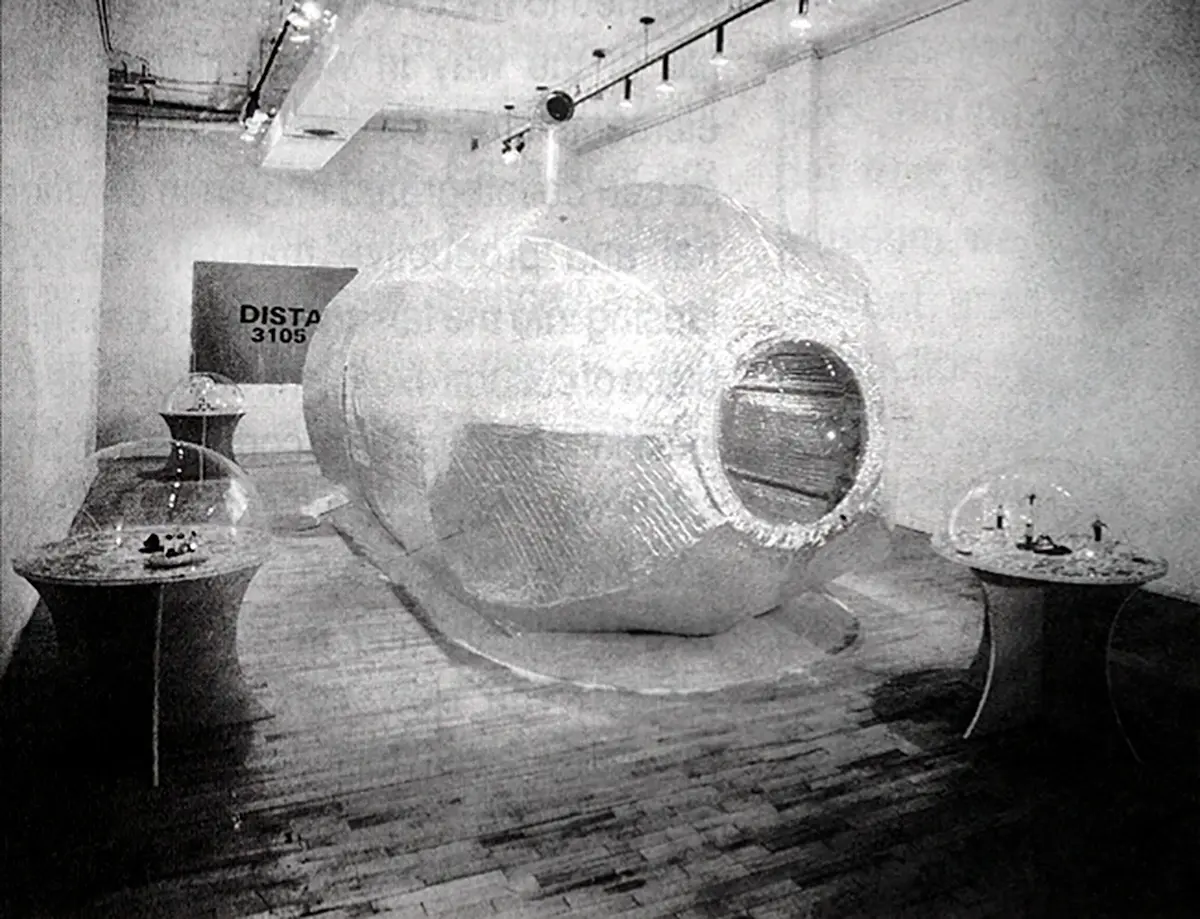
In contrast to this barren land of stereotypes and commonplaces, there were two exhibitions worth visiting, which provided a very welcome breath of fresh air: one by Meyer Vaisman and the other by Javier Téllez. In this note, I shall review the latter, a small but excellent individual show which Téllez presented in the Silverstein Gallery throughout almost all the month of April. This young Venezuelan artist proposed an intriguing installation rich in theoretical connotations and incorporating a good dose of humor. It took the form of an enormous silver capsule which filled almost all the gallery space, and around which visitors could walk. At one end, there was a kind of skylight allowing us to look inside the capsule where we could see the artist, dressed in an orange suit and wearing glasses, sitting on a chair, with an enormous shell held at his ear, and surrounded by yellow furniture.
The artist spent a couple of hours inside his object during the installation of the show, and repeated this exploit each Friday and Saturday throughoutthe month. The strange capsule rested on a sea of detergent, and from a horn located at the top, at the end of a periscope-like tube, the vessel gave off the rhythmic sounds of a tropical cumbia dance. Outside, on one of the walls, there was a flag the color and inscription of which recalled a Prozac capsule. The artist explained that his piece was an attempt to make a new reading of the biblical story of Jonas and the whale. He was interested in combining the themes of imprisonment and penitence with the idea of an artificial world, a fantastic and isolated kind of reality. If in ancient times Jonas spent several days isolated in the stomach of the whale, nowadays many people, with a dose of Prozac, create an equally isolated and unreal kind of world for themselves. This interest in "encapsulated realities" also led the artist to include four "satellite stations" installed around the main capsule—small tables which, under a dome of transparent plastic, showed plastic landscapes full of smiling figures surrounded by false green fields.
The logical thread of all these associations was a little difficult to seize, especially since the piece did not attempt to communicate any didactic or moralistic message (one of its qualities), although it functioned very well as a reflection of the mechanisms operating in the artist’s mind, especially as regards the expression of certain ideas and conscious and unconscious concerns. In this sense, the handling of technique recalls certain works by the English artist Georgina Starr or the Mexican Miguel Calderón—the three are all young artists who have used installations as a means of exploring what Rosalind Krauss has called the "optical unconscious."
This new reading of the story of Jonas seemed to me to be an excellent example of the way in which themes and elements characteristic of Latin America can be integrated into art in an original and productive manner, without lapsing into the falseness and commonplace of cultural exoticism. Javier Téllez’s installation managed to combine regional elements—especially Caribbean music and the architecture of the "capsule"—with a serious and audacious artistic project. The New York art world will anxiously await this energetic artist’s next proposal.
RUBÉN GALLO