
During the last Havana Biennial in May 1994, the Cuban artist Kcho (Alexis Leyva Machado) presented, in a parallel exhibition to the main event, a crocodile that had a little palm tree attached to its back. Looking serious in its cage, My Green Crocodile breathed life into the metaphor which has so often been sung to the Cuba of exile. But nostalgia could not find any rest in the energy and potential violence of the animal, nor even in the fragile palm tree, which nevertheless remained upright.
This action, filled with urgency, involved other equally uncertain matters. Local artists have been powerfully present in the various editions of the Havana Biennial. From the mid-1980s, the international artistic community kept expectations high that the challenge of the Biennial would be confirmed through them. However, the most recent edition was presented with the diaspora of the Cuban artists hanging over the event. The general mood resulting from the socio-economic deterioration of the island was compounded by a sense of confusion and anger, coupled with the feelings of impotence, compassion, and frustration which generally accompany the solidarity and good intentions of the liberal spirit. And in the midst of expectations and bedevilments, Kcho’s crocodile in its cage not only evoked the repressed energy building up on the island, but revealed the actual situation of the Cuban artist. It exposed the stigma of the Cuban artist, who is trapped on various sides: by socio-political circumstance, the resulting meditations, and the international art world with its slanted perspective.
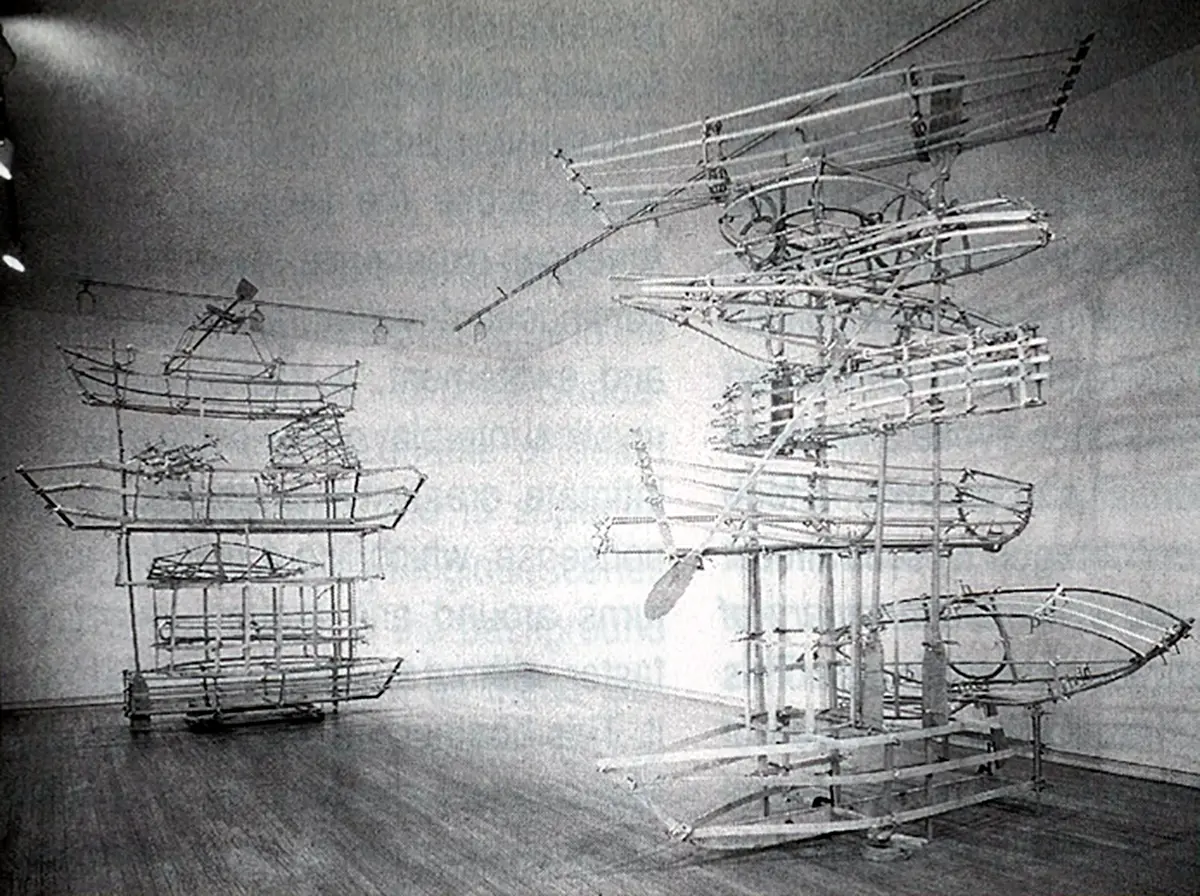
At his recent one-man show at the Barbara Gladstone Gallery in New York, Kcho presented a new scenario in his work, made up of three sculptures and two mural drawings divided over two floors. Curiously enough, there was an indirect and substantial difference between the sculptures upstairs and downstairs. The former, entitled Infinite Column I and II (1996), made a direct reference to the work of Brancusi with the same title. They are very elegant pieces: strips of wood connected with metal presses create a structural volume of boats, vessels, oars, rafts, and other related elements. Each boat is superimposed with apparent lightness onto another, giving the delicate structure a weightlessness, immateriality, and sense of fantasy. The Columns suggest an abstract and poetic vision that encompasses, but also exceeds, their immediate reference. The subtle sophistication of the Infinite Columns confirms the agility of Kcho’s poetic resources.
The contrast between the two floors was disquieting. The care evident in the Infinite Columns might suggest that the poetics of waste materials and the urgency of the artist’s previous works had now become contaminated by the clean-cut work of a good ironmonger, with the asceptic touch of sophistication leading to the glamour now associated with arte povera. On the lower floor, on the other hand, there was a boat constructed with books published in Cuba, most of them referring to Marxist indoctrination. This sculpture was a more direct reference to the exodus of the boat people and was echoed in the drawings, in watered-down versions on the wall depicting two other boats.
The contrast between the works on the different floors highlighted the difficulties faced by artists, curators, gallery owners, and critics in establishing any sense of convergence and precision between cultural differences and the globalization of the contemporary art circuits. The artistic exploration of such specific situations, and in particular those which generate passion on all sides, making the work a hostage of all kinds of ideological interpretations, has a number of implications for artists like Kcho. This is the double edge which Cuban artists of the diaspora have to permanently negotiate and measure.
Whether as metaphor or stigma, the allusion to Cuba has been the bait for presenting Kcho’s work in New York in a heroic attempt to bring the boat/raft theme into the "mainstream." When his one-man show opened, the New York Times ran a review that said that art was the ship used by a Cuban artist to achieve freedom, pointing out that he was denied a studio in his own country and was now using a TriBeCa studio to present his first one-man show in New York. The mandatory bedeviling of Cuba in the North American press does not seem to result in any other possible reaction than that of Michael Kimmelman, the New York Times critic, who wrote that such vessels were synonymous with escape and freedom.
The expectations generated by this exhibition were biased by the confusion about playing the part of the good liberal or prosecutor. What is certain, however, is that Kcho does not need any compassion or any angels of salvation: they would only make the stigma of Cuban art go on being like the crocodile trapped within its cage.
CAROLINA PONCE LEÓN