
This survey of Mutal’s stone sculpture from the last twenty years presents a strong case for considering her as one of the stronger cross-cultural fusionists working today.
Mutal, who was born in Holland, has lived almost half of her life in South America —first in Colombia and later Peru— and has recently split her time between Peru and New York City. In many respects, she can be placed firmly in the context of other contemporary artists who attempt to convey the plurality of their personal identities in their art. However, this is where the similarity ends. While many of her contemporaries tend to favor devices such as assemblage and references from popular culture in their own personal histories, Mutal has not abandoned a more traditional "high art" practice.
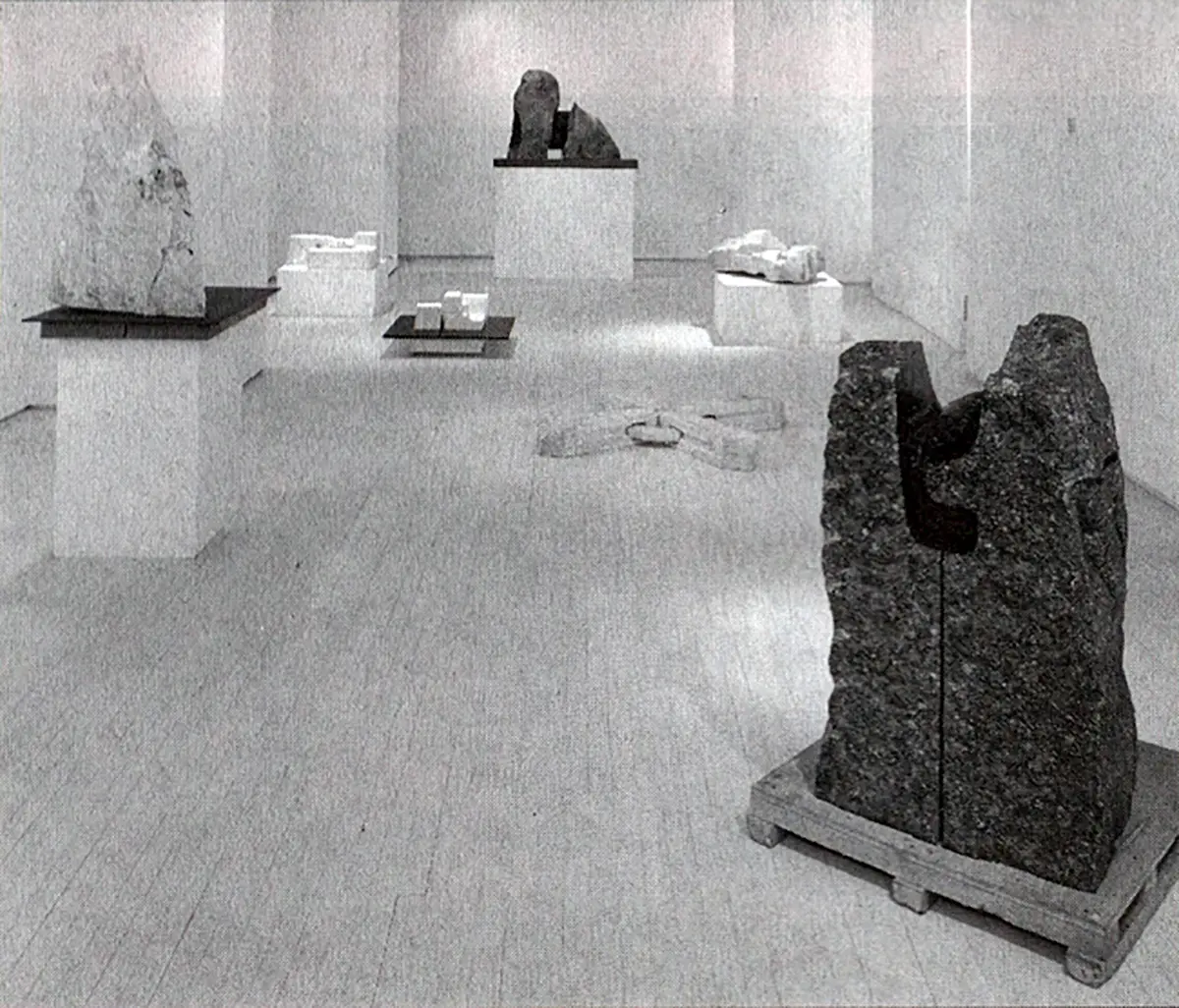
In a sense, she can be compared to Isamu Noguchi. Although their works are formally different and the cultures Nogichi engaged are not Mutal's, the two sculptors share a sensitivity for the actual material they are working with and attempt to retain a quality of the natural form of the rock. Both sculptors’ works have a monumental presence that, no matter their actual size, allows us to envision them on an enormous scale. Mutal, however, has her own aesthetic sensibilities. She clearly tends to favor denser stones such as black granite or pink travertine, from which she hews a final product that is a mix of the rough and highly polished, the random or organic, and the pristine or geometric. Works such as Labyrinth in Situ (1992) combine a De Stijl-derived geometrywith the suggestion of ancient natural rock formations and the evocation of a kind of pueblo dwelling, whereas a work like Threshold of the Light (1991) clearly derives from pre-Columbian carvings.
Mutal’s interest in such cross-pollenization does not rest merely on the surface. Her works often evoke a sense of contemplation, almost devotion, a feeling which is encouraged by such almost overdetermined titles as Sanctuary of Opposites and Garden of Voyage. This indicates her awareness that much of the indigenous stone work from South America was ritualistic and spiritual in intent rather than merely formal or decorative. She is then able to find a point of commonality between this and the spiritualist notions that influenced much of the geometric abstraction of the Dutch modernists. Regarding her work of the last two decades, we can see that in her own quiet way, Mutal has mined the depths of two very different cultures, and unlike many of her peers, she chooses not to portray the clash of opposities but rather to celebrate what is shared.
JOHN ANGELINE