
To some extent, those of us who have followed closely the development of María Elena Bernal’s work since her series of Buses (1977) down to her most recent work, Like Father, like Son, are accustomed to the constant mutations in that work which began which her exploration of the inside parts of a bus, when she discovered her great vocation for construction and color. Subsequently, she turned her attention to the rearview mirror, the observation of the urban world and landscape, recalling pop figuration through her handling of flat colors and her pleasure in everyday objects. In recent years, that observation has become more complex and begun to reveal intricate relations between the objectual world and its reflections, resulting in new chromatic structures in which the natural landscape and urban setting cohabit. Each of these stages has been achieved step by step, in various series in which one cycle seems to be completed and another announced.
However, her current work, notwithstanding the constant change of landscape to which we are accustomed in her case, is singularly surprising. The first surprise comes from the eminent presence of the human figure, only traces of which can be found in the earlier work. The human figure, the protagonist of this new pictorial series, is affirmed in various ways, at various stages, which governed the structure of the show, which was organized into two clearly defined sections.
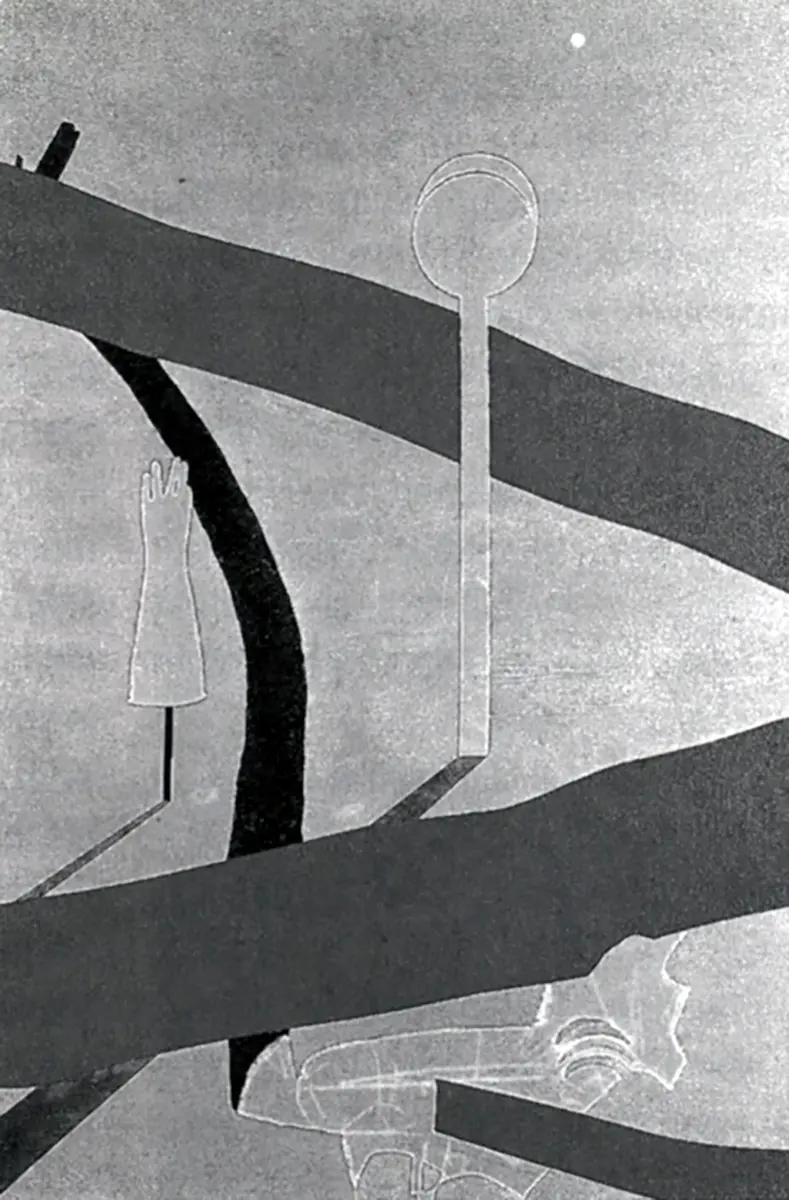
In analyzing this exhibition, we must bear in mind Bernal’s concern with language, the construction of meanings, and verbal relations—an interplay which has been one of the constant features of her work over the years and which is reflected, for example, in the titles of each series and each individual work. This new exhibition created an interplay of meanings that are established within the works through the presence and handling of the human figure.
Thehuman figure bursts violently onto a multicolored landscape, in constant and agitated movement, a landscape made up of bits and pieces of the urban environment and human life, which produce a violent shock when the visitor enters the first room, where Bernal refers to the state of chaos of our city and the sense of destruction and preservation with which all of its inhabitants are familiar. In our everyday lives, we see workers engaged in the daily task of cleaning our streets and collecting garbage; we are also aware of the growing presence of beggars and the poverty- stricken who, like shadows, and sometimes in athreatening way, roam through the city. These two types of figures have resulted in a wordplay which is both cruel and arbitrary: the two-fold meaning of the verb "to clean." These "throw-away" persons are marginalized, and many simply disappear in clandestine and dark "clean-up" operations. Maria Elena Bernal uses this situation as the central theme of the work in the first room, where she establishes a relationship between these two forms of "cleaning" and with the related wordplay. Thus, in some works, the human figure painted in silhouette form refers to the work of cleaning in the literal sense of the term, i.e., the collection of garbage, whereas the other meaning is evoked through fragmentary figures which shock us by their formal decomposition and the violent colors in which they are depicted.
This interplay of meaning continues in the second room, where we are surprised by the presence of the human figure, this time through the presence of strongly colored rubber gloves—which continue to play with the meaning of the word "cleaning"—and the reiteration of the human form through the presence of the hand.
And then, in the lower part of the second room, Bernal produces her big surprise. With an almost total absence of color and using roller prints, she recalls themes that are constant features of her work: the presence of marks and reflections. This time, it is the trace of light that gives rise to the reflection of trees, imprinting the marks of nature on the urban chaos. In this installation, we ourselves are the protagonists who, through our own presence and physical bodies, enter and become the human figure who inhabits this magical and fleeting landscape, which protects and envelops us with an astonishing and singular force.
These two rooms highlight all the preoccupations that have characterized Bernal’s work over the last five years. This exhibition stressed in an unusual way the importance of a process in which art emerges as a kind of reflection encompassing different spheres. There is the everyday aspect, which is related to a clearly defined urban problem, which in turn involves a host of other problems, aspects of an intellectual kind, which are related to the construction of meaning, the forms of thinking, association, and relation reflected in language. And finally, the plastic level, where emphasis is placed on the importance of space and the constructive value of color within that space. All these elements, in different forms, are characteristics of Bernal’s work and give continuity to her artistic proposals.
MARTA RODRÍGUEZ