
Using research models related to anthropology, archeology, sociology, or history, various Uruguayan artists have revealed in their environments and installations conflictive aspects of their national identity1 through different themes and a wide range of analytical strategies. In this way, they have tried to deconstruct the opacity of local history in the process of anamnesis or revision and, at the same time, revealed their sense of disquiet and belief in the need for change to resolve the crisis affecting the model of the country.
These significant proposals have arisen within the context of the postdictatorship (from 1984) and the so-called culture crisis, the pessimistic country, the stagnant country, the desperate country, and the fragmented society. In the wake of the profound trauma of the dictatorship (1973-1984), artists have become aware of the need to rethink the country.
Each of them is examining in his or her own terms the failures or fallacies of a system which had managed to conjure up, for some imaginary collectivity, the concept of a paradise on earth,2 with Uruguay being seen as the Switzerland of South America, the cultural champion of the continent, the Athens of the River Plata, a land overflowing with milk and honey. These fictions led people to believe that they were living in the best of all possible worlds. The country's artists have now had to face up to the sense of disillusionment which has accompanied the return to democracy, since it is clear that the restoration of our institutions has not been enough to restore our sense of normality.3 In such circumstances, our artists, like other thinking Uruguayans, have proposed various possible paths of change, new models, and new forms of imagination. Nelbia Romero is one of the most significant artists engaged in this process.
Debate on these themes and the * need for change have become intensified with the new challenge posed by MERCOSUR, the Common Market of the South.4 In Bye Bye Yauguru, Nelbia Romero examines this topic of crucial importance in present-day Uruguay,5 exploring the process of identity within the post- and supra-national construction of MERCOSUR, without it being clear for the moment whether this will lead to the loss or salvation of the sense of identity. For Romero, as for many others, the project remains a source of expectation and fear, but above all, it is a signal of alert.
In Bye Bye Yauguru, the very title calls attention to the inverted and altered Uruguay of today (Yauguru is Uruguay in reverse). The Uruguay of the past, that of the collective imagination, has become so transformed that it is practically unrecognizable: a new name is needed for the new reality. The absence of the real name is an implicit recognition of the mourning for the country that has disappeared.
At the same time, the artist uses English in her title, an inevitable consequence of the global village and the invasion of English words into everyday Uruguayan life. Eye that Doesn't Feel, Heart that Doesn't See is another reference to the world in reverse, a signal alerting us to other forms of subversion and the incapacity of a society too often anesthetized to react to the destruction of its artistic and architectural heritage and of its natural environment. Nelbia Romero is worried that it is this Uruguay, which has been turned upside down and inside out, which has forgotten its own values, that will have to face up to the challenges of MERCOSUR.
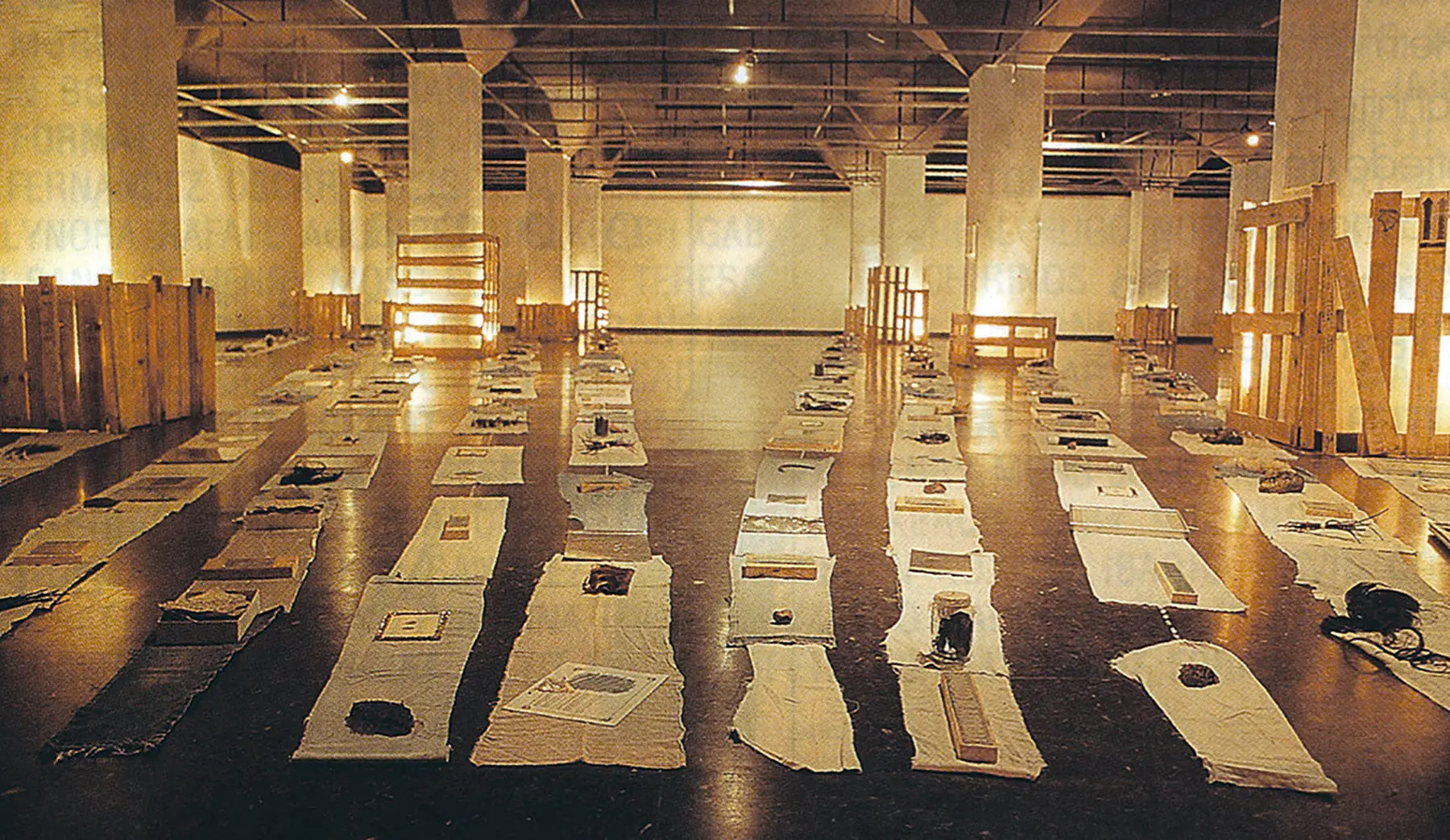
Bye Bye Yauguru develops these troublesome themes in a site-specific environment, which recreates in the form of a huge diagram the 19 departments into which the country is organized at the political level, and structured on 18 columns and 18 lines on the ground, which lead to the entrance and exit, representing the macrocephalic Montevideo.
In this way, the artist creates a network of routes that allude to the ancillary relationship of the country with its capital and the hegemonic role played by Montevideo. Symbolic pillars - the columns-departments - support the country, although Montevideo ignores them sometimes or minimizes their importance. The very structure of the work is a criticism of hegemonic discourse and the oppressive centralism of the capital.
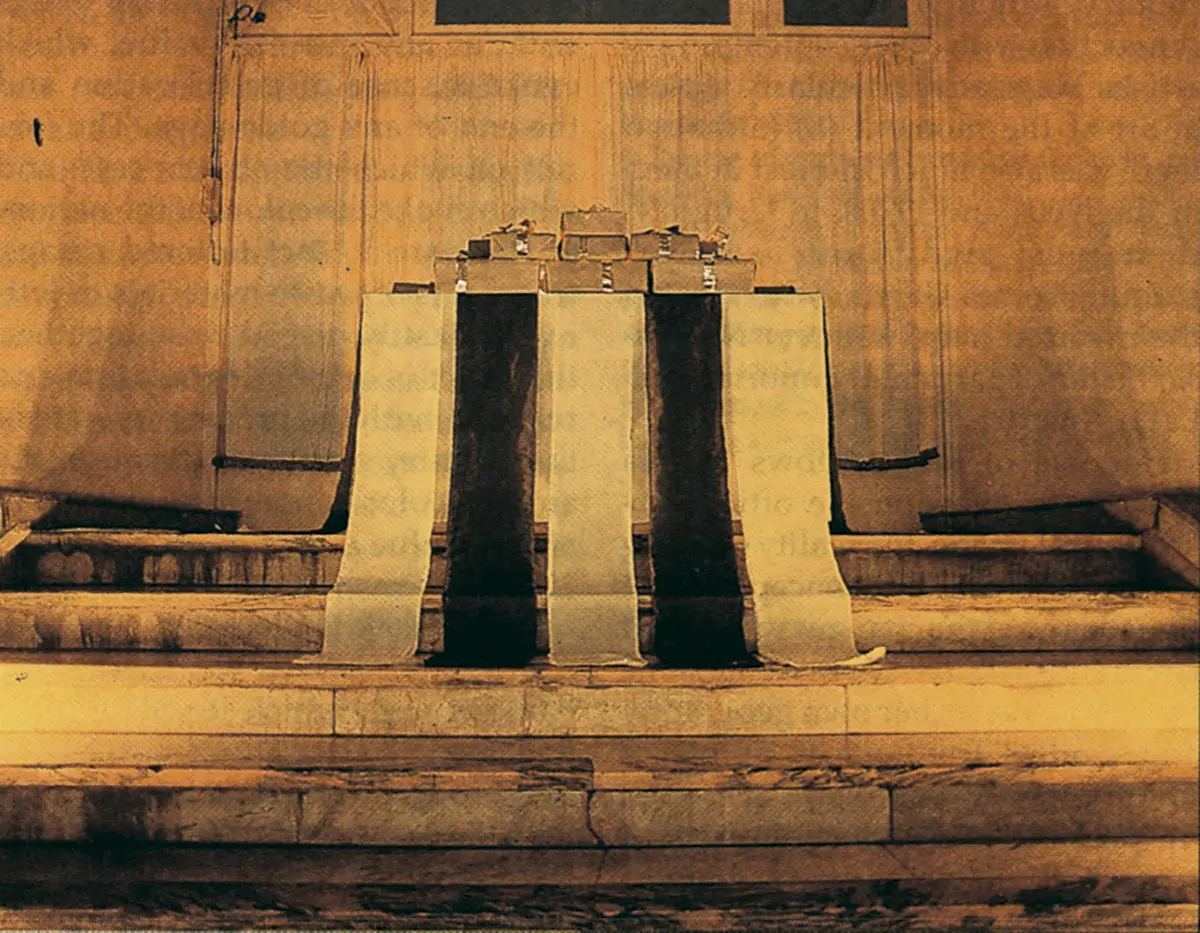
All the lines end on a large table (which can be seen as an ironic altar to the fatherland), covered with a tablecloth on which there are packages and presents from the members of MERCOSUR, the true nature of which remains to be seen (will they benefit Uruguay, will they prove to be merely colored illusions or unpleasant surprises?). For their part, the columns-departments are surrounded by wooden containers which allude to the country's imports and exports, the comings and goings, and trade, which are all so vital to the process of regional integration. The entrance and exit areas refer to the former culture of immigration and the new culture of emigration and diaspora, the inevitable components of the new reality and the new national imagination.
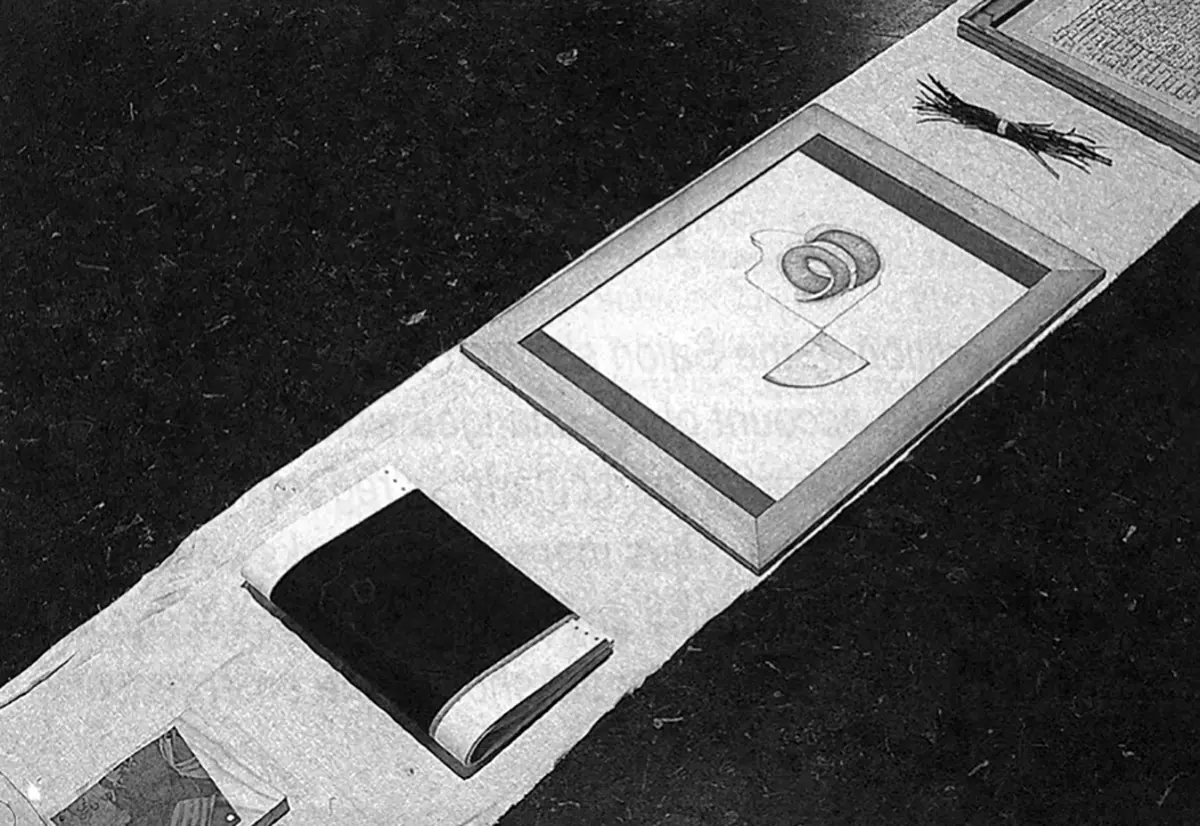
On each of the lines, Nelbia Romero arranged drawings, collages, objects, packages, heaps, pieces of fabric, and photocopies. The isolated aesthetic object (whether painting, sculpture, or print) becomes integrated by losing its individual identity; there is no single work of art distinguished as such, just as there is no single model of the ideal country. This is a fragmented and multifocal artistic reality, a metaphor of a country in exactly the same situation. But it also highlights the discontinuity of the contradictions that make up the national text.6
Replaced by plural and juxtaposed elements, by fragments and objects distributed over space in a sporadic, ephemeral manner, the traditional works of art have given way to expressions that cannot be classified in conventional terms. Both art and the country oblige us to ask questions and redefine things as new challenges appear.
The masses of plastic objects are scattered on the floor, rather than arranged in their "usual" place on a wall or on a base. The theme of place is here of fundamental importance, and is linked to problems reflected in the works of other contemporary artists.7 Nelbia Romero raises questions not only about the place of art but also about the place of a country's inhabitants, the place of Uruguay in the new historical context, and the concept of place in general.
By putting art on the floor, Nelbia Romero places the spectator before a challenge of perception, forcing him to broaden his attitudes towards the way art is presented. She challenges our conformism and brings us face-to-face with new situations. At the metaphorical level, the reference to the floor evokes certain emotional states, highs and lows, revealing moods of depression and despair. At the same time, placing her work on the floor also seems to be a reference to the devaluation of art as something that is spread out, ready to be sold, auctioned off, or liquidated. Other interpretations are also possible: laying out the work on the floor may be seen as a reference to street vendors plying their cheap wares, pulling their carts through the streets, living from day to day, trying to make ends meet.
Images of the Collective Imagination
The floor can also be seen as a reference to the soil of the fatherland: it is in this context that we find the images that have nurtured the collective imagination, and which must now be revised in the context of integration with other countries. Romero casts an ironic and painful glance at these images, which have become devalued and fleeting, dull and anemic, and are now covered with sky blue garbage bags (sky blue is one of the colors of the national flag: sometimes the excess of patriotism hides the truth of things, stifling and smothering reality, and distorting our perceptions).
Since MERCOSUR will imply regional integration, it is understandable that the map plays a crucial role in Bye Bye Yauguru. Drawn with pencil on paper, it appears in various ways, from very succinct diagrams to more elaborate, detailed forms. When an empty silhouette, it serves to project space, a place about which little is still known or whose future is uncertain (Uruguay's role in MERCOSUR). Sometimes the map guides us, and other times it confuses us, just as real maps do. When stippled or tacked or with an evanescent contour line, it becomes the epitome of a lack of security and the symbol of something floating between being and non-being. Vertical and horizontal axes recall the key importance of the essential coordinates, the axes of nationality. Some maps are superimposed, because Uruguay is both one and many at the same time and has various multicultural, dissimilar realities, although it is seen as a whole. MERCOSUR will mean a number of challenges, in the face of which the country may become smaller and more inward-looking, or expand and become larger.
The map offers a framework for reflection and for re-reading the country, although it also establishes a connection with other contemporary artists. Maps are particularly topical in art at the moment8 (although there was also much interest in them in the 1960s and 1970s: in Uruguay, their most significant user was Joaquín Torres-García, who created the inverted map, with our North is our South, of particular importance in Latin America9).
Her use of maps allows Nelbia Romero to question the official archetypical image, the reality of traditional frontiers, the concept of nationalism, and the changes that will result from MERCOSUR. At the same time, she creates her own geography and studies frontiers as points of union or separation. Maps also open up possible readings of the acts of transgression, which may metaphorically occur when frontiers are crossed and limits are passed. Maps can also be revised, manipulated, and handled in different ways as symbols of belonging, identity, home, and place of origin. Romero also calls attention to our potential ability, of which we are sometimes unaware, to change and alter reality and geographies. In the case of Uruguay, a country that is reticent about change, such a call is of particular importance.
In this period of treaties with neighboring countries, Nelbia Romero uses cartography as a means of orientation, of raising questions about such subjects as our roots and sense of separation, exile, the dangers and advantages of integration. The maps also become a means of emphasizing the necessarily subjective understanding of reality: although they are generally considered as representing a scientific truth, maps are in fact an artifice and an abstraction, the result of a codified reading (they have been manipulated through history, even by the most exact form of science, and reveal the realities, fantasies, and ideas of those who make them).
Nelbia Romero's discourse also concerns the idea of precariousness, as reflected in the arrangement of her work on the floor, the ephemeral nature of the installation, and the placement of the works along the lines. The crisis situation is emphasized by the fact that the work as a whole is made up of found objects, ordinary things without any intrinsic value, which evoke a sense of deterioration and the end of any golden age. The fabrics on which the objects rest (and which evoke the colors of the national flag) are, in fact, tattered scraps, fragments of waste materials or leftovers, hastily placed close together: the effect is one of degradation and rupture, with the precarious state of the country conveyed through the austere color range of gray, white, and sky blue.
Uruguay already has three companions with which it will have to live in one way or another, as Nelbia Romero reminds us in her placards with the names of the Mercosur countries. Uruguayan society will have to create a new mode of being and perhaps needs to discover new sources of self-esteem. At all events, it will be a process of transition towards something, and for this reason, Nelbia Romero obliges the spectator to walk through the exhibition room and follow the lines of identity, looking, analyzing, and discovering, leaving behind what is obsolete and recuperating the valuable elements of the country's past and present culture. Bye Bye Yauguru, like MERCOSUR, evokes a world of contradictions and discrepancies, doubts and uncertainties, reflections and debate.
In discussing these themes, developing her discourse and formulating her critical response, Nelbia Romero harmonizes both form and content in the manner of conceptual art. She does not exploit her outstanding gifts as a print-maker or endeavor to create traditional works of art, but prefers expressive strategies of a conceptual kind, reminiscent of Duchamp in the emphasis given to the act of reflection and the mental process involved in visual creation. The work ceases to be ponderous through its critique of the mercantile spirit and the consumerism of art. It is a sui generis kind of conceptualism related to other Uruguayan and Latin American currents which shun coldness and rigid tautology, preferring warmth, sensibility, the restoration of "poor" objects, the textural qualities of such materials as leather (recalling the cattle-raising heritage and wealth of the country), or locks of hair (suggesting suffering and personal experience).
Nothing is absolute or fixed in Bye Bye Yauguru: it is an open-ended, unstable, and multiple system where everything can change, presented in the form of a work in progress. In this sense, too, it is a metaphor of the need to remain dynamic and receptive, because identity is not a fixed but changing kind of truth, obliging us to ask questions and face up to challenges. For this reason, the semantic range of the environment (over and above its explicit message) would encompass, as a subtext, the invitation to a variety of changes, including the constant and healthy (although painful) re-evaluation of all kinds of fixed structures governing our way of life, patterns of behavior, sensibilities, identities, myths, obsessions, and certainties.
NOTES
1. See Alicia Haber, "Ambientaciones sobre la identidad en el arte uruguayo de hoy," Arte Latinoamericano Actual, Juan Manuel Blanes Municipal Museum of Fine Arts, Montevideo, 1993, pp.65-67.
2. On the concept of the country as a paradise, see Hugo Achugar, La balsa de la medusa: Ensayos sobre identidad, cultura fin de siglo en Uruguay, Ed. Trilce, Montevideo, 1992.
3. In this sense, artists are at the epicenter of the debate as expressed in the many essays on identity and culture by intellectuals in the country today. For example, see Identidad uruguaya: Mito, crisis o afirmacion, ed. by Hugo Achugar and Gerardo Caetano, and note 2) above.
4. The treaty came into force on January 1, 1995 (it was signed on March 26,199I in the city of Asuncion), and provided for the free circulation of goods, services, and factors of production, with common tariffs, and the coordination of macro-economic and sectoral policies and legislation.
5. Similar concerns have been expressed by many sectors of Uruguayan society, including historians, sociologists, artists, intellectuals, teachers, and young academics. Now that the Treaty of Asuncion has come into full force, an initial evaluation is being carried out of the role which Uruguay might play and the changes which will have to be made, and attempts are being made to anticipate the consequences of the process on politics, the economy, thought, culture, and art. See also Hugo Achugar, coordinator, Cultura Mercosur, Fesur, Logos, Montevideo, 1991, Gerardo Caetano, coordinator, Uruguay hacia el siglo XXI, Trilce, Montevideo, 1993 and Hugo Achugar and Gerardo Caetano, eds., Mundo, región, aldea, Fesur, IMM, Goethe Institute, Trilce, Montevideo, 1994.
6. See the concepts put forward by G. Spivak, quoted by Homi K. Bahba (ed.), in Nation and Narration, Routledge, New York, London, 1990.
7. See Madeleine Grynsztejn, About Place: Recent art of the Americas, catalogue of the 75th American Exhibition, The Art Institute of Chicago, 1995.
8. Some of the major examples include the exhibition Mapping, MoMA, New York; Art on the Map, Chicago; Another Cartography: 14 Contemporary Latin American Artists; the installations of Carlos Capelán, entitled Maps and Landscapes; the work by Guillermo Kuitca at the Center of Fine Arts, Miami, etc.
9. This remark by the Brazilian critic Paulo Herkenhof is quoted by Robert Storr in the above-mentioned exhibition catalogue, Mapping, MoMA, New York, 1994, p.6.
ALICIA HABER
Critic of the newspaper El País, professor at the Instituto de Profesores Artigas, and contemporary art researcher. Lives in Uruguay.