
"It is necessary to go back to the foundations of life," reads the text from I Ching, which Néstor Quiñones selected as an introduction to his recent exhibition at the Drexel Gallery in Monterrey, Passage of Knowledge.
Although his work had already opened a breach between real and illusory space, this time the artist managed to explore the subjective spheres of his inferiority, fusing his almost mystical universe with his natural surroundings.
The works bring about a progressive and gradual immersion of the spectator, whose eye becomes focused on the successive planes of the pictures. However, the staggered use of transparent mesh as a kind of veil or support, and the integration of extra-pictorial materials such as wood, earth, thread, or metal, do not give the works an objectual character. On the contrary, Quinoñes seems to be trying to recuperate the traditional concept of the picture as a window, but not as an opening onto the outside world—since the irregular and changing formats he uses are not intended to enclose the ungraspable nature of the images—but as fissures which, in the darkness, allow us to see into the innermost depths. Quinoñes’s work can be summarized in two words: star (a heavenly body irradiating energy) and constellation (a group of stars which, through imaginary traces on the visible heavenly surface, form a drawing which evokes a certain figure).
Néstor Quiñones has conceived most of his pictures in such a way that nebulous transparencies conceal and reveal his images in the darkness. Like psychic x-rays, skeletons and skulls emerge, along with torsos and arms, hands and legs, luminous parts from which a strange current emerges.
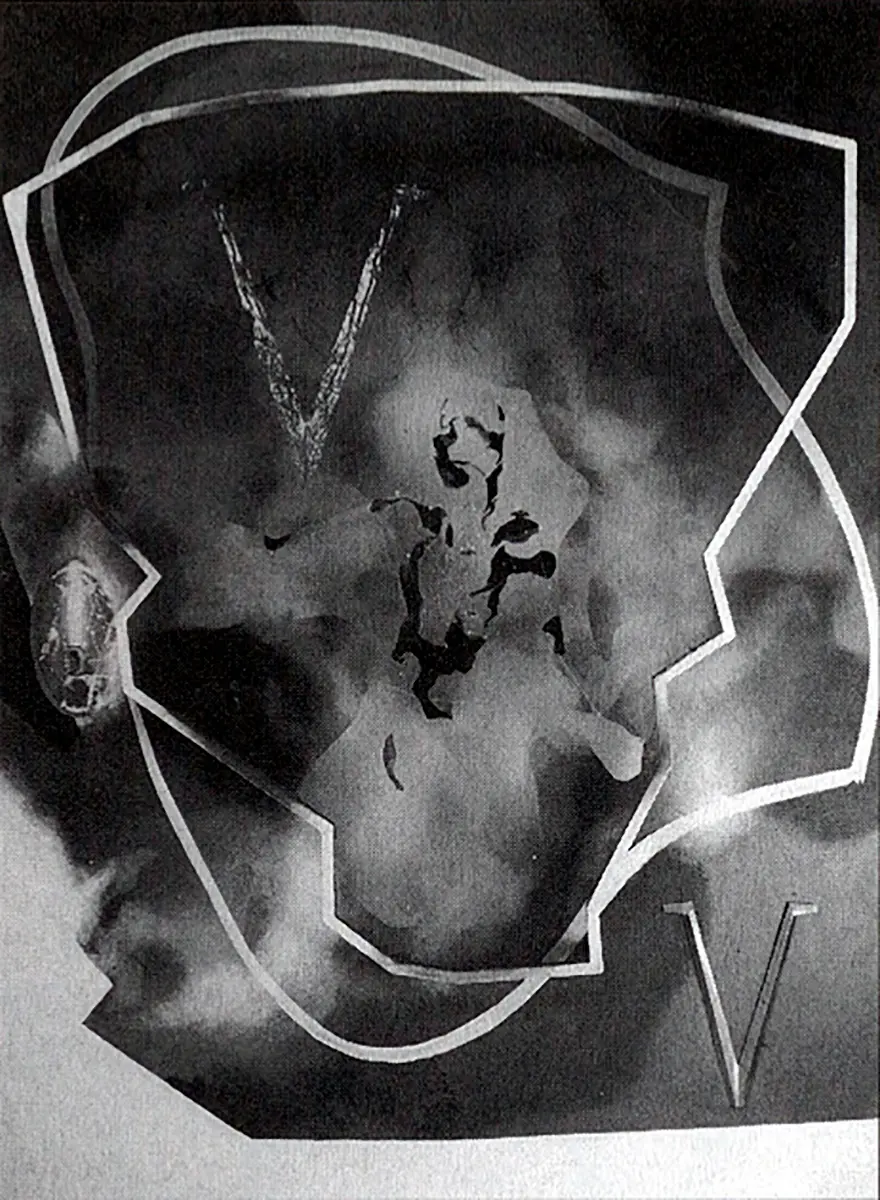
Against the translucent surfaces of such works as Awakening and Passage of Knowledge, the phosphorescent pigments create silhouettes of convulsed beings which, in a flash of lucidity, become conscious of their condition. We are alone, says another picture, in the lower left part of which two arms appear in a gesture of solidarity, whereas on the right, the bones of the figure stand out against a star-filled night sky in a symbolic evocation of the infinite. The work is entitled For This We are Different, to which the text from the I Ching adds that "the life of man with its demands continues to be eternally the same."
The work of Néstor Quiñones seems to suggest that the path to knowledge is made up of moments, of instantaneous states of consciousness which, when taken together, can allow us to perceive the true configuration of the human being.
NOTE
* Title of an exhibition by Néstor Quiñones at the OMR Gallery in 1992.
MAGALI ARRIOLA