
After participating in two major group shows in Berlin, the Argentinian artist Pat Binder finally presented a one-woman show at the Gallery of the Institute of Foreign Affairs (IFA) in this city between March and early May. Entitled Zapping, the exhibition included objects and installations, most of which were created last year, and in which she proposed a new artistic concept of work, which attracted much attention.
Three earlier works provided a counterpart to the elaborate drama of the show. Two of the installations (No More Fuel and Umbilical Cord) were done during a period of intense experimentation in London in 1993. Forms linking the wall and the floor could be seen as archetypal representations of heaven and earth. Through a sort of umbilical cord, currents of energy seemed to flow between books, the bearers of spiritual strength for the cultures based on writing, and other related elements.
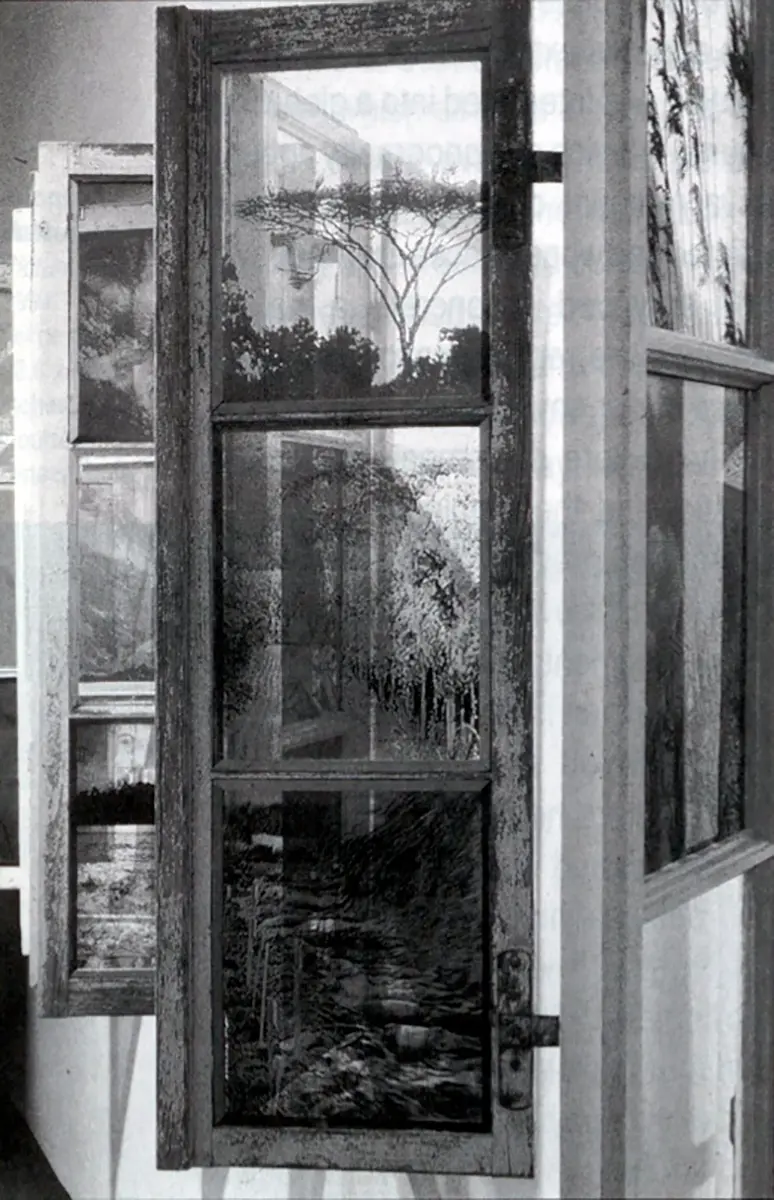
On the other hand, the newer works referred to a concept of reality increasingly influenced by the electronic communication media. Among otherthings, the artist focuses on the sea of images to which we are exposed today and which to a large extent determine our perception of things. Television has, for many people, become the only contact they have with the outside world. Zapping, the title of the show, is the term used for the widespread habit of hopping from one channel to another and the considerable confusion resulting from the enormous broadening of the mediatized landscape. But Pat Binder does not propose any detached criticism of the media—a current trend nowadays—but prefers to analyze a general situation in light of her own involvement. Her sense of artistic restraint makes her insert something undeniably personal into the flow of images, to produce her own program, to express the consciousness of her own self in a kind of resistance image, a stronghold for her own aspirations, doubts, and fears, a kind of publicity spot for her deepest essence.
In doing so, she uses a technique that seems anachronistic in the high-tech world of the modern media. A coat of photographic emulsion is applied to glass and processed and developed in the laboratory to produce black and white transparencies on glass or enormous slides. Photographs taken from a television screen, images passing in front of us for a second, are thus fixed and transformed into static crystals with a diffuse kind of chiaroscuro, and incorporated into objects and installations, reinterpreted according to a different kind of perception. Thus, for example, the glass of a window frame is turned into an explicit window on the world. The projections of the photographs onto a distant wall incorporate an immaterial level of light and shadow. In Zapping Line, which is seven meters wide, a countless number of these television stills are superimposed and combined with photographs from videos of her own body. As in other works, there is a correlation here between the use of the photographic motifs and our everyday television experience. For most of us, it is normal to zap—often out of sheer boredom—jumping to and fro between news programs, weather reports, cooking programs, scenes of violence, talk shows, game programs, and documentaries on the calamities of the world. To the extent that the work makes this obvious, it achieves an objective to which we should give more thought. But this is not imposed in any didactic or moralizing manner, but appears as an unusual and complex metaphor of the interwoven relationship between our personal reality and that of the media.
After capturing in static images the simultaneous and interdependent nature of perception as determined by the communication media, Pat Binder uses in her most recent work images in movement as her medium of expression.
In particular, she presented her first video-installation in this show, Ballottement. On nine desynchronized screens, a colored ball was trapped in the whirlpool of a stream. The hypnotic images were very briefly interrupted by the sequence of a body emerging from the water to breathe in air with difficulty. The installation could be read as a very concentrated existential metaphor of our vain attempts to assert ourselves in the eternal and infinite stream of images.
GERHARD HAUPT