
Muring the course of two weeks in Los Angeles (repeated by two weeks in Mexico City), the performers of Terreno Peligroso frontally and obliquely addressed subjects such as the NAFTA Treaty; the eruption and significance of the Zapatista Liberation Army; the passage in California of Proposition 187 which as a prototype for the rest of the xenophobic United States, is directed toward denying social services such as public health care and education to the families of undocumented migrants; the needs of AIDS (SIDA) victims; the psychosocial problems of gays and lesbians in their families and in society; the representations of women in which feminist gains are being eroded by consumerism and the retrograde demands of new (and old) forms of sexism; and new challenges to a hoary concept that the traditional Latin American family structure provides the best of all possible worlds. Feminism may have dismantled Patriarchy, but Matriarchy doubtless needs to be reconsidered when exercised in a class-bound situation or is encoded in the icons of religious rituals. The eleven artists brought together in the name of Terreno Peligroso/Danger Zone included the Mexicans: Felipe Ehrenberg, Lorena Wolffer, César Martínez, Chilean-born Eugenia Vargas, Elvira Santamaría; and the California Latinos from Los Angeles and San Francisco: Luis Alfaro, Guillermo Gómez-Peña and his assistant Roberto Sifuentes, Nao Bustamante, Rubén Martínez, and Costa Rican/Californian Elia Arce. Underwritten by the U.S./Mexico Fund for Culture, the J. Paul Getty Trust, the city of Los Angeles' Cultural Affairs Department, and the Disney- sponsored California Institute of the Arts, the month-long event (divided between Los Angeles and Mexico City) was co-produced by Josephine Ramírez and Gloria Westcott of Spanglish Only Productions in Los Angeles, and Lorena Wolffer of Ex-Convento de Santa Teresa in Mexico, and cocurated by Ramírez, Gómez-Peña, and Wolffer. Formal performances were presented at the University of California, Los Angeles (UCLA), and at the Ex-Convento.
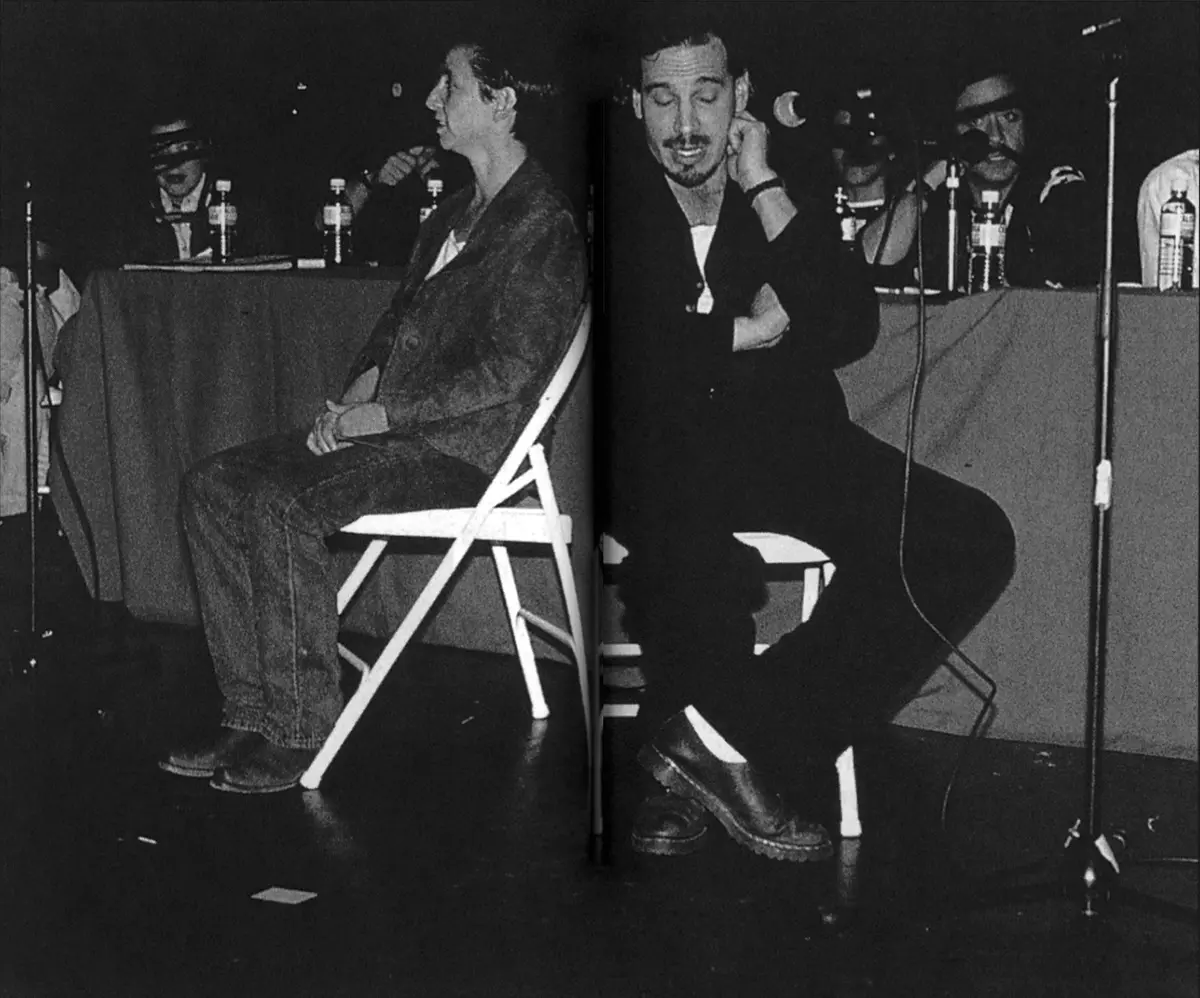
Terreno Peligroso was organized along the lines of a residency with public performances and public participation lacing into formally organized events. The ten Mexicans and California Latinos conducted street events and invited a public audience to discuss their activities at the Plaza de la Raza, a cultural center serving a populous working-class Mexican neighborhood. Though the hall was filled and the discussion heated, the audience was largely young middle-class people, most of them articulate in English and Spanish, and with some knowledge of the arts. The artists themselves gave mini-performances as an introduction. Rubén Martínez and Eugenia Vargas, seated almost back to back, carried on an alienated, almost hostile discussion about the particularities of their sexual attractions—hetero, homo, or bisexual in character. César Martínez, in a bathing suit, coyly displayed a large beach towel ornamented with an almost life-sized image of the Virgin of Guadalupe. After using it to dry his body, he lay it image-up on an imaginary beach and lowered himself on the towel face-down. The sexual implications were obvious and certainly sacrilegious, but neither of these risky propositions received any challenge from the audience. Another exchange took place between Chicano Luis Alfaro, who delivered in broken Spanish anti-Mexican remarks commonly heard on the streets of Los Angeles, which were translated into English by Mexican Felipe Ehrenberg. Since Ehrenberg is perfectly bilingual, the sarcastic humor intended was miscarried to some extent by not being obvious as a role reversal, especially to those not familiar with the two protagonists.
When the four days of planned performances began at UCLA, the atmosphere changed considerably.
Performance in Los Angeles, unless it takes place in a museum setting, is usually informal, held in small open spaces where the audience is practically face-to-face with the performers, even when there are seats. The UCLA area, intended for dance, theater, and other activities, was a proscenium arrangement without curtains. Since several presentations used candles, lighting was kept very subdued and, as a result, actions were hard to see. The performers emerged out of an intense penumbra, often counting on the candles, of focused spotlights, for whatever visibility existed. It added mystery to many of the presentations, but also unintelligibility at times.
Mexicans and Latinos were paired together within each time period. Opening night began with El juego de joteria (a play on the word joto and loteria) by gay Chicano poet Luis Alfaro, whose most moving presentation among those he offered took place on roller skates as he carried on a dialogue with his (absent) father. The painful nature of the interchange was emphasized by Alfaro's repeated heavy falls as he skated rapidly around the stage in a large circle. First considered accidents, the psychosomatic nature of the falls quickly became apparent, though no less jarring than the failures of misunderstanding, of paternal homophobia, were translated into bodily anguish. Alfaro's presentations were all based on memory, on storytelling, on verbal texts that explained the action in personal terms.
Felipe Ehrenberg's No Man's Land also invoked memory, but with a historical and cultural focus that depended completely on the visual. One of the most respected experimental artists from the generation of the 1970s, Ehrenberg was a key figure with the Grupo Proceso Pentagono during the era of the Mexican Front of Cultural Workers, which he helped organize and sustain until the mid-1980s. Forced to leave Mexico after the massacre of Tlatelolco in 1968, Ehrenberg became familiar during his exile with many of the European experimental artists of Fluxus and other groups. His long list of innovative techniques and concepts after his return in the mid-1970s caused him to assume the apt title of neologo—a role he fills admirably. His self-possession and measured procedures during his performance turned his piece into a memorable one. Slowly circulating the space he occupied, which was equipped with a table containing a water pitcher, a basin and other implements, and an easel with a large mirror instead of a canvas, Ehrenberg lighted a series of candles mounted on the floor, then turned on cassettes in which music dating back to the pre-Columbian period was overlaid with sounds from the colonial to the contemporary periods. The resulting audio-collage was jarring and unpleasant, but served to remind the spectators of a long history of conflict and pain. By the light of the flickering candles, Ehrenberg slowly began to shave one-half of his face from the hairline to the neck, removing eyebrow, mustache, and other facial hair. Thus denuded, he wrapped his entire head in layers of gauze, then painted skeletal features in black to simulate a calavera. Appearing thus, he stretched a white sheet on the floor, proceeded with a razor blade to cut incisions on his bared chest, spreading the blood outward like ribs, and imprinted them on the sheet, which he then hung over the mirror on the easel. Extinguishing all but one candle, he screamed loudly, then violently smashed the mirror under the sheet until it fell into pieces on the ground.
As a sequence of action/visual symbols drawn from Mexican preconquest and colonial sources, Ehrenberg's half-shaven face reminds one of the many Mesoamerican masks combining a living facial image with that of a skull denoting the duality of life and death, and the commemorations of the Día de los Muertos. The bloody skeleton invokes Xipe Totec, and other Aztec deities, while the imprinted cloth can refer to the Mantle of Turin, the cloth of Verónica, and the image of the Virgin of Guadalupe, which was imprinted on a cloth still cherished at her church in Mexico City. Combined thus, they invoked the painful and precarious position of Mexico today, between the "No Man's Land” of Chiapas and that of the U.S. Mexican border. The mirror on the easel has long served as a symbol for art, just as smashing it would be the destruction of art itself, as the candles (or light) go out. Ehrenberg is known as an intensely political artist who integrates his artistic poetry with contemporary issues. The ground remains very fertile for a further layering of meanings for his piece.
Both Guillermo Gómez-Peña in Borderama and César Martínez's Performan-CENA, in wholly different ways, provided just such a layering. Gomez-Peña, a Mexican living in the United States since 1978, attended the experimental CalArts Institute in Valencia before settling in San Diego (both in California, the latter bordering on Tijuana, Baja California, Mexico) in the 1980s. He was a co-founder of the Border Arts Workshop/Taller de Arte Fronterizo, which for many years was the cutting-edge group on border issues and border art in the United States, working with installation and performance. His famous Border Brujo personality underwent many variations during the 1980s, utilizing extravagant costumes like its festive gold-trimmed El Aztec High-Tech suit with masks, feathers, and breach clout, a Mariachi-Liberachi suit of chaps and ornamental sombreros, and the Caballero Tigre zebra-striped zoot suit. He combines audio-tapes with a loquacious stream of multi-lingual and inspired prose that deliberately mingles kitsch from both sides of the border with philosophical, social, and parodic irony and comedy.
As a writer, a “visual poet,” his witty text, which constantly changes languages and is too dense to reproduce (or even paraphrase) except as it is published by the author, has been an essential part of his activity since the beginning. In 1992, the second of a trilogy of performances commenting on the Columbus Quincentenary, Gómez-Peña verbally laid out the following imaginary scenario: "Queen Isabella is an impresario of the European common market/ a friend of Violeta Chamorro and Salinas de Gotari/Columbus is an illegal alien lost in Ohio/Cortez and La Malinche are two transvestites from Veracruz/ who migrated to Tijuana... Montezuma is a ranchero singer dying of AIDS... Spanglish has become the official language/and a Free Art Agreement has replaced the Brady Plan/Puerto Rico, Hawaii, and Panama have finally seceded/from the Federation of U.S. Republics... wherever we go/we witness the effects of Gringostroika."
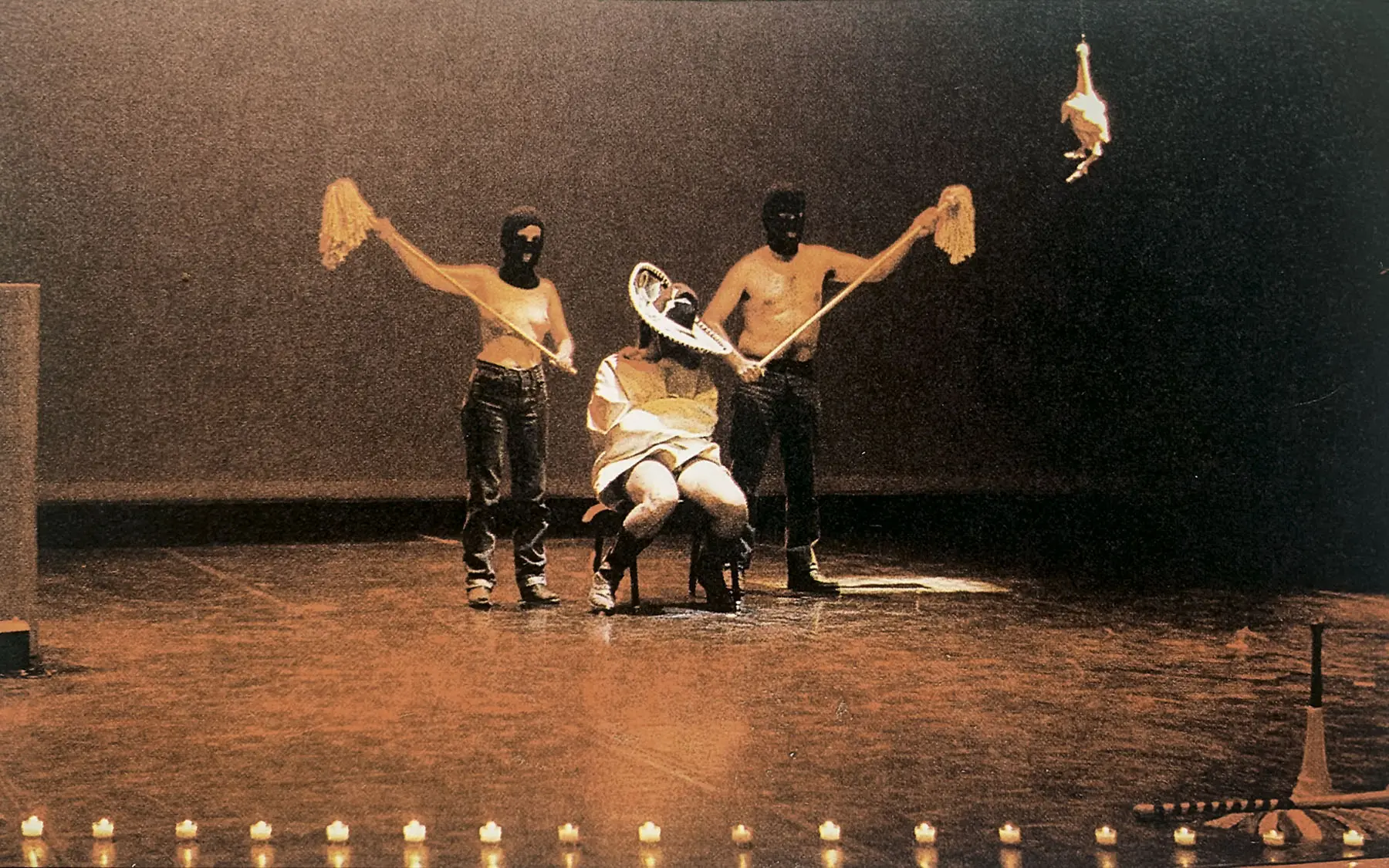
The visuals for Borderama were reincarnations of previous personae, with the addition of two personalities in black ski-masks carrying mops as invocations of the EZLN and the worker-immigrant, in encounter with a downcast Gómez-Peña, face hidden by a huge, lavishly ornamented sombrero. Hanging bodies of plucked dead chickens have long been a staple of his performances; they were invoked again, like hanging piñatas, beaten to shreds on the stage by Roberto Sifuentes. Rage and sorrow over the exacerbation of border attacks by the U.S. Immigration Service (the "no man's land" of Ehrenberg), brutal attacks rather than political negotiation with the Zapatistas, the economic collapse of Mexico, and the further immiseration of its people seemed to be the major motifs.
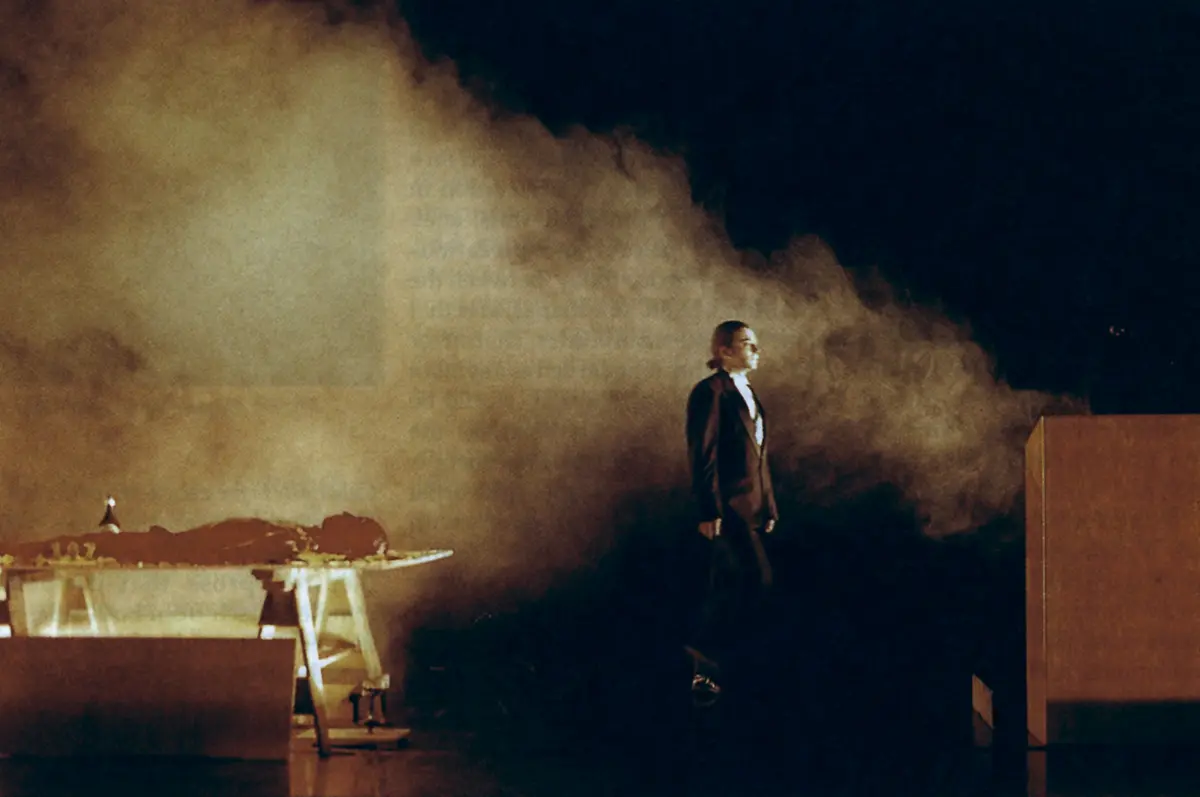
Cesar Martinez began his performance on a lighted podium dressed in a dark business suit across whose white shirt was the tricolor band of Mexico's presidents. Partially hidden in darkness and white steam exuded by dry ice was a wooden table containing the life-size body of a man made of red gelatin embedded with slices of fruit. With a witty bilingual monologue that played with such terms as consume/consumer, and with the music of a dirge, the "president" invited the audience to the stage area where dishes, knives, and forks were provided for them to partake of the body of Mexico during the Performan- CENA. He himself began by slicing off the head with a butcher knife, and then plunging the knife upright into the chest (removal of the heart, sacrificial fashion?). Laughing nervously, half the audience, and the other performers, ringed the figure, first (unexpectedly) cutting off the sex (the U.S. "Latin Lover" stereotype?), then an ear (Van Gogh?), then dishing up other parts of the prostrate body. For all its macabre and cannibalistic atmosphere (a reversal of the "Ariel/Caliban” metaphor in Latin America), the bizarre feast was completely understood and "enjoyed" in the same fashion as one revels in the strange and bloody tales of Edgar Allan Poe—its total political critique poeticized, emotionalized, and personalized.
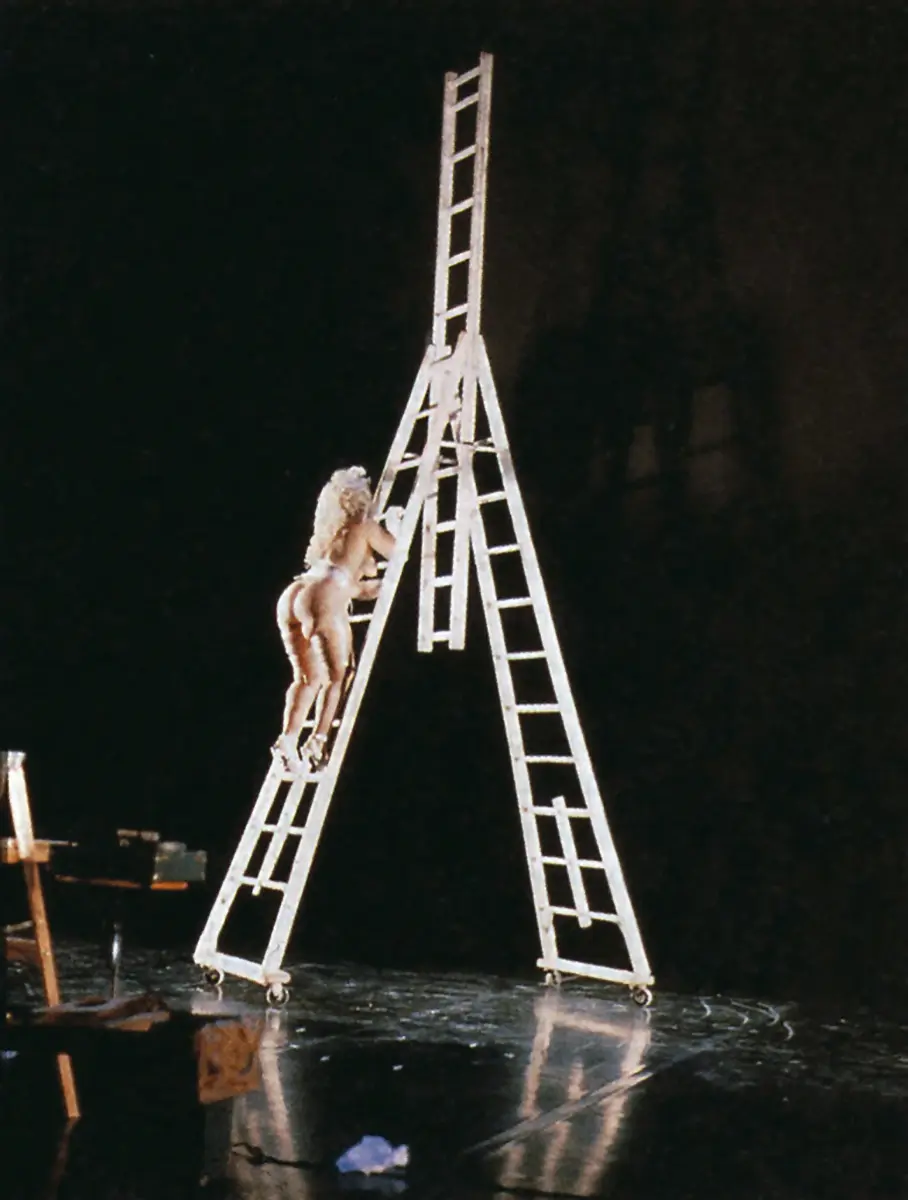
Four of the women performers presented works that were more introverted and psychological, without ever becoming maudlin; three of the four in complete nudity—a reference to performance art beliefs that the unhampered body itself is the "canvas" or surface of action, and also to feminist engagement with the nude body. Nao Bustamante, a Chicana artist from San Francisco with a fifteen-year history of performance and theater work, depended on the same tension one experiences watching a tight-rope performance at the circus—a combination of fear that the performer will fall, combined with the sadistic hope that she will. For her piece America the Beautiful, the props included a record player with symbolically broken and scratched records of sentimental love ballads; a small household ladder on top of which she carried on some of her activities; and an enormous ladder taller than a street light, the height of which represented the epitome of her desire to be the All-American love goddess.
Seated nude on the small ladder, crowned by an extravagant curly blonde wig, Bustamante parodied the beauty rituals exercised by women in the search for glamour—from eyelash curlers and lipstick to the precarious support of platform shoes. Satisfied, she descended and then tightly corseted her nude body with transparent plastic tape, drew on long white gloves and her platform shoes, then proceeded with vaudevillian clumsiness to climb the huge ladder of seductive success. Spiraling up and through the ladder, as though waltzing in a ballroom with the man of her dreams, she achieves her erotic apotheosis, signaled by a briefly dazzling holiday sparkler, with her body spread-eagled through the upper steps of the ladder. The antithesis of the dream was an ironing board mounted with brown beer bottles of Carta Blanca, through which she chimed the song America, the Beautiful as a parody of herself, and of U.S. patriotism, feminine fashion.
Elia Arce, a film student and performance artist who shares her time between the United States and her native Costa Rica, chose coffee production and domestic servitude as her main themes, and the geography of economic border crossings (of products and people) as her space for "I Have So Many Stitches That Sometimes I Dream That I'm Sick. Teach me, her monologue begins. I would rather be here stealing than there being stolen from." The first episode occurs "there," in Costa Rica: her nudity (herself) covered by a brown robe, she sits drinking coffee and reciting the litany of coffee production: fertilizing the land, planting and separating the trees, picking, drying, sorting, grinding the vari-colored beans, filling the burlap sacks, delivering them to the export companies—thanks to the Costa Rican workers. Crossing the border, the same workers serve the coffee and wash the cups—a continuation of the labor process by people who all look like me.
Her second role is that of a cleaning woman, hauling the bucket, scrubbing the floor, hating the mud, the laundry, the beds, the dirt she has to clean—other people's dirt—with which she begins to rub herself as her oppression becomes self-oppression. The oppression in this situation is a domestic one, doubtless supervised by a woman—the matriarch of a family or the forelady of an all-female cleaning crew. The final phase takes place in a bathtub—where she cleanses her body, her spirit, and her anger with milk and water in an act of catharsis, then clothes herself in a white robe. Like Bustamante, the brown/white dichotomy is subtly indicated.
Finally, two women from Mexico, Chilean-born Eugenia Vargas, who has made an international reputation with her photography, installations, and performances, and Elvira Santamaria, who, as the protagonist, is in control of the untitled event in which a persistent nightmare is symbolically worked out. Santamaria slowly unfolds a large white sheet on the ground as Vargas disrobes and curls in a fetal position on the sheet, into which she is carefully hidden and tied. The Freudian suggestiveness continues as Santamaria, tugging and bumping this awkward bundle with great care and secrecy, invites the audience to accompany her odyssey downstairs, across porches, following paved pathways through crowds of people, on to lawns and hills, her breathing becoming increasingly more difficult as she labors with the heavy burden. The audience's empathy urges its members to help her, but they refrain because of the performative nature of the act and because she asks for no aid. Multiple possibilities are conceived: burdened women with tasks almost beyond their strength? A woman dragging her dead to burial? An abstraction of the Third World vis-à-vis the First? A metaphor for women worldwide said to do 80 percent of the world's heavy labor despite fables to the contrary? It is the power these suppositions give the act that makes the explanation at the end of the journey of a nightmare being exorcised too simple, almost anticlimactic. Nevertheless, the explanation is a postscript to the performance and, as such, does not necessarily invalidate the other dimensions. Indeed, it adds a personal vision that complements the other, more ambivalent, meanings.
Taken as a whole, Terreno Peligroso proved to be well-titled. The complexity of the works themselves, their infringement of "good taste," their perilous suggestiveness, and their contemporaneity underlines the subversiveness claimed for performance when it outstrips even the most supposedly vanguard presentations in traditional media and venues. Only independent film and video occupy the same danger zone today.
SHIFRA M. GOLDMAN
Art historian and researcher with the Latin American Center and the Art History Department of the University of California, Los Angeles.