
In the small group of sculptures presented by Galería Ramis Barquet, Teresa Serrano makes use of a language that astounds for its sparseness, elegance, and irony. The artist plays with contrasts of form and texture to stir in the viewer unexpected associations. Her vocabulary is so basic that it is not difficult to approach her work, although the reward is commensurate with the amount of patience involved in contemplation.
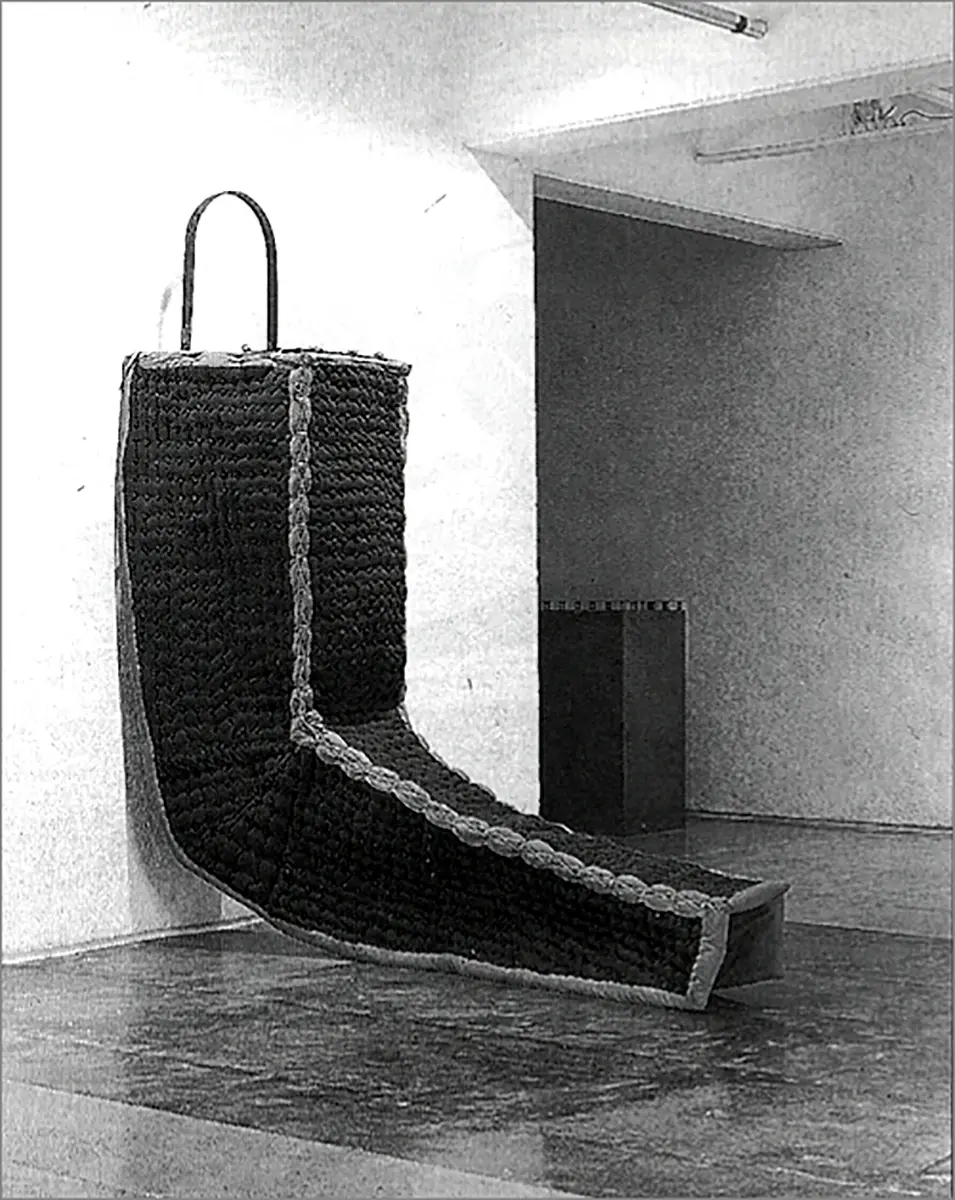
We are instantly drawn to the series of sculptures entitled River, made up of great tubes of cloth suspended from the wall, creating the sensation of water flowing from a faucet. The cloth is the very same that is used to protect horses during bullfights, and we are therefore tempted to touch the sculptures, as if to confirm their protective properties, and to know what they have inside that merits such protection.
The rest of the pieces are of stainless steel, among which we find a subtle echo of Duchamp. Untouched, of 1995, recalls the famous bottle-holder, but it differs from the ready-made in that it retains a defined craftsmanship in the smoothness and shine of the metal and in the economy of its forms. The very title alludes to the perfection of an object so pure we dare not soil it with our touch, and it suggests immediately the concept of virginity. We suspect that our association depends at least in part on the similarity between the sculpture and a corset, and with all the notions of sexuality, artifice, and masochism that the latter might imply.
In the same vein is Sleeping Beauty. A steel cube serves as the base for a mirror, and a white veil covers the entire top of the sculpture. The veil conceals, the mirror reveals. In fairy tales, the mirror possesses magic powers; the veil must be lifted to break the spell. In order to know our identities that are revealed only in the mirror, we must rip the veils of modesty. The charm and, at the same time, the curse of this piece is that we cannot see ourselves in the mirror except through the veil.
Perhaps the most seductive piece in the show is Secret, made in 1995. Steel bars enclose a small space—a closet, a shower, a confessional. Over one side hangs a piece of white lace; the thickest side has a square hollow covered with steel mesh. Without the lace, the sculpture would be heavy and solemn.
However, upon the introduction of a "feminine" element, adynamictension is created in the work. Lace is a woman, interior, manual work, religiosity, tradition. Steel, on the other hand, is man, exterior, technology, secularity, and innovations. As in most of her works, Serrano succeeds in establishing a silent and endless dialogue between parts of a sculpture, between sculptures, and between sculpture and viewer