
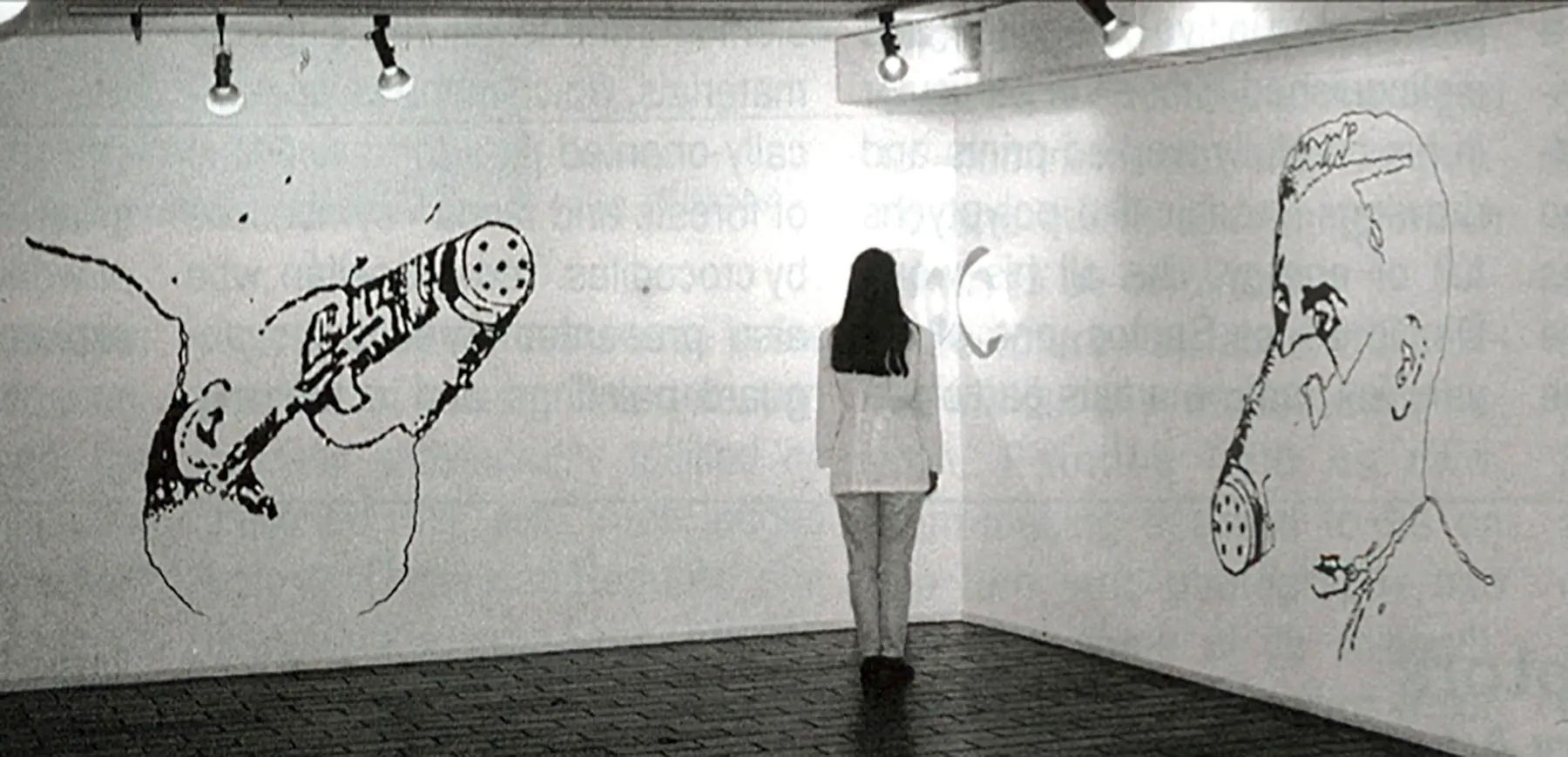
This was an exhibition that attempted to present the production of four artists whose investigations have concerned various topics: the materialization of allegories through contrasting elements, allusions to sexuality, disease, death, humor, and nostalgia. These were the themes explored in these works, which used real space to project paintings and objects and insert drawings and sculptures within the programmatic concept evoked by the title of the exhibition.
Miguel Bohmer (1968) used a large wall to present his visions of the city, which were amplified and printed in heliographs. The fragmentation, image, and process referring to architectural elements and eloquent gesture through an ironic use of painting and muralism give his work a wry quality coupled with iconographical comments of a rather humorous kind. The monochromatic silhouettes make the action banal and lower the temperature of his arguments. Bohmer works with photographic registers, which he enlarges and manipulates as a base for his backdrops; this time, he preferred to use them like a kind of wallpaper, the matrices that have helped shape his repertoire of urban structures.
Wilson Díaz (1963) is an artist who uses different procedures in creating his work. He is interested in infantile iconography and the trite, maternal paraphernalia accompanying a child’s early years. His work both evokes and satirizes with a controlled sense of perversity the furtive encounters between innocent images and cynical postures. Diaz uses painting, collage, and objects, as well as installations, performances, and collective surveys to generate his images. In this exhibition, he presented two paintings that reflected his habitual exploration of elements of a fortuitous, humorous, and occasional kind, as well as a participatory installation entitled
Seme(n)tery, a mural made up of pieces of cardboard with semen from different persons. Through a theme that evokes the AIDS situation, the artist raises questions and explores different meanings and intentions. Seme(n)tery, through its use of graphic elements combined with watercolor, alludes with grim humor to life, contamination, reproduction, and death, and is an astute and sensitive kind of allegory.
John Edwards González (1969) presented a set of phallic toys, the functioning mechanical parts of which complemented their irony. The rats in his installation of 20 little cars, which functioned with a wind-up mechanism, offered the spectator a two-fold piece that seemed to oscillate between humorous disgust and perverse eroticism, since a closer look revealed that the rats were in fact phalluses in a childlike and ingenuous setting. Another piece, which was directly inspired by the wooden horses to be found in fairs and shopping centers, was intended for adults. A large mechanical phallus could be ridden after the introduction of the required coins, which set it in motion. The action of the object created a voluntary contract between the spectator and the mechanical sculpture, the final existence of which was transformed into an individual and, in a certain sense, private act.
Jorge Acero (1968) appropriates real architecture to project his installations, which seek the active participation of the spectator. Elegant drawings executed with solvents on the walls, attached objects, and a sparse sense of color create a vital space, which is the strong point of his proposal. The timely references to aspects of Dada and the reiterated allusion to figures such as Duchamp or Beuys strengthen the character of this work, which considers history as a referent of vitality and energy. Through its different ingredients, spaces, and reflections, Acero’s work endeavors to attract the spectator through the establishment of affective bonds and to stimulate thought about the environment and the information provided.
The Imaginary was an exhibition that focused on proposals underway and confirmed the value of artistic works that explore diversity and contrasts as a feature of late twentieth-century production.
MIGUEL GONZÁLEZ