
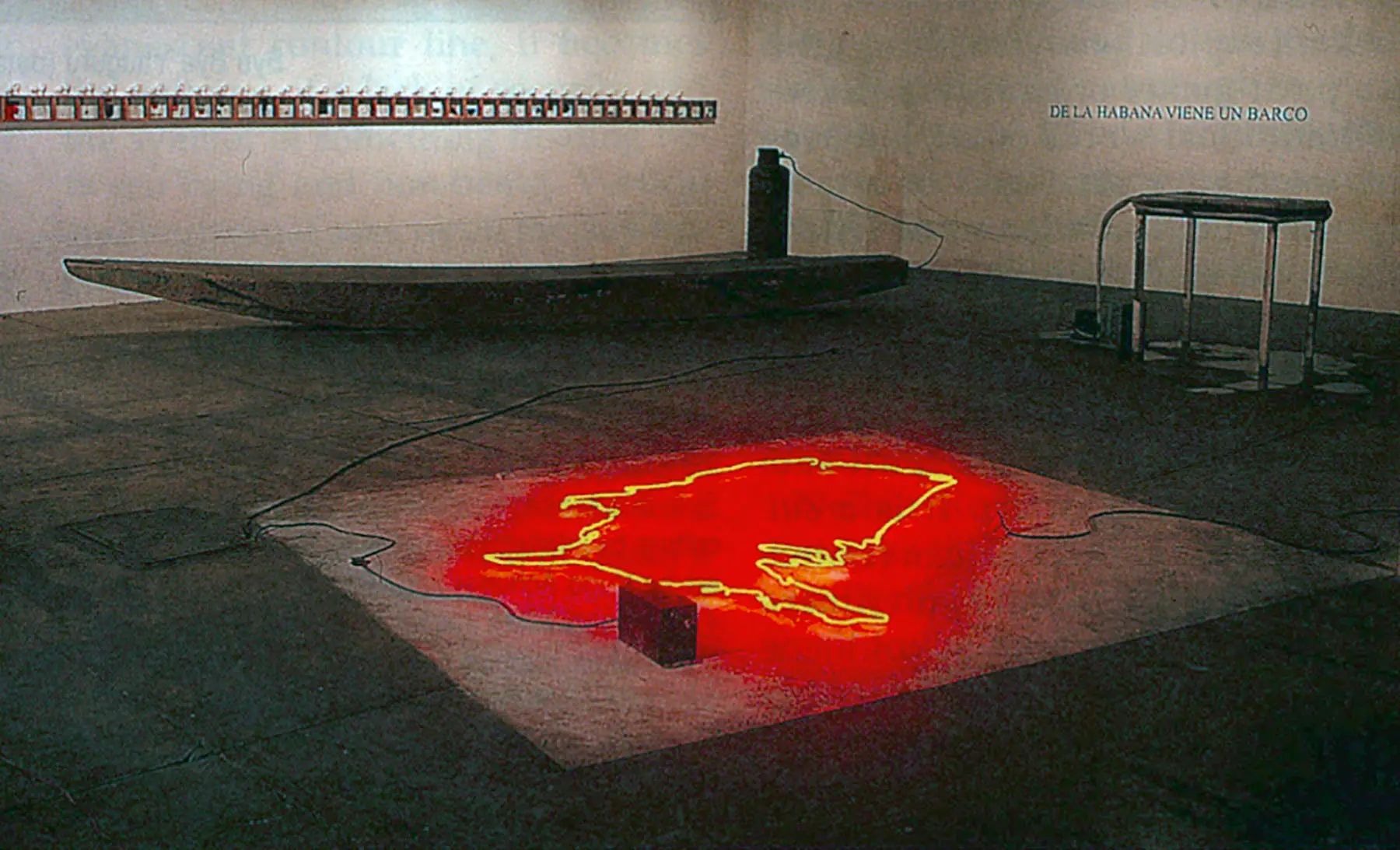
The National Salon of Artists is an event that offers an opportunity to reflect on the process of art in our country by highlighting the characteristics and emerging trends of that art. It is therefore the most important artistic event in the country and places an enormous responsibility on its organizers. This year, as in the past, the Salon generated considerable expectations and debate—aspects which attest to the validity and importance of the Salon in our environment.
In this new edition, as in the two previous ones, the regional salons were used as a means of selection. In the Central Zone section, which was held at the end of last year in Bogotá, the outlook did not seem to be very favorable: many believed that it would be just another university-style event with works of uneven quality. The validity of the selection criteria used was called into question when the plastic arts committees of Colcultura proposed to discontinue the invitation system and to require all the participating artists to pass through a selection jury. This decision was based on the experience of the 1994 Salon to which many artists were invited without recourse to any valid selection criterion; the result was an excessively large and confused Salon of very uneven quality. The new format institutionalized the absence of artists with a well-established and solid reputation and who have played a decisive role in the development of Colombian art—qualities which would easily justify their participation as invited artists. Some artists of the intermediate generations who accepted this system were inexplicably left out of the selection. Strangely enough, in what would appear to be an act of repentance, a few months before the inauguration of the Salon, a last-minute list of invited artists appeared, which once again cast doubt on the criteria that supposedly governed this 36th edition. Some artists responded; others remained firm in their absence. The entire process upset some members of the Colcultura board as well as the artists themselves, and this fragility, which seemed to affect the overall criteria used, proved to be one of the dissonant notes of this edition.
In the face of such vicissitudes and bearing in mind all the efforts made to hold this Salon, the event merits careful attention since, as Beatriz González pointed out, the Salon "gives us an opportunity to take the pulse of our national art."1
Although we may not agree with the preliminary organization of the event, it must be admitted that the show was a relatively purified one in that there were few redundant works. However, as an indication of the "pulse" of our art, the Salon could not be described as being fully representative of Colombian art as a whole, contrary to the previous two editions. At the same time, in this respect, account must be taken of the chaotic context of these earlier editions, where, although everyone was present, it was not always easy to actually see them all.
One positive aspect of this 36th edition was the use of four conceptual axes, which are not an attempt to limit a practice that, in itself, is mobile and uncertain and which transgresses codes and categories. The axes are an attempt to suggest ways of exploring contemporary artistic processes. They are also an attempt to suggest new ways of looking at the Salon and to propose new ways of bringing art and the public closer together.2 These four axes reflect four attitudes: an intimate approach, entitled Personal Archeologies, consisting of memories, histories, and introspections which attempt to give expression to personal myths and obsessions. The second axis, Cultural Reflections, highlighted the emphasis placed by certain artists on the different relations and connections between art and culture. The third category, Revisions, included artists who proposed a revisionist approach towards cultural and social realities as seen from the immediate present. The final axis, entitled Processes and Dematerializations, comprised "works in which formalization gives way to a closed, finished, and permanent object."
These conceptual guidelines were necessary and proved very useful to both the general public and to those more familiar with the subject. They were also useful for the artists themselves, who, shunning specific categories and codes, move freely between one form or another. I should like first of all to analyze the use of these axes in the Salon, their relevance and relationship with the contemporary practice of art, the artists themselves, and the works, and then to look at some of the characteristics of our national art and the difficulties with which it is faced.
We should begin perhaps by referring to the content of one of the talks which was organized simultaneously with the Salon, and which defined the situation of contemporary Colombian art in terms of a "tension between modernity and postmodernity,"3 a tension which we can locate between the legacy of avant-garde art and the symptoms of its voidance. Undeniably, the art of today owes a debt to the changes that occurred at the international level in the 1960s, and which revealed strong evidence of rupture with the practice of traditional art, with the term traditional here referring to avant-garde art. This was the time when the avant-garde movements were becoming history, when the "new" began to appear as belonging to the past. The attitudes reflected in pop art, minimalism, arte povera, and conceptual art called into question values, concepts, and vocabularies that had difficulty in gaining acceptance in the first half of the century. These concepts included the problem of abstraction, which was developed in Colombia in the work of such artists as Carlos Rojas, Negret, Ramírez Villamizar, and Manuel Hernández. With these artists, and others, such as Obregón, Roda, Beatriz González, and Santiago Cárdenas, a new stage began in the history of our art.
At the same time, it is undeniable that from the 1980s, and perhaps even before, Colombian art has undergone a process of destabilization, with the emergence of major changes, as reflected in the comments made about the Salons at the end of the 1970s.4 The last two Salons, in 1992 and 1994,5 are good examples of this and of the coexistence of a plurality of languages and the growing number of artists throughout the country.
The 36th edition offered a purer and more accessible view of the process of change that has occurred in recent years, following the break with the values and languages bequeathed by the avant-garde movements. An understanding of this process requires reflection on our part, and when I speak of understanding, I mean the possible interaction between the public and artistic practice, an interaction which art itself has been calling for from the 1960s, but which, as a result of the characteristics of contemporary art itself, has led to even greater separation between the source and the recipient.
One of the main causes of this increasing separation and difficulty of contemporary art is the fragmentation of art into individual and subjective practices, which have moved away from the concept of tendencies or schools, which, in the case of the avant-garde movements, offered the possibility of a group vision. The contemporary artist, because of the freedom which he or she has inherited from the avant-garde movements, can disregard any type of classification and move with full freedom, exploring his own expectations and using means and materials which appear most suited to his own purposes. Thus, both artist and spectator find themselves in a world of infinitely open possibilities, where nothing would appear to be excluded. This situation gives legitimacy to the action of the artist, although it requires maturity and reflection on his part if he is to avoid falling into a banal game of unlimited experimentation without any real meaning, a useless pursuit which leads nowhere. And for the spectator, such a situation can create a sense of confusion and chaos if the values noted earlier, which have been acquired through much effort and difficulty, now appear to be out of date and ineffective for exploring contemporary art.
It is in this sense that the open categories used for the spatial and conceptual organization of the Salon provide an effective means of mediating between the work and the public, of achieving the integration of artistic practice into the fabric of life, of making the spectator an active participant who gives meaning to that practice. These categories are defined with a vocabulary that allows this mediation to be achieved without being taken off the individual and subjective intentions of each artist.
It is here that the second problematic factor of present-day art appears: the unavoidable presence of verbalization as a means of mediating between a work and the public. This is not an exclusively contemporary phenomenon, since it applies to the art of all the century, which is an art that needs to be comprehended and understood: this understanding is acquired to the extent that its internal processes are fully assumed and integrated into the context of life and cultural transformation. To some extent, the proliferation of manifestos and theories—many of which are proposed by the artists themselves in letters and documents which they have written—highlights the need for a verbalization which provides access to the transformations generated by art. There is no doubt that this verbalization arrived very late at the National Salon. However, the presence of the four conceptual axes in this current edition provided a set of useful guidelines in this respect, mirroring the strong link that has been established between artistic practice, theoretical reflection, and museological proposals.
Such an organization meant that each of the four axes had its own space, which allowed the public to appreciate the full scope of the respective intentions. For example, in the lower levels where the works making up the section on Personal Archeologies were presented, it was possible to establish a direct relationship between the intimate tone of each work, some in small format, others with a very delicate finish. However, the montage failed at the final level, in the section entitled Processes and Dematerializations. The subtle and thought-provoking work by Germán Martínez, How Many Souls are Left in Life?, was placed face to face with the demolition materials used by Juan Luis Mesa in his work, and a series of panels that obstructed the space. This year, the invited artist was Santiago Cardenas, who presented a series of recent paintings, which fortunately gave the public an opportunity to see some excellent work.
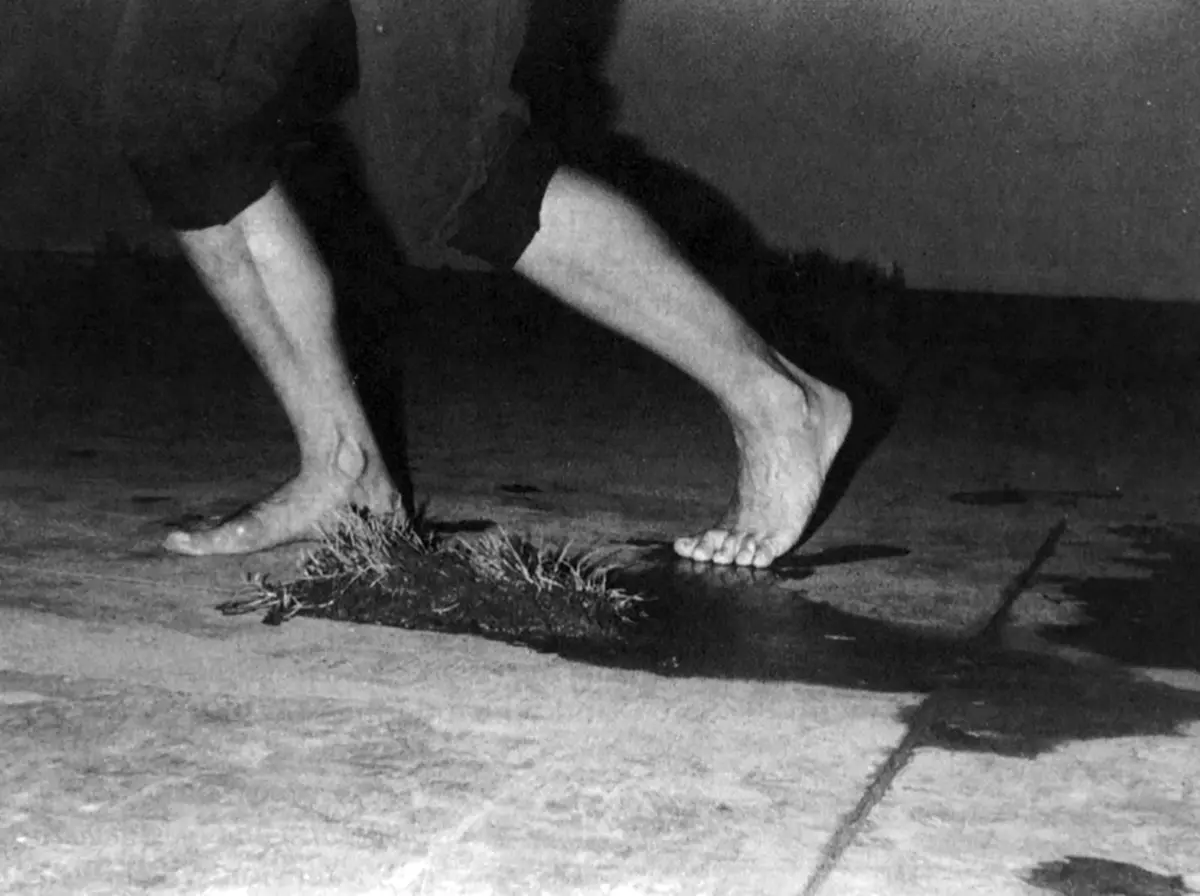
The first prize was awarded to the performance entitled Divine Proportion, by María Teresa Hincapié, undoubtedly one of the most important works of the Salon. It was an extremely solid and consequential work, constructed slowly and step by step within an arduous and highly disciplined process in which art and life were perfectly fused. The precariousness of its material nature—little piles of grass placed in an absolutely empty space which were watered each day by the artist—provided the setting for an action which was characterized by its slowness. There was perfect control over the body, the product of a mental attitude that, over time, has allowed María Teresa Hincapié, with just her presence, to transform and give a sacred dimension to the place occupied by her body.
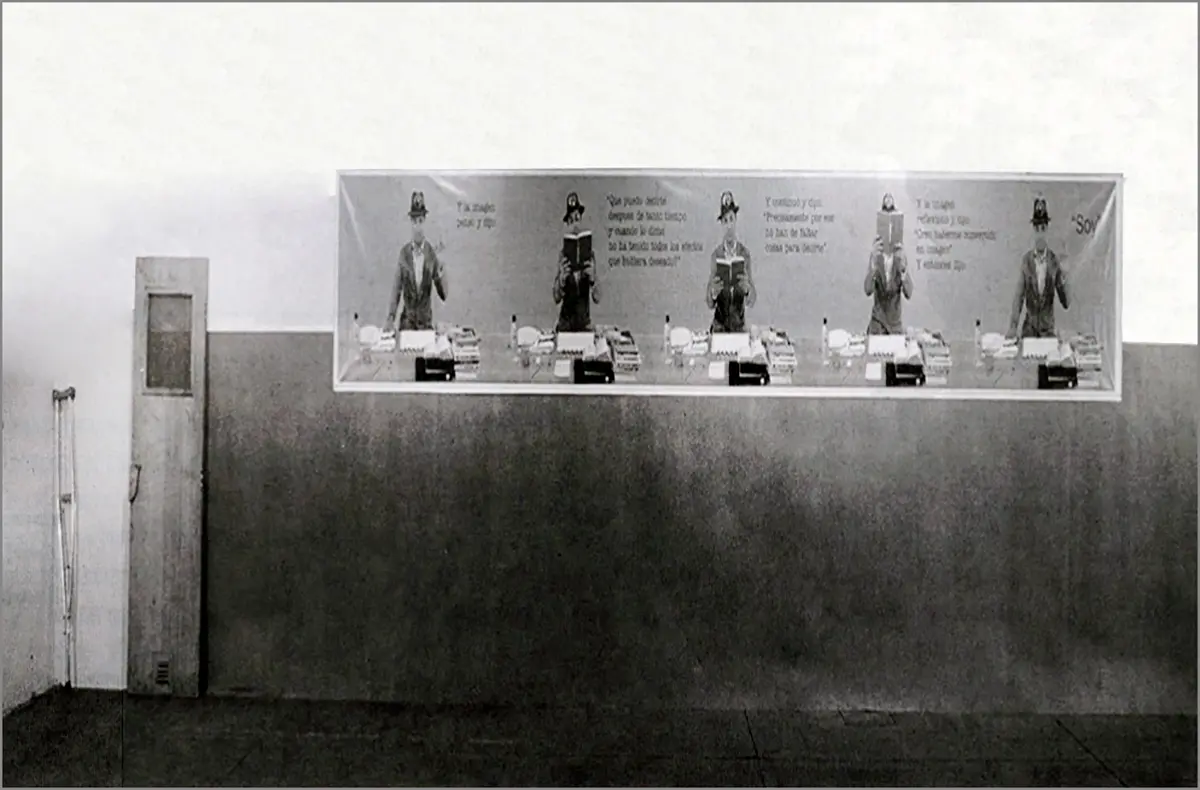
The second prize went to an installation by Mario Opazo, entitled Ícaro González, from the series on the Absent Ones. Opazo is an interesting artist who has participated in various events whose installations tell intimate, sad, and almost always very personal stories with a very poetic language made up of images and words.
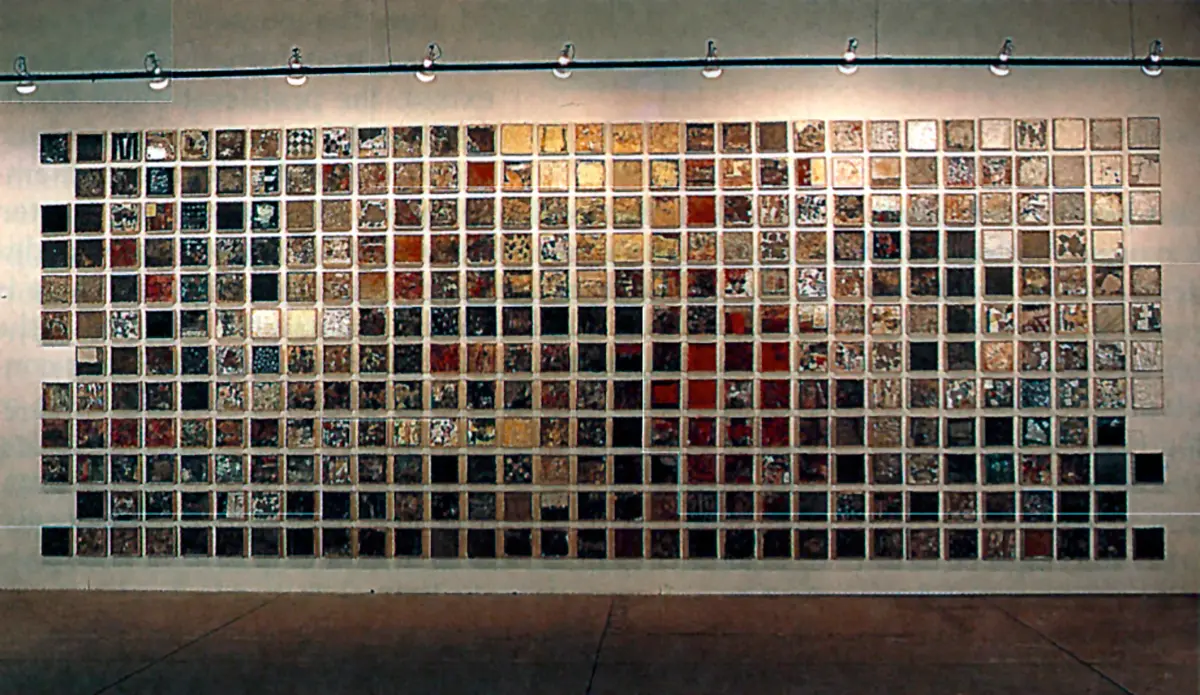
The third prize was awarded to a work by Luis Fernando Roldán, Calendar, a large surface comprising 365 small-format pieces, which created different textures and colors with a variety of materials.
The jury, made up of Carolina Ponce, Eduardo Serrano, and Miguel Ángel Rojas, also awarded seven mentions to the following artists: Leonel Castañeda, Wilson Díaz, Gloria Posada, Eduardo Pradilla, Germán Toloza, Ana María Rueda, and to Las Matracas group. The public awarded a prize to an installation by Antonio José Cadavid, entitled Still Life.
Conclusions
This latest edition of the Salon seemed to have been designed to take account of the changes that have occurred over the last two decades, particularly as regards the art produced by the new generations. Thus, many of the works on show were not very mature or backed up by any process in the real sense of the term. What these works did show is the emergence of what Marchan Fiz has called a new sensibility,6 and how this is being assimilated by the youngest artists. This new sensibility has given the Salon a certain playful character; this edition seemed both fresh and uncomplicated, agreeable and, at times, very moving. However, the absence of certain artists was certainly felt, and their presence would have given more consistency to the event.
If we compare the current Salon policy with that of previous editions, with their very "democratic" criteria and suffocating and chaotic "representativity," we can conclude that Colombian art needs a kind of intermediate solution, since its "pulse" is not determined exclusively by this new sensitivity—although the latter is important and must be taken into account. But there are also other languages and processes which are important and relevant, and which have generated much change. The Salon's memory must not be a short-lived one, or confuse a "national" Salon with an event showcasing the work of young artists. That being said, I do not, of course, wish to discredit either the work of the generation that has embraced this new sensibility nor the undoubted achievements of this 36th edition of the Salon.
NOTES
1. Beatriz González, "El XXXIII Salon Nacional de Artistas. Tomando el pulso del arte del país", El Espectador, Sunday supplement, 1989.
2. Javier Gil, booklet accompanying the 36th National Salon of Artists, 1996.
3. Talkgiven by Luis Fernando Gaviria, member of the Selection Committee of the Salon, on May 6.
4. Marceles Daconte wrote an article on the XXVIIth edition of the National Salon of Visual Arts entitled "El arte conceptual se toma el Salón Nacional" (El Espectador, December 10, 1978.
5. ArtNexus, No. 13 y Arte en Colombia, No. 59.
Simón Marchan Fiz, "Del arte objetual al arte del concepto (1960-1974)." Epílogo sobre la sensibilidad ‘postmoderna.’ Antología de escritos y manifestos. Edición Akal, 1990.
MARTA RODRÍGUEZ
Professor at the Institute of Aesthetic Research of the National University of Colombia.