
A new Foundation for the Arts has opened in Buenos Aires, with premises of more than 10,000 m2, which will house national and international exhibitions and an auditorium for conferences and congresses. This Cultural Center is located in the Galenrías Pacifico, at the intersection of Viamonte and San Martín Streets, in the Bajo Retiro district. The Center is currently presenting an exhibition entitled Alberto Greco. Going Astray over Three Decades, curated by Jorge López Anaya, and sponsored by the Telephone Company of Argentina.
Alberto Greco (1931-1965) is a mythical figure in the art of the 1960s. He was a member of the Informalist Movement in Argentina, and in 1962, created actions which were called Vivo.
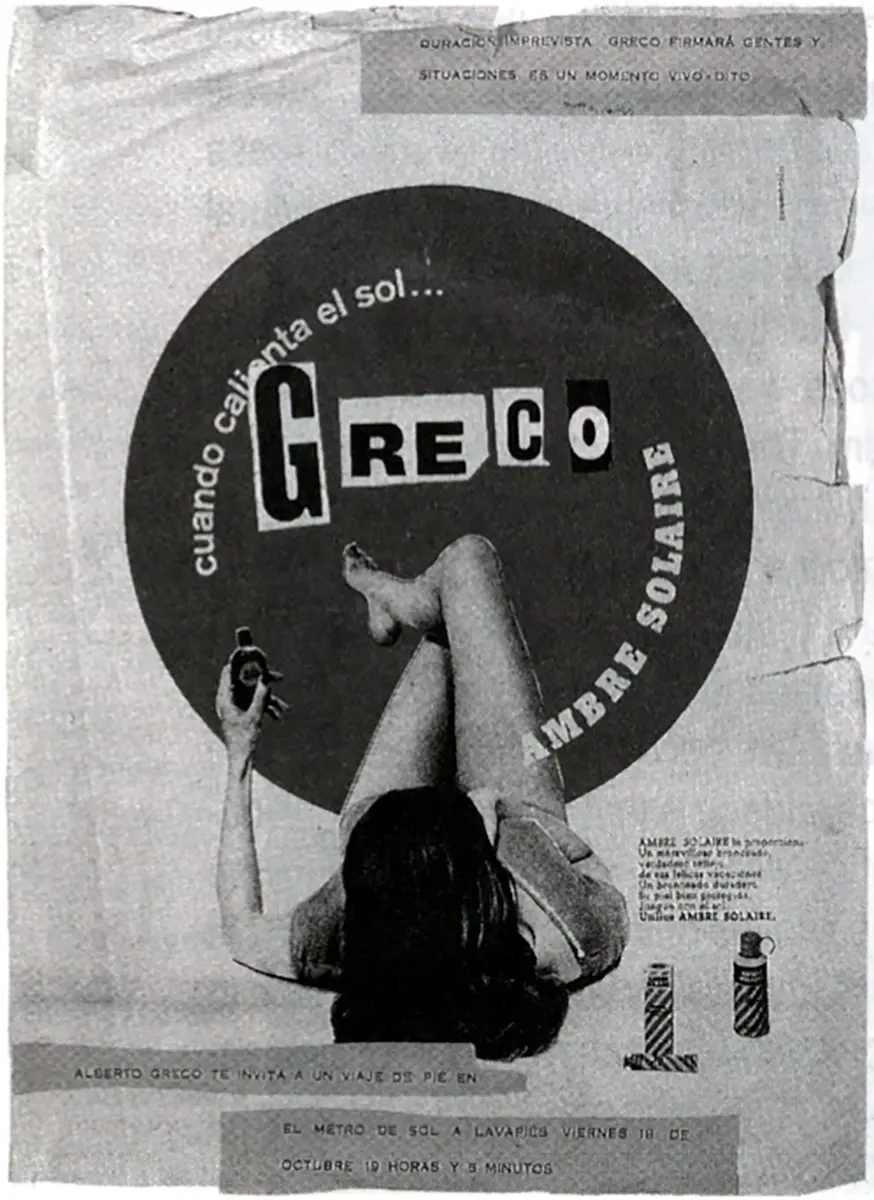
Arte-Vivo is the action of marking out a person by drawing a circle of chalk around him. In this way, situations are created that deny the possible existence of a work of art, and thus extend the awareness of the spectator. The works presented in this exhibition had been left in storage by Greco in the house of some friends in the Costa Brava, some 30 years ago. When the house was sold, its owners found the twelve canvases and passed them on to a young artist for reuse. This Spanish painter never used them, and one day he discovered the identity of their author when he was going through a catalogue of the exhibition which the IVAM had dedicated to Greco in 1991. And so the canvases finally arrived in Buenos Aires. Two of them were painted in collaboration with Antonio Saura and refer to Kennedy’s assassination in Dallas. The others have superimposed images and stains, writing, and collages. Within the context of the theoretical framework of hermeneutic criticism, Greco’s work functions like a palimpsest.
A palimpsest is a manuscript that retains the traces of earlier writing that has been erased. The concept of inter-textuality allows a relationship to be established between the existing discourse and those which have preceded it, and those derived from a simple or complex transformation. These twelve canvases are like ancient manuscripts, like the Dead Sea Scrolls, which, on their discovery, raised the question of their possible interpretation. Greco’s work is a sense- producing machine which transcends its location in time. Not only does it provide keys to certain aspects of informalism of the 1960s, but its content is updated by producing new and meaningful re-formulations. In this sense, there are certain paradigms of the 1990s that can be verified in the work of this artist. They include the legitimation of the private domain, through the confessional value of all his work; the raising of a gender-based thematic content from the standpoint of the gay difference; the narcissistic and self-referential standpoint, as in the works in which his family name, Greco, appears in large letters as almost the only theme of the painting. Three months before he reached the age of 35, Alberto Greco committed suicide in Barcelona. It was the last act of a radical aesthetics.
LAURA BATKINS