
As I write this article, which will appear close to the date of the exhibition of works by Arturo Duclos at the Museum of Modern Art of Bogotá, events are occurring here in Santiago that once again highlight the crisis in the representability and designation of the human body. This is a local phenomenon subtracted from the universalizing requirements of the "postmodern discourse" in the visual arts. Whether the triumphant curators like it or not, the art of Duclos is rooted in the unconscious level of Christian representations. Not only "empirical" death, but the death and burial of the works when they are expelled from the notional "paradise" of the art circuit.
In Santiago, the bodies of persons who died or who disappeared during the period of the military Government after the "events" of 1973 have been exhumed. Twenty years later, the bodies have been recognized and returned to their families for Christian burial. In other words, what was intended to remain hidden has now emerged in the open, despite all the efforts made to prevent the exhumation.
It was possible to re-establish a connection between some of the bodies and certain names which had been left in the air, hovering like a ghost over Chilean society. This is the context in which Duclos works. He uses the same procedures applied by forensic scientists: he establishes and marks out the scene of the crime (site-specific), determines the position of the body, and then proceeds to describe, enumerate, draw up an inventory, compare, classify, exhibit, etc. (the process of collection, selection, and montage). This is forensic science, courtesy of archeology, hermeneutics, and semiotics.
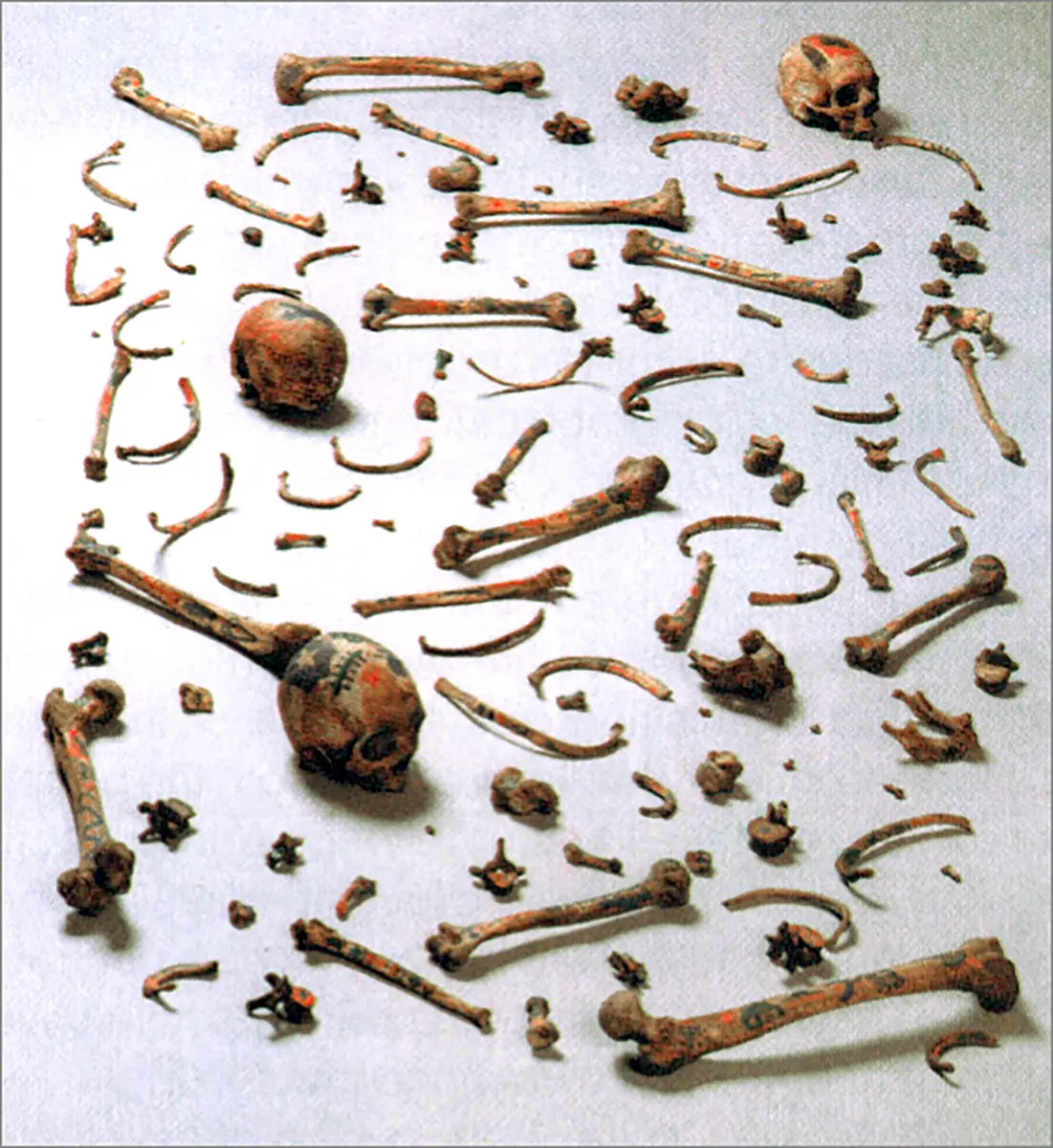
Ten years ago, Duclos produced a work entitled Anatomy Lesson (oil on 119 human bones, placed on a towel material). In 1995, for an exhibition at the National Museum of Fine Arts in Santiago, Duclos "drew" a picture, measuring 3 x 5 meters, of the Chilean flag on a wall of the Museum, using 70 femurs. This funeral flag created a number of protests in the leading national newspaper. But curiously enough, things did not go any further. The newspaper in question took up the matter, for Duclos had symbolically delivered a hard blow concerning the omission of the names of those who had died or disappeared. The newspaper, in fact, was delivering certificates of existence to the persons being named, and this, in turn, transformed them once again into persons.
Duclos speaks in his work of the processes of certification, both of bodies and of the poetics of contemporary art. He is, in this sense, a conceptual painter, a painter of concepts who modifies the status of the painter in the Chilean art world. I emphasize here the local aspect. I am writing from this local context about works which, in the same exhibition, were less noticed than the others. These others make explicit the complex formal manipulations and parodical combinations of style which have determined Duclos’s position on the international scene.
Methodologically speaking, it is not proper to analyze or determine the weight of an exhibition on the basis of two «anomalous» works. But it is a useful means of determining the signs of deconstruction in the works.
The femur is the longest bone in the skeleton. Duclos exhibits the piece, objectifying a document that is a substitute for a paradigm of the teaching of anatomy: Vesalio. Duclos’s academic training in xylography is evident here, i.e., an archivist of the popular graphic arts. (Weshould not forget the piracy emblem reproduced in children’s magazines and in illustrated school dictionaries). This is Duclos’s cultural tradition: the artist as pirate, the artist as thieving magpie, the artist as curator of his own prestige. An artistic reality that lives by lending and reproducing, i.e., for the posthumous glory of the catalogue. In this sense, Duclos spares no effort in producing the catalogue raisonne of his editorial and creative work. But above all, with his femoral flag, Duclos presents an emblematic enunciation, the diagram of which dedramatizes the current fascination with installations.
Through a criticism of representation, Duclos engages in controversy with those artists who endorse the animist inflation of our times. That is, he establishes a link between installations and the rhetoric of the "vanitas" (still life). In a "vanitas," the object represented is "sewn" into a rigorously coded representation. The meaning is «attached» to the signifier. The emblematic nature of Duclos’s work is expressed in his desire to control the code and manipulate the distance between pictographical signifier and "spiritual" signification. His "advanced free association mode" (Cameron) expresses his unease at the difficulty of controlling the supposedly arbitrary nature of the sign. In fact, the homogenization practiced by the international museum circuit encourages the omission of the source of the images. This is a further difficulty faced by artists from the periphery.
In the exhibition at the Museum of Fine Arts in Santiago, entitled The Eye of the Hand (November 1995-February 1996), the works executed with bones played a central role. They indicated the time limits of the retrospective covering a ten-year period. It is not by chance that the femur, which is linked to the hip, is the bone that permits human movement. But its objectual-spatial articulation is a critique of the "clear conscience" of the "Toscani strategy." In 1992, there appeared in the subway stations in some European capitals enormous posters with images which attempted to stir the conscience of the spectator; one showed the back of a Somali guerrilla, holding in his hands, like a baton of authority, an enemy femur. Faced with this sublimation of the depiction of horror, Duclos objectualizes his thought and subjects his design to the regulation of the patriotic emblem: the flag. This is, furthermore, one way of indicating the price to be paid for marking out the territory of the nation. Duclos uses this twisted method to mark out the limits of the representation, whether "aureatic" or mechanical, of the bodies.
In conclusion, I should like to point out that two other major exhibitions of works by artists were presented at the same Museum in 1995, which illustrated their historical importance over a period of fifty years of Chilean art: José Balmes (May) and Gracia Barrios (August). The Duclos exhibition (November) provided a further and important historical twist, highlighting another pole of activity vis-à-vis artists who had been important at the national level well before 1973.
I mention this last date because it indicates an unconscious link between these two poles of artistic production as regards the question of the restitution of names and bodies. If art does not take up such matters, who or what will?
Duclos presented his ten "official" years of work in the art circuit, distributing his work into two periods: those that had clear constructivist and geometrical references and those that were dominated by a "multilingual accommodation of styles" (Cameron).
We cannot speak about this exhibition without mentioning the catalogue, which was a veritable instruction manual and guide to a reading of the work in the context of three critical Chilean generations. Guillermo Machuca, the critic who has been closest to Duclos’s work, pertinently examines questions of procedure. Adriana Valdés proposes a conversation that contextualizes Duclos’s proposals, in particular as regards authorship, ornament, borrowing, and archival procedures. Nelly Richard explores elements in Duclos’s work that permit the formulation of a strategy for the feminization of culture. Finally, Dan Cameron examines the evolution of Duclos’s work, with emphasis on an unusual feature: Duclos is "a painter whose work seems to be firmly based on the short but potent legacy of conceptual art."
In this context, the catalogue was the reverse of the Museum exhibition, with the latter being the anverse, which presents only the spatial-monumental aspect of a postulate that, in material terms, involves the editorial industry. This industry inevitably acts as a kind of substitute for the museum validation process. In this sense, Duclos works at a two-fold critical level, occupying both the anverse and the reverse of the same operation of formal inscription.
JUSTO PASTOR MELLADO
Chilean art critic. Resident in Santiago.