
Nine uniform works in various sizes—the main format being the horizontal rectangle—established a dialogue of aesthetic and historical tensions in this recent exhibition by Arturo Elizondo at the Annina Nosei Gallery on West 22nd Street. The real and imaginary autobiographies of the artist fused together gyroscopically with the infinite and indissoluble realities of a magical Mexico. The stories painted by Elizondo in these works evoke the Mexican and Latin American experience of a definitive and continuous devotion, a life full of spice and excitement, a tragic narrative, a mystical interplay of friendship and envy, intimate creativity, brotherhood, and nonsense, which like a musical record turns around and around, faster and faster, without anyone being able to stop it. This boomerang situation applies to Mexico and Latin America as a whole. Although certain aspects of politics and social adjustment in the continent can be found elsewhere in the world, the romantic caprices which Arturo Elizondo evokes, along with the traditional Mexican trimmings, express realities which are inconceivable, mythical, and yet commonplace, personal worlds of the fantastic kind. His compositions can be seen as a speculation about space and time, Artaud, the Frida, the photo taken by Don Manuel... in short, this is Mexico, an infinite and ungraspable reality.
This is "neo-Mexicanism," a fountain into which Arturo Elizondo, Julio Galán, and Javier de la Garza have cast some of their coins, each in his own way, with the characteristic solidity, solvency, discipline, and pride characteristic of those who are still young. Who does not want to go back to Rome-Tenochtitlán? Who does not know about the remarkable bronze race, feel admiration for these robust classical proposals, and anguish at their extinction? They were imbued with the most devoted kind of religiousness, with myths and fears resulting from their religion, the multiple and beautiful images of Christianity. Those who had journeyed through the Huichol liturgy of the pedestrian and the manual, through visions and achievements, the Zapotecan heritage and the harsher Mayan version, know that everything exists until we no longer desire it anymore, and that even after that, the magical reality subsists. A surrealizing reality fills these pictures as the morning of the past meets the dawn of today.
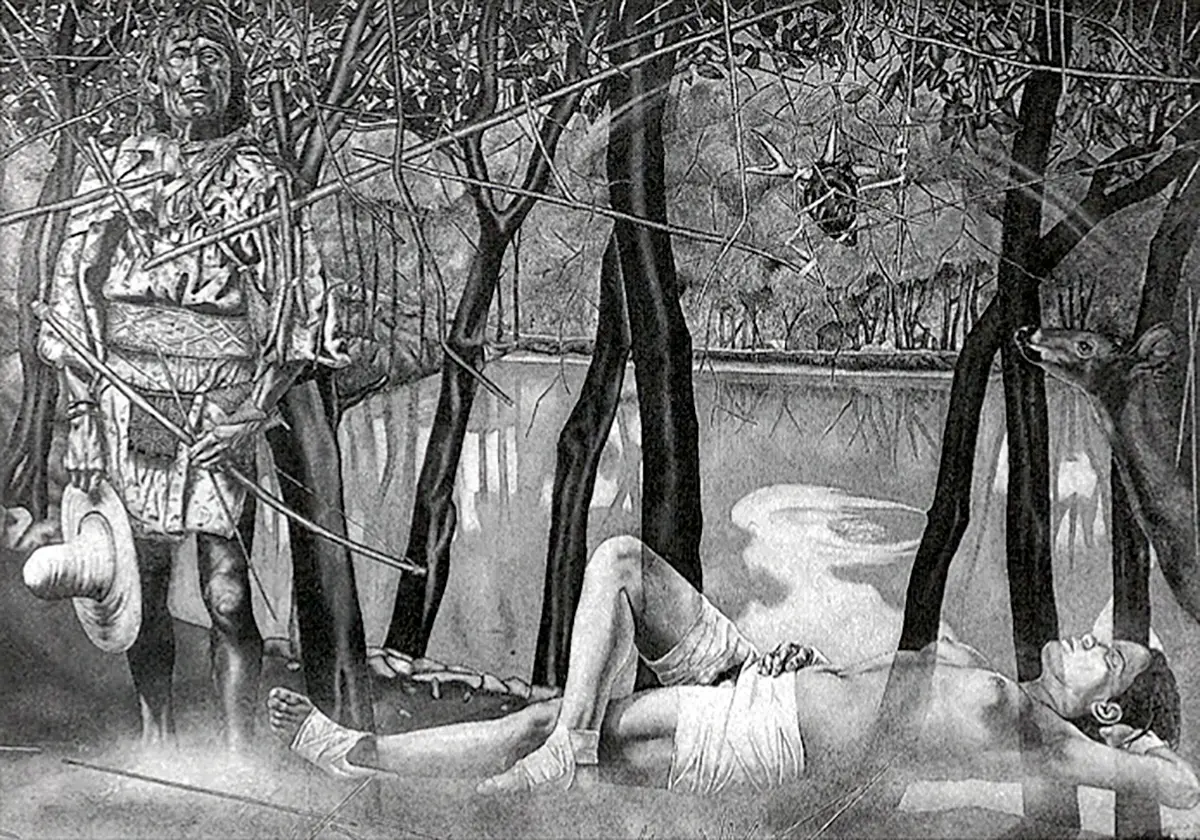
The living appear in portraits and seem to be dead, far away in a painting of some photographic memory. The human figure is paramount, and its iconography creates an impression of sensuality and power. The sense of memory is so powerful and omnipresent that the figures seem about to spring out of the picture. The historical figures—from politics, the arts, mythology—and even the constant autobiographical elements in various forms, from portraits of the artist down to the presence of his dreams, can be interpreted only with the help of the author. Various resources of lighting are used for the different figures or situations, with a two-fold interplay of integration and dispersion through symbolic elements, which also function as plastic resources. The traditional and craft elements, as well as those of a religious nature, are incorporated naturally to create not a copy but an "echo" of the feeling of Mexico. The frontal presentation of several of the characters reflects attitudes which range from challenge to submission, sculpture to void, from little bodies which look like cut-out and dress-up dolls with sensitive faces (almost all self-portraits) to representations of turn-of-the-century romanticism which is still with us.
There are important connections between the looks expressed in the portraits and the space outside the pictures, that is, the space of the spectators, with various points of each picture becoming an exercise in mnemonics. The Unprotected Love (Romeo and Juliet) seems to be about religion, ex-votos, and popular faith, with an unusual mass of actions and memories of a Hispanic-Mexican kind: Sancho Panza, the Horsemen of the Apocalypse, José Guadalupe Posada, death which comes to us all, even beautiful and creative children. This baroque style of new combinations is a reactivation of political criticism, reflected in the native rictus of the closed mouth and an expression of austere serenity. There is a prototype of painting and photography of days gone by incorporated into this work, and a multiplication of scenes, with the color acting as a means of ratifying, signalling, and distracting. The series can be seen as a retrieval and integration of other key aspects from the history of art, as for example in Dream of Antonin Artaud. In this work, several scenes are depicted at the same time in a triple grid: vertical, horizontal, and three-dimensional. There is a re-arrangement of the relationship between surrealism and magical realism, between Europe and Latin America, between the Huns of the former and the indigenous tribes of the latter, and to some extent, the emergence of neo-Mexicanism is due to all these features. Part of the drawing and/or technical process is visible, but treated differently from the manner of the neo-conceptualists. Here, it is not the initial drawing that permeates the layers or establishes the times and distances of the artistic structure; instead, there are galloons, long-stemmed roses, and floating petals, explosions of bones, and religious painting of the ex-voto kind.
The present in Mexico is nourished by the history of powerful generations in which splendor and decadence have succeeded one another. The decorative and the symbolic are present in bodies, in clothing, architecture, and work in clay. The capacity of synthesis of figuration and geometry and their consolidation in a comprehensive language based on the stylization of forms, expressive gestures, barbarianism and creation, delicacy and usefulness, were characteristics of the Mayas and Zapotecas, and other indigenous groups, and have been maintained down to the present. The magnificence of pre-Hispanic and Greek architecture and paintings of totemic figures and inscribed stelae has, over the centuries, resulted in a hybridization in which all this coexists with religious scenes depicting the European conquistadores. Inspired by the baroque opulence of the churches of Cholula, Puebla, where he studied, Elizondo also highlights the baroque in the carving of the figures of José Guadalupe Posada and the theme of death, which interacts with and is superimposed against serenely religious scenes in the mosaic-mural in the background of Romeo and Juliet. If all these elements are realities and events, then too is the kind of windmill or gyroscopic group of bones in a composition which coincides with the venerable rosette of Coyolxauhqui. There is the coincidence of the star with the red peppers, the strategic presence of ribbons with the colors of the national flag at three points which form a kind of half-arch at the top that contrasts with that formed by both figures with the same kind of ribbon unfurled, as if ready to participate in the traditional festivities of All Souls’ Day—a tradition reflected in the presence of the bones which refer to the pelican and the attack by the figure of death riding against others who are dead. The Unprotected Love (Romeo and Juliet) is a work of monumental language, an enormous backdrop, in which each of the five realities depicted merges into the others. The work may well be seen as the reconfirmation of history, the fact that it repeats itself in everything, in death, battle, love, innocence, theatricality, and in liturgy. Two Mexican doll-children, bereft of the breath of life, control the passions (aesthetic, muralist, theological, satirical, mortal) with their narrow ribbon of tricolor innocence. The artist reflects a personal and contemporary kind of ritual in his works, defusing the powerful situation of the scenes that depict more than one story from the flayed skin of history. The work that accompanies this note is a small portrait of Marcel Proust, the French writer with whom Elizondo shares certain physical and conceptual similarities. Arturo Elizondo was born in the asphalt and cobble-stoned Mexico City in 1956, and now lives in the asphalt and cobble-stoned city of Brooklyn, New York.
GRACIELA KARTOFEL