
National identity is a matter of special—and even excessive—importance for Mexicans. It is easy to distinguish between Mexicans and people from other Latin American countries, and despite the North Americanization process currently underway in Mexico, it is not difficult to distinguish Mexicans from other North Americans. But despite the notorious—and changing—nature of their identity, Mexicans like to make it one of their main concerns. Between 1922 and 1955, national identity and its expressions constituted the great theme of Mexican art, and during this so-called nationalist period, many authors were the spokespersons, among other things, of the government's version of the history of their country. Mexican nationalism was an effective antidote against Eurocentrist cultural hegemony, but its decline was due, among other causes, precisely to its government filiation.
From the second half of the 1980s (and even before, as in the case of Enrique Guzmán in the 1970s), neonationalism—also called neo-Mexicanism—became one of the characteristics of contemporary Mexican art. The Mexican neo-nationalists are now adopting different artistic postures, which in some cases are even the opposite of those of their predecessors, the historical nationalists. Some have opposed the official version or fought it directly; others have chosen irony as their form of expression, subversion as a theme, and rebellion as an attitude; yet others have avoided overpraising a stage in the history of the country to the detriment of the present. There are also those who have referred to aspects of national identity which have not been well documented or even admitted, such as its pretentiousness, while the most advanced no longer believe in the existence of a single monolithic identity, but of as many different identities as cultures and nationalities in Mexico.
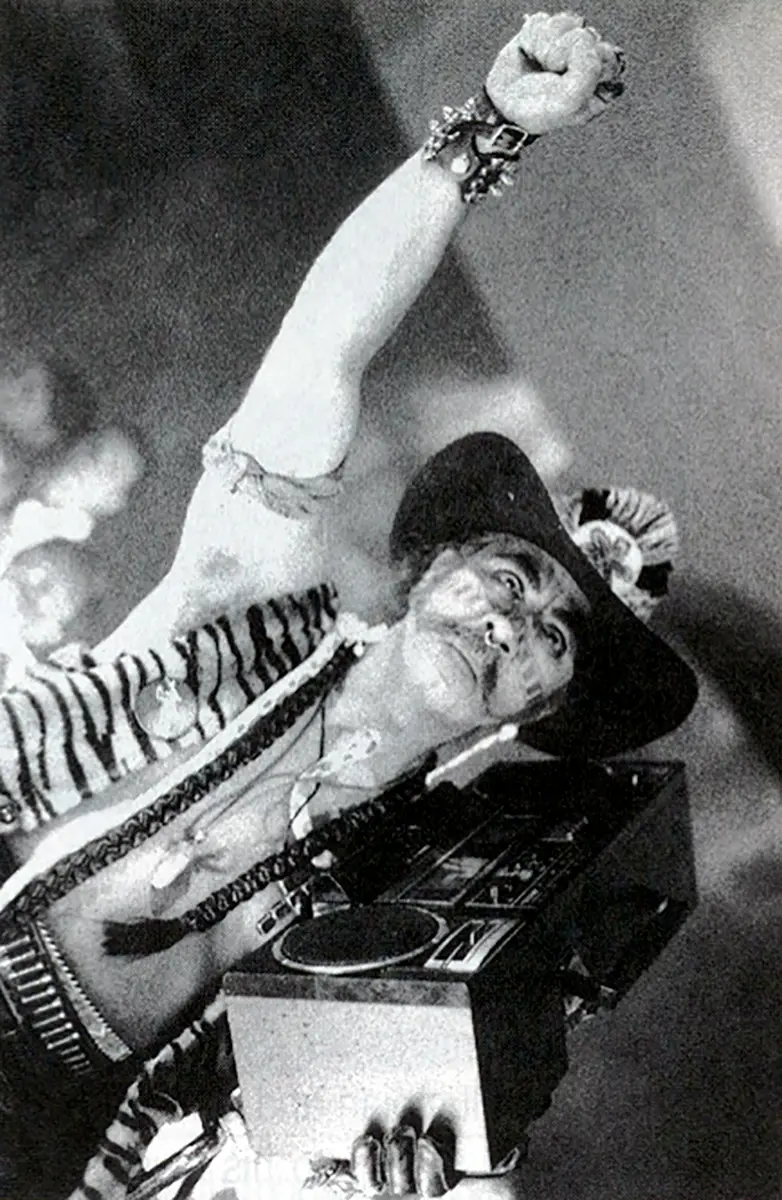
Guillermo Gómez-Peña is a neo-nationalist artist who, in his works, refers to the survival of traditional elements in the individual and social behavior of the hybrid Mexicans of today, both within and outside Mexico. But there is more. As a Mexican migrant who lives and works in the United States and who refers to aspects of identity which are characteristic of Mexico’s northern frontier, Gómez-Peña is not so much addressing the Mexican or Latin American publics but the inhabitants of the United States, both those who have come from south of the Rio Bravo or are descendants of Mexicans or Latin Americans, as well as the other North Americans.
As part of the XII Festival of the Historic Center of Mexico City, Guillermo Gómez-Peña presented, on March 13, 14, and 15, in the recently refurbished Museum of Mexico City, his performance-installation entitled Museum of Frozen Id, with the participation of Sara Shelton-Man, an unidentified participant whose face was covered by a balaclava like those used by the members of the Zapatista National Liberation Army, and Gómez-Peña himself. This non-narrative performance- installation, which lasted more than three hours, was produced by Ex-Teresa, Arte Alternative, and coordinated by Lorena Wolffer. The production and coordination were successful; the only regret was that the back patio of the Museum of Mexico City, where Gómez-Peña presented his work, also contained—in an abandoned state and with the risk of further deterioration—the stupendous neo-figurative mural painting Destruction of Tenochtitlán (1964) of the late Francisco Moreno Capdevila, a work which, during the remodelling of the Museum, was excluded from the mu- seographical setting for which it was specifically executed.
The proposal underlying Gómez-Peña’s Museum of Frozen coincides with the view that many Mexican migrants or persons of Mexican origin in the United States have of Mexican identity, as if it were a single concept, and of their own role in the modern world. Since they do not always have access to critical and updated information on the history of Mexico, in general, they unthinkingly overrate certain aspects of their past, and schematically overestimate certain historical figures, while they see their own social role and that of other people in the United States in stereotyped terms, and decisive to the times in which they live.
With his references to the growing hostility of sectors in the United States towards Mexicans, the communication skills of the Neo-Zapatista combattants who maintain an armed peace in Chiapas, as well as to his earlier work (with videotaped scenes included in this performance-installation), Gómez-Peña managed, as he usually does with his presentations, to attract a large number of spectators to his Museum of Frozen Identity, many of whom had difficulty in u nderstanding the texts which they heard in the "Spanglish" which was an integral part of the performance-installation.
CARLOS-BLAS GALINDO