
This exhibition of picto-sculptural objects by Inés Vega at the Alvear Collection of the Zurbarán Gallery was very impressive. The artist had not shown her work in Buenos Aires for eight years, and her unusual form of representation was striking in its maturity and the atmosphere enveloping her images. The protagonist of these works is the human figure, with an unusual handling of ambiguity. It is particularly interesting to note how this kind of representation is closely linked with popular art of pre-Hispanic origin, the ex-votos on the one hand and the Nazca pre-Columbian ceramic art on the other.
This hybrid mixture, which reflects the best traditions of Latin American art, is perhaps what gives originality to her imagery. It may be that this aesthetic proposal arises unconsciously, but it is valid to approach her work in these terms, which are part of the cultural tradition of the artist.
Her figures achieve a verism which goes well beyond descriptive naturalism. The use of chiaroscuro generates an illusion of volume, which is integrated into the slight relief or additions of fabric and metal objects. The observation is frontal, and as our eye moves over the work, we become aware of the illusion: the surface is that of a rag doll in silhouette, with the volume suggesting the heaviness of the arms and hands. It is this uncertainty that makes us stop to look: the atmosphere is one of suggestion, something more than a successful formal combination.
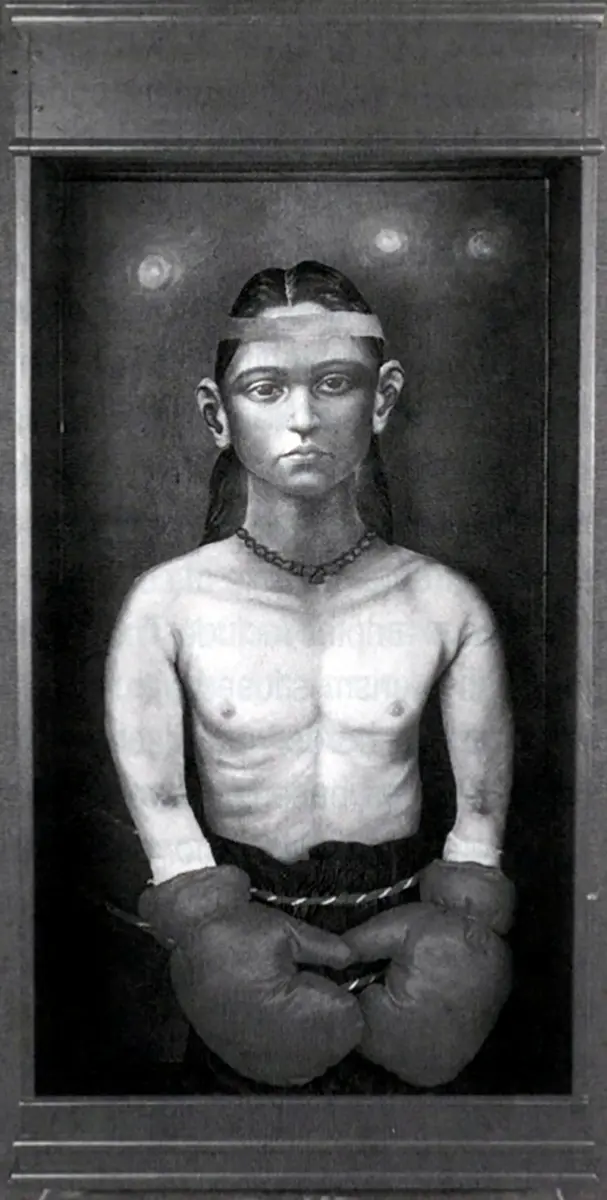
It is perhaps for this reason that we associate these images with the popular religious iconography of the Spanish Baroque, ex-votos, and funeral portraits.
Yet Inés Vega’s work differs from all these by its inclusion of ordinary figures or figures from the popular imagination, with a recycling of themes and techniques. The ambiguity of the volumes also reminds us of Nazca ceramic art, in which only the contours are depicted, with the illusion of the image being generated through the use of color.
Good examples include Moon, in which the verism is fused with ingenious elements to border on kitsch. In The Three Desires, based on a work by José Luis Borges (The Metaphor of the Thou Sand and One Nights), the forms are more complex and sculptural and include the female image mounted on a steed.
ALBERTO COLLAZO