
According to Gaston Bachelard, memory and fantasy create in man the link with the dreaming will, which in turn gives rise to creative action. Echoes in the memory become a rich bric-collage which makes up the story of human life. This is the world which Inés Wickmann explored in her exhibition, entitled Other Stitches, last March at the Colombo Americano Gallery in the north of Bogotá.
The work in this new exhibition revealed a major change. The artist has now left behind the dark period, which began in 1990 following a fire at her house, and when her work was full of oppression, heaviness, and pain, not only in its physical appearance but in terms of the requirements necessary to its production. At that time, she used rough materials, handled with tools such as hammers, chisels, pliers—tools more associated with the male world than with the softness and delicacy of traditional female activities. In her work from those years, as Wickmann herself has said, there was no superimposed color, the objects were "not made up," there was no hiding of their origin, no masking of the elements which she used as supports, and which she collected on the trips she made.
From 1994, at the affective level, there came a desire to free herself from, or exorcise, the burdens which had been weighing her down during the previous period. This encounter became a new challenge and celebration of life in the form of a desire and a need to express herself through lightness and fragility and flexible materials, in particular textile materials evocative of the sentiments, memories, and marks left by the passage of time. It is these materials that she uses to weave an intimate and personal (rather than social) history.
Inés Wickmann has understood that the development of auditory and tactile elements can also be an important vehicle for the perception of life. The language which emerges from the fingers or the sound of each object in nature reflects an understanding and pleasure of little things, which, in the final analysis, is the intimacy of existence in which we can hear the "voice of things." This drawing out of the voice of memory, of found elements and objects with affective connotation,s goes beyond the frontiers of the traditional to create through the richness of textile materials which open up different worlds. Whereas before sound had been a basic concept of the objects, now the artist has felt through her contact with thread, fabric, and fiber the constructive metaphor of intimacy, the source of the strength of the works in this exhibition.
The subtleties reflected in weaving "patterns," and samples of bobbin lace, crochet, and cross stitch evoke worlds silenced by generations that denied and misinterpreted women’s work, considered more as an act of abnegation than a means towards self-fulfillment. Now, thanks to this re-encounter with fantasy, lightness gathers strength—opening up this tranquil world in a re—evaluation of the lost taste for fibre and textile. The affective and emotional dimensions are essential here, since without them, the "pattern" could not exist. "Pattern means a sample or model of what is good or made; it is an example of virtue, full of intentions about correct apprenticeship, where the model sets the guidelines to which reference is always made in the search for perfection in forms or mental spaces. It is applied in the moment of constant aspiration towards "learning, in the transformation and creation" of new forms. The life of the individual in terms of existence can be related to the stitch, which marks time.
In this exhibition, the reading of existence-time was marked in several patterns. The stitch as a pattern was present in the work entitled Pattern 1994, 1996; and the country, politics, and cosmic elements in Constellation and Puzzle, and in the form of an ecological pattern in works which used natural elements—seeds, hair, and plant fragments, such as Se-mi-lleros, Herbarium, Fibers, and Ygdrasil.
Almost all her works conclude with flashes of intuition complemented by moments of coincidence and everyday accidents. Works with a marked emotional discharge attempt to recycle found objects and yet paradoxically attract us by their connotations of mystery and secrecy, taking us towards an encounter with the existence of marvellous things. Thus, the concept of "mental space" is emphasized in the pieces entitled Anniversary, Lace, and Theme of the Flight.
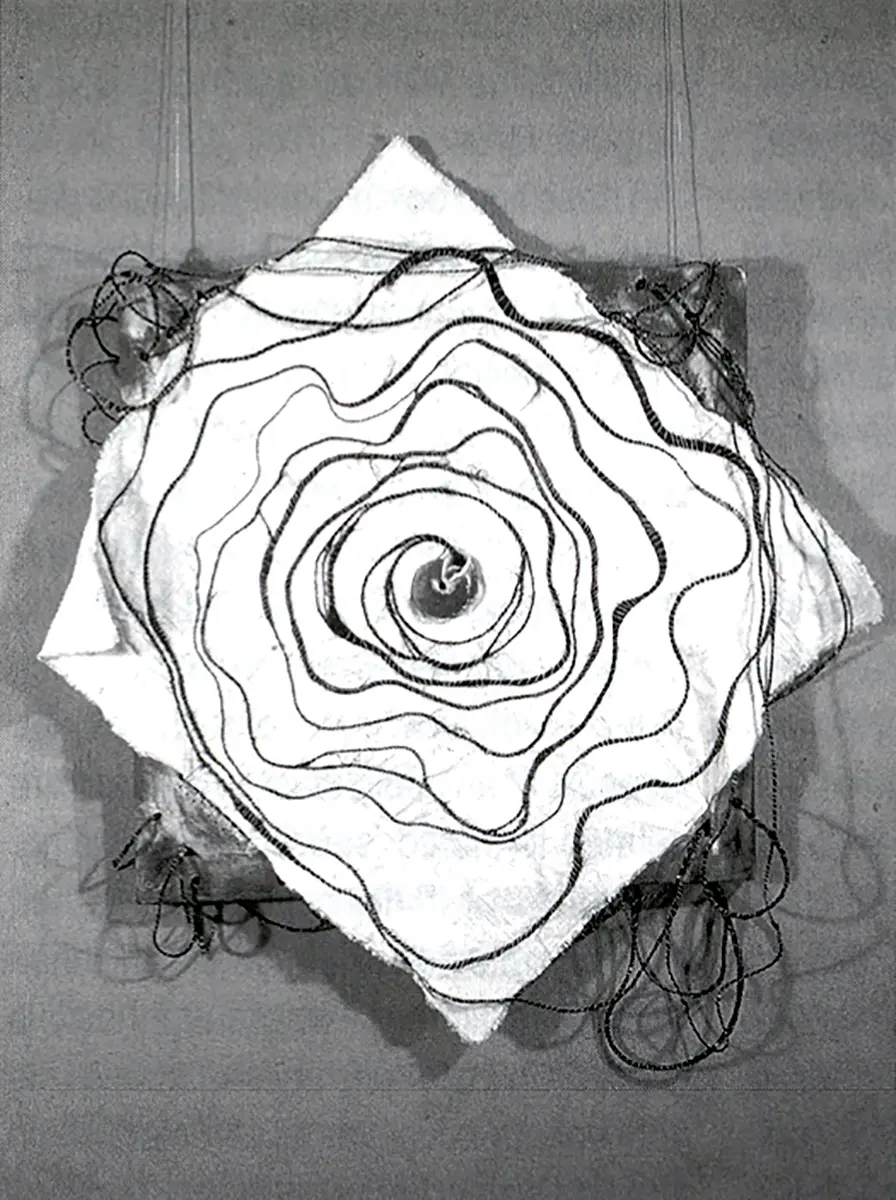
This intuition is complemented by a chance taken to the point of obsession. Subsequently, the explanation given by reason reveals the symbols that have enriched the work. The paradoxes encountered in each work speak through "the mysteries which each object in itself" contains, with each work encompassing commensurable female symbols full of strength and temporal relationships in their variety of accompanying signs. In Labyrinthus Angelopolites, with athread of human hair, like sound waves, part of the center marked by a shell opens its ear up to let the sound or noise of the earth come and go. The poetics of the materials configure this world of sensitive forms.
Sewing and sewing, stitch after stitch, is action made into a process. It suggests structures, achieves lightness as a concept, and reflects the meaning of women’s condition through such symbols as the rhomboid, needle and thread, and seeds in signs which indicate origin or birth. A new expression emerges where the most important quality is the "synchronicity" of intuition, an ability to capture all the riches of the world and the instant before us, awaiting discovery by those who are sensitive to tactile reality, elementary things, and sentiments, and who can convert them into signs imbued with the force of life.
MARÍA TERESA GUERRERO